


Government Schemes and Initiatives: Boosting Cold Chain Infrastructure for Agricultural Growth in India

The farmer holds rice in hand.

The development of cold chain infrastructure is crucial for a country like India, which has a large agricultural sector and a significant need for efficient storage and transportation of perishable goods such as fruits, vegetables, dairy products, and pharmaceuticals. Government policies and initiatives play a key role in the large-scale development of cold chain infrastructure in India. The Indian government recognizes the importance of cold chain infrastructure and has implemented various policies and initiatives to promote its large-scale development.

One of the key approaches taken by the Indian government is the introduction of subsidies and grants-in-aid to incentivize the establishment of cold chain facilities. These financial incentives aim to offset the high capital costs involved in setting up cold storage units, refrigerated transportation, and other infrastructure components. The subsidies help reduce the financial burden on entrepreneurs and encourage private sector participation in cold chain development.

These flagship programmes promote the development of complete end-to-end cold chains, from the source to the end-customer. These initiatives aim to bridge the gaps in the existing supply chain and ensure the seamless movement of perishable goods. Some of these programs include:

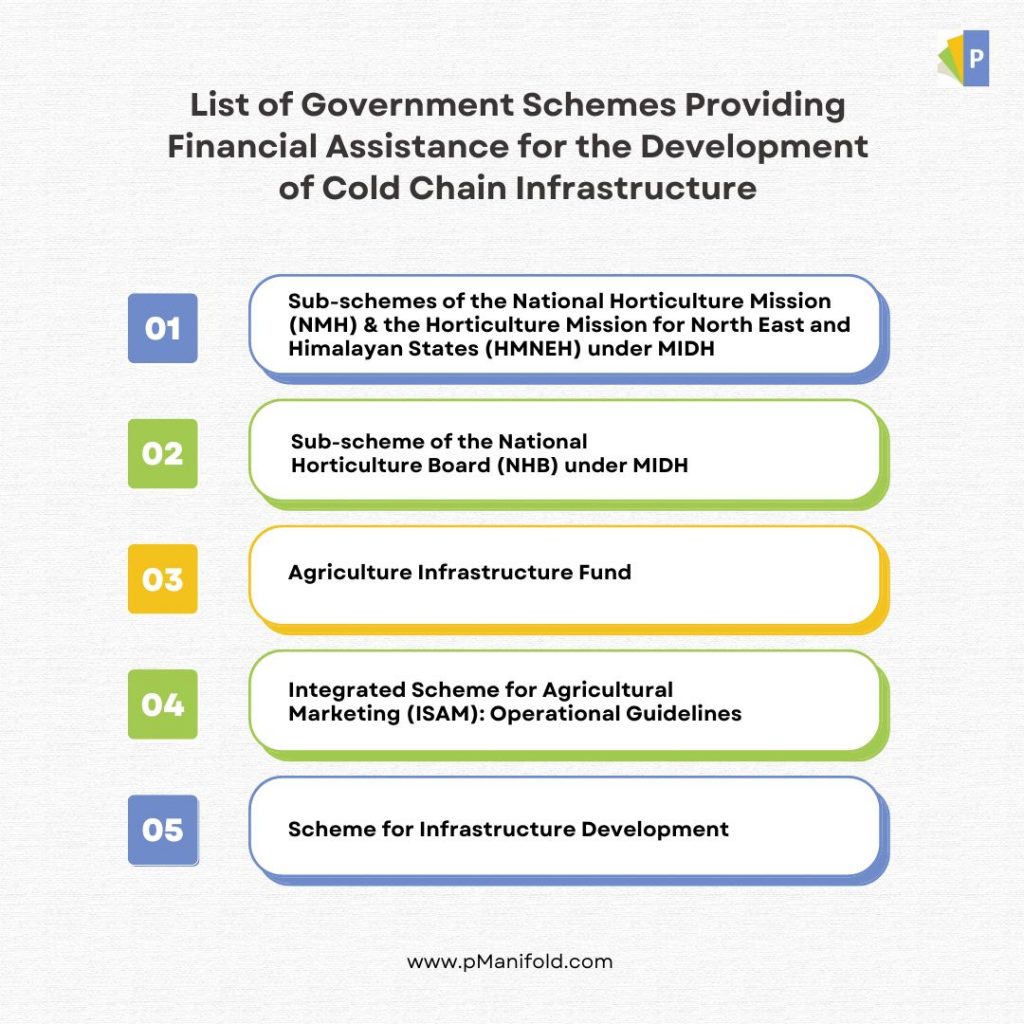
  1. Mission for Integrated Development of Horticulture (MIDH)

MIDH is a government scheme for holistic growth of the horticulture sector ((fruits, vegetables, root and tuber crops, mushrooms, spices, flowers, aromatic plants, coconuts, cashews, cocoa and bamboo shoots). It provides financial assistance, including for cold storage. Subsidies of 35% (or 50% in hilly areas) are available. MIDH helps establish energy-efficient multi-chamber cold storage units with thermal insulation, humidity control, advanced cooling systems, and automation. Long-term storage hubs up to 5,000 MT capacity are covered by NHM/HMNEH, while 5,000-10,000 MT hubs are covered by NHB scheme.

  1. National Horticulture Mission (NHM) / Horticulture Mission for North East and Himalayan States (HMNEH)

Long-term cold storage and distribution hubs of up to 5,000 MT capacity are eligible for assistance under this open-ended sub-scheme of MIDH. Assistance comes in the form of credit linked subsidies, amounting to 35% of the capital cost of the project, or 50% in NE, hilly and Scheduled Areas.

  1. National Horticulture Board (NHB)

The National Horticulture Board (NHB) is implementing the “Capital Investment Subsidy for Construction/Expansion/ Modernisation of Cold Storages and Storages for Horticulture Products.” Under this scheme (a sub-scheme of MIDH), assistance is available for the installation and modernization of cold storage units with capacity between 5,000 MT and 10,000 MT. This is an open-ended credit-linked programme offering subsidies amounting to 40% of the capital cost of a project (limited to INR 30 lakhs per project), or 50% in NE, hilly areas and Scheduled Areas (limited to INR 37.50 lakhs per project) sub-scheme of MIDH. Assistance comes in the form of credit-linked subsidies amounting to 35% of the capital cost of the project, or 50% in NE, hilly and Scheduled Areas.

  1. Pradhan Mantri Kisan SAMPADA Yojana (PMKSY)

SAMPADA stands for Scheme for Agro-Marine Processing and Development of Agro-Processing Clusters. It consists of a comprehensive package to create modern infrastructure and efficient supply chain management from farmgate to retail outlet, with the goal of boosting the growth of the food processing sector and improving returns for farmers. This is in line with the GoI’s goal to double farmers’ income, creating significant employment opportunities in rural areas. It also reduces food waste, using efficient and modern technology to help the food processing industry and export houses convert surplus produce into an export commodity.

The following will be developed under PMKSY:

  • Mega Food Parks
  • Integrated cold chain and value addition infrastructure
  • Creation, expansion and modernization of food processing and preservation capacities
  • Infrastructure for agro-processing clusters
  • Backward and forward linkages
  • Food safety and quality assurance infrastructure
  • Human resources and institutions

So far, the Ministry has approved 41 Mega Food Parks, 353 cold chain projects, 63 agro-processing clusters, 292 food processing units, 63 backward and forward linkages projects and 6 Operation Green projects across the country.

  1. Scheme for Integrated Cold Chain, Value Addition and Preservation Infrastructure

Part of PMKSY, this scheme is implemented by the Ministry of Food Processing Industries (MOFPI) with the aim of reducing post-harvest produce losses and providing better prices to farmers for their produce. Financial assistance (grants-in aid) is limited to a maximum of INR 10 crore per project for technical civil works, eligible plants and machinery, subject to the following conditions:

  • For storage infrastructure (including packhouses, pre-cooling units, ripening chambers and transport infrastructure), grants-in-aid are provided amounting to 35% of total project cost, or 50% for NE and Himalayan States, Integrated Tribal Development Project (ITDP) Areas and islands.
  • For value addition and processing infrastructure (including frozen storage and deep freezers integral to processing), grants-in-aid are provided amounting to 50%, or 75% for NE and Himalayan States, ITDP Areas and islands.
  • For irradiation facilities, grants-in-aid are provided amounting to 50%, or 75% for NE and Himalayan States, ITDP Areas and islands.
  • For reefer vehicles, credit-linked back-ended grants-in-aid are provided amounting to 50% of the cost of a new reefer vehicle/mobile pre-cooling van, up to a maximum of INR. 50.00 lakh. Integrated cold chain and preservation infrastructure can be set up by individuals, groups of entrepreneurs, cooperative societies, Self Help Groups (SHGs), Farmer Producer Organisations (FPOs), NGOs or central/state PSUs. Standalone cold storage units are not covered under the scheme.
  1. Small Farmer Agri-Business Consortium (SFAC) Assistance

These subsidies are available for cold storage facilities set up as part of an integrated value chain project, provided the cold storage component accounts for no more than 75% of the Total Financial Outlay (TFO). Subsidies can amount to 25% of the capital cost of a project with a maximum ceiling of INR 2.25 crores, or 33.33% with a ceiling up to INR 4 crores in NE, hilly and Scheduled Areas.

In order to meet the government’s goal of doubling farmers’ income by 2022, several market reforms are being rolled out to encourage the development of CCI:

  • The establishment of 22,000 Gramin Agriculture Markets (GrAMs) to act as aggregation platforms
  • An Agri-Export Policy, which aims to double agri-exports by 2022
  • The promotion of 10,000 FPOs by 2024
  • The creation of the following Corpus Funds:
  1. An agri-marketing fund to strengthen eNAM6 and GrAMs (INR. 2,000 crores)
  2. An Agricultural Infrastructure Fund (AIF) to provide collateral-free loans with an interest subvention of 3% (INR. 100,000 crores)

Apart from this, the government is also providing profit-linked tax holidays, priority sector lending, and lower tax rates for raw and processed products. Cold chain services – including pre-conditioning, pre-cooling, ripening, waxing and retail packing – are also exempt from Goods and Service Tax (GST).

Some of the other key government initiatives in the cold chain sector are as follows:

  • Exemption from Customs and Excise Duty
  1. Customs Duty: A concessional basic customs duty (BCD) of only 5% is applied for cold storage, cold room and industrial projects (including farm-level precooling) for the preservation, storage or processing of agricultural, horticultural, dairy, poultry, aquatic and marine produce and meat. Truck refrigeration units and other refrigerated vehicles are fully exempted from BCD.
  2. Excise Duty: Central excise duty has been fully exempted for the installation of cold storage, cold rooms and refrigerated vehicles for the preservation, storage, transport and processing of agricultural, apiary, horticultural, dairy, poultry, aquatic and marine produce and meat. This also applies to air conditioning equipment and refrigeration panels for cold chain infrastructure, including conveyor belts used in cold storage units, mandis and warehouses.
  • Foreign Direct Investment (FDI):

100% FDI is allowed, leading to an increase in private sector investment. This policy requires a minimum investment of US$100, with at least 50% invested in back-end infrastructure.

  • Fiscal Incentives for Cold Chain”
  • Section 80-IB of the Income Tax Act provides deductions for cold chain-related industrial activity. Deductions apply to 100% of profits for the first five years, then 25-30% for the next five years.
  • Under Section 35-AD of the Income Tax Act 1961, deductions of 150% are permitted for expenditure incurred in setting up a cold chain facility.

These government initiatives aim to reduce post-harvest losses, improve farmers’ income, create employment opportunities, and enhance the overall efficiency of the agricultural supply chain.

GOI’s schemes and initiatives to support cold chain infrastructure signify its commitment to fostering efficient storage and transportation of perishable goods. By providing subsidies, grants, and incentives, the government encourages private sector participation, reduces post-harvest losses, and promotes the overall growth of the agricultural sector. These efforts align with broader goals of doubling farmers’ income, boosting food processing, and enhancing the efficiency of the supply chain. Overall, the government’s focus on cold chain development contributes to the economic growth and sustainability of India’s agricultural industry.

List of Government Schemes Providing Financial Assistance for CCI Development
Potential of Cold Chain Infrastructure : Boosting Food Security and Farmers’ Incomes in India

Every year due to post-harvest losses, US$19.4 million worth of crops are wasted in India daily due to rejection at the farmgate and delays in the distribution process with significant impacts on the environment. Effective Cold Chain Infrastructure (CCI) is one intervention that could mitigate many of these challenges.

India is the world’s highest milk producer and the second-largest food producer. Agriculture, alongside its associated sectors, is India’s largest source of livelihood.

Almost 70% of rural households depend primarily on agriculture, and 86% of farmers are smallholders. Despite this production level, India is still home to over 190 million malnourished people, a quarter of the world’s total. The Global Hunger Index 2020 report ranks India 94th out of 107, lagging behind neighbouring countries like Bangladesh, Pakistan and Nepal. Farmers and food producers, especially smallholder farmers, still struggle with low-income levels, and 4.6-15.9% of fruits and vegetables (FFV) are lost annually throughout the supply chain. The country loses approximately INR 926 billion (US$14.33 billion) every year due to post-harvest losses, and US$19.4 million worth of crops are wasted in India daily due to rejection at the farmgate and delays in the distribution process with significant impacts on the environment in terms of toxic waste, water pollution, long-term damage to ecosystems, hazardous air emissions, greenhouse gas emissions and excessive energy use. Effective Cold Chain Infrastructure (CCI) is one intervention that could mitigate many of these challenges.

As the world’s second largest food producer, India should be able to feed its population; instead, 190 million Indians are malnourished. Proper food preservation techniques could help change this by ensuring that a higher proportion of domestically produced food reaches the Indian population. Reducing food losses would also boost the incomes of smallholder farmers and others who earn their livelihoods at the first mile segment of the value chain, creating jobs and improving food security for rural populations.

What is a cold chain?

A cold chain is an environmentally controlled chain of logistics activities that cools and preserves produce or products within stipulated parameters, including temperature, humidity, atmosphere, and packaging. A well-designed and developed cold chain can prevent food losses and reduce carbon emissions related to food waste. Cold chains also ensure food security by reducing food price inflation, buffering the food supply, and overcoming seasonal shortfalls. This buffering mechanism dampens the price fluctuations that typically put vulnerable communities at risk of poverty and hunger and better supports the growth of farmers’ incomes.

Barriers to Scaling-up CCI Business Models:

Different stakeholders in the cold chain sector face economic barriers that need to be addressed through a sustainable business model. These barriers include:

  • High investment cost:

Large-capacity CCI requires a sizable investment. For example, a 5,000 MT cold storage facility costs around INR 5-6 crore (US$670,000-800,000), including the cost of the land. A reefer truck with a 7.2T capacity costs around INR 18-19 lakh (US$24,000). Although the government provides subsidies of 35-75%, the remaining cost is still too high for most farmers.xxiii

  • High cost of land and its availability to the operator or service provider:

The cold chain business is capital intensive, and installing high capacity (~5,000 MT) cold chain infrastructure (like packhouses and cold storage facilities) becomes even more expensive due to the high cost of land. To access government subsidies the land where the cold storage unit will be installed must be owned by the individual or company, and a 5,000 MT-capacity cold storage unit requires 1-2 acres of land. Securing land near a farmgate can also be challenging for OEMs and operators.

  • High operating costs:

Most rural areas have access to grid electricity, but it is highly unreliable. This is a major issue for CCI near a farmgate, because it requires a constant power supply. Operators are forced to rely on diesel generators for about 30% of total expenses for the cold storage industry in India.

  • Access to financing:

Access to financing is a challenge for smallholder farmers. Low-income earners, many of whom are unbanked and have little financial literacy, find it extremely difficult to secure loans to purchase a cold storage facility since they are considered a credit risk. Loans and subsidies are generally only available to government institutions and FPOs, not to individual farmers.

  • Demand aggregation:

Due to a lack of awareness of the benefits of cooling, demand aggregation is often a challenge for CCI operators, resulting in low utilisation rates.

  • Low utilisation affecting revenue:

Low utilisation rates are a major challenge to the business viability of CCI. 90-95% of CCI assets are owned by the private sector, but due to smallholder farmers’ limited ability to pay for storage and transportation, many do not use the cold storage available. CCI funded by the government also lacks modern efficient technology and transport facilities, resulting in low capacity and utilisation. To ensure better adoption of CCI, it is important to develop sustainable and affordable business models for farmers. The focus should be on decentralising CCI solutions, which would reduce investment costs. Decentralisation would also make CCI more accessible to farmers and increase utilisation of the assets, resulting in better revenues for operators and allowing farmers to sell their produce at relatively high prices. The pay-as-you-store model should be scaled up, since it lifts the burden of ownership from the farmer and therefore removes the barrier of financing.

Also read : Challenges to the Uptake Of CCI

Potential Interventions to Increase the Uptake of CCI

Various strategies could be adopted to increase the uptake of CCI solutions in India, and to ensure that these solutions scale by 2030. The following are some recommendations for the sector.

For the Government and Donors:

  1. Mainstream decentralised CCI at first mile (near farmgate):

Most CCI today are centralised and high-capacity, located near urban areas which are expensive for farmers (especially smallholder farmers), and are difficult to access. Decentralising CCI can potentially solve the problem of access, benefiting farmers from cold storage through improved incomes. Decentralised CCI solutions would also significantly reduce post-harvest losses, since unsold produce could be stored rather than being discarded or spoiling. Such units could provide multi-commodity storage at affordable rates near the farmgate. The government should consider scaling them up through a programmatic intervention similar to the KUSUM scheme, which focused on solar water pumps (SWPs).

  1. Promote the use of renewable and alternative energy-based CCI solutions:

The government should promote the use of off-grid solar PV for CCI technology, as well as solar thermal systems, solar-biomass hybrid systems and PCM for thermal storage. There are several different ways this could be done: providing additional incentives for renewable energy-based CCI solutions under existing subsidy schemes; integrating support for CCI into existing renewable energy schemes (such as the SWP KUSUM Scheme, since the excess power generated by SWP systems could be used to power small cold rooms near the farmgate); or promoting the Decentralised Renewable Energy livelihood scheme. Deployment of these technologies would both reduce GHG emissions and mitigate the risks associated with weak grid connectivity. It could also bring down operating costs significantly, making CCI less expensive for operators and allowing farmers to store their produce at more affordable rates.

  1. Develop a standards and labelling programme for cold chain components:

Decentralized renewable CCI solutions should have defined and measured energy efficiency, quality, and performance. The Bureau of Energy Efficiency (BEE) under the Ministry of Power (MoP) can establish energy performance parameters and minimum standards (MEPS) for equipment and appliances. BEE’s Standards and Labelling (S&L) program, which has improved energy efficiency for various consumer products, could be extended to cold chain technologies. Technical specifications and cost benchmarks for renewable-based CCI solutions are currently lacking, leading to improperly sized systems. Clear standards and guidelines would promote technology innovation and help consumers choose the best options.

  1. Develop demand aggregation models for deployment and utilisation of CCI:

Today, CCI is concentrated in urban areas, primarily consisting of high-capacity and capital-intensive cold storage facilities. This uneven distribution leads to operational inefficiencies, undermining the benefits of the cold chain. The high investment costs hinder CCI growth, and low demand aggregation results in underutilised assets and increased costs for farmers. To address these issues, demand aggregation is necessary to deploy appropriately sized and technologically advanced CCI across the cold chain while reducing upfront expenses. This can be achieved through data-driven optimization of overall cold chain requirements and integrated deployment of storage and transport facilities. Establishing a feedback loop from wholesalers, retailers, and consumers to producers enhances farmers’ decision-making, amplifying the holistic benefits of CCI. A demand aggregation model similar to the successful programs for LED bulbs and electric vehicles, implemented by Energy Efficiency Services Limited (EESL), can lower upfront costs. Such a model could be integrated into existing government schemes like KUSUM, utilising surplus power from solar water pumps for productive-use applications.

  1. Create behavioural change for farmers:

There is a need to provide incentives for medium and smallholder farmers to start using CCI. Stakeholders report a lack of awareness around CCI among farmers, who see it as a luxury rather than a necessity. Enhanced understanding of cold chain technology should change this perception, driving CCI uptake and improving income generation opportunities for farmers. Awareness drives led by government, financing institutions like NABARD, and NGOs would demonstrate the benefits of using CCI, convincing farmers to adopt it. Such campaigns could educate farming communities on pre- and post-harvest cooling practices to better manage their produce, and on how cold chains can improve incomes. This could be done through targeted consumer campaigns such as mobile van displays, live demonstrations and goodwill ambassadors, all of which will help scale demand for CCI.

  1. Provide incentives for demand and supply side CCI ecosystems:

Currently, the government is providing various capital subsidies for CCI development. It is recommended that the government uses additional incentives to encourage the growth of both a demand side and a supply side CCI ecosystem. The supply can be boosted through grants, tax rebates and R&D funds, while providing fiscal incentives to CCI users would help grow demand. The supply side ecosystem could also be developed through capacity building, creating a pool of service providers and technicians. This would not only grow the CCI industry, but would establish India as a leader in CCI for both domestic use and export.

  1. Build capacity and raise awareness of CCI:

Lack of awareness hampers the optimal operation of CCI, impacting commodity quality and consumer confidence. To address this, comprehensive capacity building and training are needed throughout the supply chain, including farmers, operators, and technicians. Training should cover economic impacts, business models, technical expertise (such as temperature requirements), system monitoring, installation, and maintenance. Special focus should be given to empowering rural women through skill development programs like “Pradhan Mantri Kaushal Vikas Yojana.” Collaboration among industry leaders, associations like ISHRAE, practitioners, construction professionals, academics, NGOs, and CSOs is vital for developing effective training programs at grassroots level.

  1. Drive energy efficiency in new and existing CCI:

The government should promote retrofits and replacement of existing inefficient CCI technologies, and the efficiency of new installations should be driven by the S&L programme. This would significantly reduce operating costs of CCI, and these savings can be passed on to the end-user in the form of affordable storage rates. EESL ran a similar Demand Side Management (DSM) programme to replace inefficient motors and air conditioning units. India currently has the world’s largest capacity of cold storage warehouses, but these are designed almost exclusively for the long-term storage of potatoes; this existing single-commodity CCI storage needs to be converted or retrofitted to store multiple commodities through preferred lending programmes.

For OEMs /CCI Owners /Operators:

  1. Strengthen product development:

OEMs should focus on product development to make their products more low cost sustainable and farmer-centric. Using clean technology (refrigerants with low GWP) would make CCI solutions more climate friendly, which would be a better fit for the market. 2. Develop financing and servicing models: TOEMs and system integrators should leverage available government subsidies to provide end-to-end financing solutions for their customers; this includes exploring pay-as-you-store and Cooling-as-a-Service models. These models can be beneficial for smallholder farmers, who do not then need to own CCI themselves. OEMs should also focus on value-added features like warehouse financing products, after-sales support from trained personnel, and integration with reefer transport to improve market linkages

For Financing Institutions (FIs):

  1. Develop a long-term warehouse financing product:

There is a need for a long term (10-15 years) financing product that de-risks farmers’ production, de-risks the CCI business for operators, and benefits smallholder farmers without requiring them to own the asset. This could be developed based on the business model of the FPO, especially those using the CCI for their own consumption or to build a new business as aggregators. For FPOs in tribal communities where this business is still nascent, longer term financing is critical. In order to reach last mile FPOs, farmers and aggregators, FIs would need to create awareness of the credit linkages and subsidies available for this sort of infrastructure (through the AIF and MIDH, for example), and would have to assist with the process of applying for these schemes and financial products. This could be done through NABARD, SFAC and other FIs empanelled under schemes like AIF.

Also read : Government Support for the Growth Of CCI

Although use cases vary across value chains, overall, CCI India is underdeveloped in the agricultural sector, and significant quantities of food are lost each year due to a lack of cold chain technology. Many smallholder farmers are still unaware of proper post-harvest handling procedures, and cannot access or afford the CCI they need to prevent losses. Business models like pay-as-you-store would help drive CCI uptake at the first mile level, as would farmer education and the development of more off-grid cold chain solutions that could reduce the risk of power cuts in areas with poor grid connectivity. Solving this problem requires more than the proper technology; a system-wide approach combining education, financing and policy changes is needed for the potential of the cold chain market to be fully realised, and for Indians to finally revolutionise their agricultural sector.

Read full assessment report on cold chain markets in India here

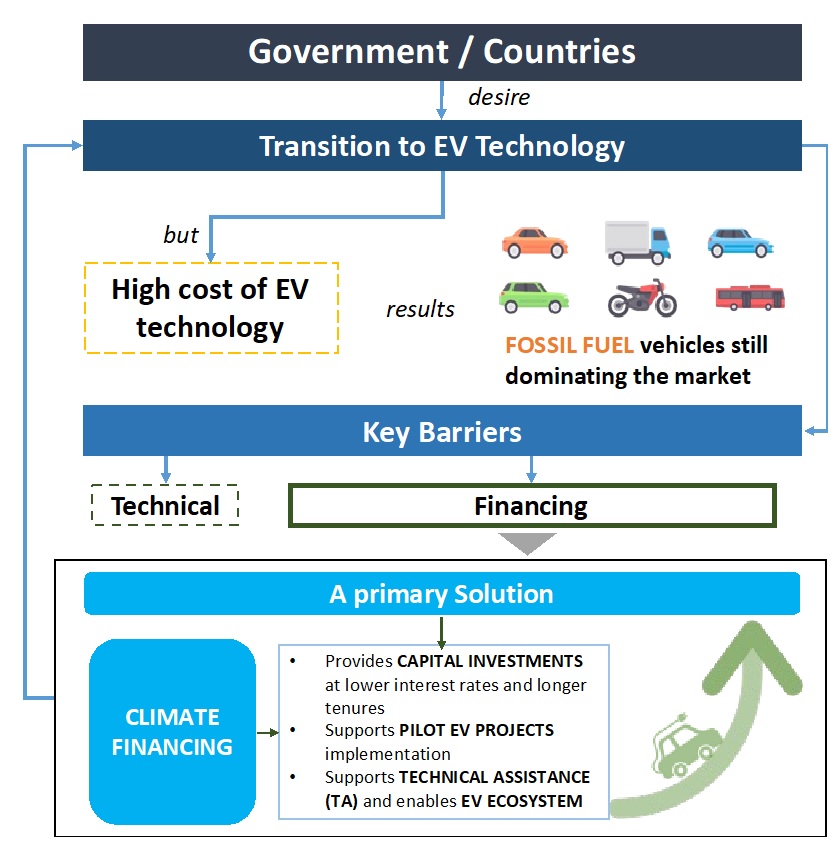
Accelerating the Transition to EVs through Climate Financing

The transportation sector is a significant contributor to global greenhouse gas (GHG) emissions. In 2021, it was responsible for almost 37% of all global emissions, according to the International Energy Agency (IEA).This makes it one of the largest contributors to climate change and underscores the urgent need to transition towards more sustainable forms of transportation. Many countries around the world have already taken steps towards this transition, with policies and regulations aimed at encouraging the adoption of Electric Vehicles (EVs). These policies include incentives for consumers and businesses, such as tax credits, rebates, and subsidies, to purchase EVs. Additionally, some governments have set targets for the percentage of EVs in their national fleet or have implemented regulations to reduce the emissions from vehicles. Despite these efforts, the shift towards EVs has been slower than anticipated, and the transition still presents significant challenges for businesses, public and private sectors.

The high cost of EV technologies in comparison to traditional vehicles has been identified as a significant barrier to the widespread adoption of EVs. This challenge has resulted in many stakeholders (e.g., businesses, government, organizations, etc.) finding it difficult to justify the necessary investment to transition towards electric mobility. The high cost of EV technologies can be attributed to several factors, including expensive batteries, limited local manufacturing capabilities, and insufficient economies of scale. These challenges have resulted in governments continuing to invest in internal combustion engine (ICE) vehicles.

The transition to sustainable transportation solutions also faces significant financial barriers, including the limited availability of financing alternatives and restricted credit access. These challenges make it difficult for stakeholders to invest in EV solutions, thereby impeding the shift towards a low-carbon future. In addition to financial hurdles, other factors such as insufficient technical expertise, inadequate charging infrastructure, unsupportive regulatory frameworks, limited availability of spare parts, and others contribute to the already substantial barriers hindering investment in sustainable transportation technologies. Climate financing is expected to play a crucial role in promoting the uptake of EVs globally as it can help overcome the financing requirements associated with EVs by providing a range of financial instruments to address the challenges. By leveraging these financial tools, it can help reduce the upfront costs associated with EVs and address several market failures related to financing, including:

Mobilizing capital for sustainable transportation projects

The financial barriers faced by countries/governments in investing in sustainable transportation projects are significant and multifaceted. These barriers include limited access to capital markets, high levels of debt, and other economic challenges that hinder their ability to effectively address the challenges posed by climate change. In order to overcome these barriers, climate financing agencies provide a range of financial instruments such as grants, concessional loans, guarantees, and other innovative financing mechanisms to help countries access the capital needed to invest in these projects. The provision of financial support by climate financing agencies not only helps them access the capital they need to invest in sustainable transportation projects but also stimulates investments from the private sector and other relevant stakeholders. This collaboration increases the potential for success and facilitates the development of sustainable transportation infrastructure that reduces greenhouse gas (GHG) emissions and enhances climate resilience.

Providing financing with concessional rates and extended repayment periods

The transition to sustainable transportation technologies presents significant financial challenges due to high upfront capital costs, technology and operational risks. Access to commercial loans with high-interest rates in many countries further exacerbates the viability of these projects. To address these challenges, the climate financing supported project/programme provides funding at concessional interest rates and extended repayment periods, making the projects more financially feasible and attractive.

Supporting EV pilots to scale-up sustainable transportation market

The climate financing aims to create a conducive environment for the development of a scalable sustainable transportation market by supporting the pilot implementation of EV technologies. This approach provides valuable insights and learnings on the technological, economic, and operational aspects of sustainable transportation solutions. The insights gained from pilot projects will facilitate the successful scaling up of these projects, ultimately contributing to mitigate the adverse effects of climate change by promoting sustainable practices and reducing carbon emissions.

Enhancing capacity building/training for stakeholders

The climate financing program provides resources for capacity building, knowledge sharing, and technical assistance to equip stakeholders such as investors, project developers, and policymakers with the necessary knowledge and skills for successful implementation of sustainable transportation projects. The aim is to bridge the information gap between stakeholders and ensure informed decision-making.

It is evident climate financing will continue to play a crucial role in promoting the adoption of EVs in the coming decades. As the world increasingly shifts towards sustainable transportation technologies to combat climate change, the need for financing to support the transition to EVs is becoming more pressing. While climate financing is already being directed towards the transport sector, the current levels of investment fall short of the estimated annual needs. The estimated cost for investment in sustainable transportation technologies, including EVs, is between $2-2.8 trillion by 2030. Key players in climate financing such as Green Climate Fund (GCF), Global Environment Facility (GEF), International Finance Corporation (IFC), European Investment Bank (EIB), and others, are providing funding for various activities related to electric mobility, such as the deployment of EV charging infrastructure, purchase of EVs, establishment of EV supply chains, and capacity building and training programs for stakeholders. Therefore, it is crucial to increase investment in climate financing to support the transition to EVs and other sustainable transportation technologies, in order to mitigate the impact of climate change.

Climate Finance: Landscape and Investment needs for Paris Agreement Transition

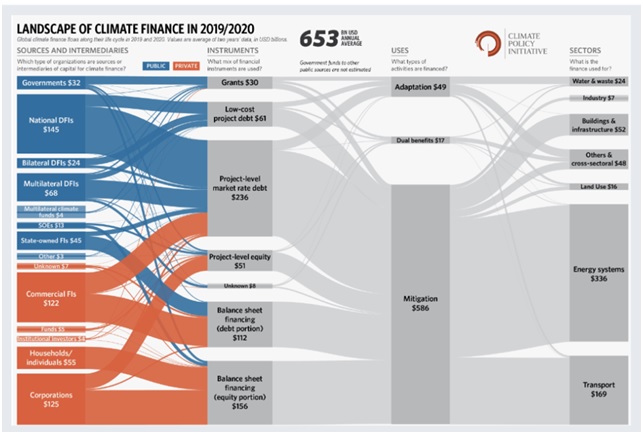
Climate finance refers to the financing needed to address the causes and impacts of climate change, including mitigation (reducing greenhouse gas or GHG emissions) and adaptation (managing the risks and impacts of climate change). The need for climate finance has grown as the world recognizes the urgent need to address the impacts of climate change, which are already being felt in many parts of the world. It has been steadily increasing over the past decade and reached USD 653 billion in 2019/2020.Figure 1shows how this finance is sourced (public or private) and used across six sectors:

i) water & wastewater;

ii) infrastructure & industry;

iii) land use;

iv) transport;

v) energy systems; and

vi) other & cross-sectoral.

Figure 1represents an average annual amount in USD billion for 2019 and 2020, and they provide an in-depth look at how funding is allocated throughout the lifecycle of climate projects. Some of the key observations are as follows:

  • The public sector provided USD 334 billion (51%), primarily through Development Finance Institutions (DFIs). Private actors contributed USD 319 billion (49%), with commercial financial institutions and corporations contributing almost 80%.
  • Grants made up 4.5% (USD 30 billion) of climate finance, with governments as the main source
  • Most climate finance raised was in the form of debt, with market-rate debt accounting for 88%, while low-cost debt was only 12%
  • Equity investments contributed 31% (USD 207 billion) of total climate finance
  • Around 90% of climate finance was for mitigation and adaptation finance accounted for 7% of total finance, while dual-use projects accounted for 3%
  • The majority of mitigation funding was allocated to energy systems, which included renewable fuel production, power and heat generation, transmission and distribution networks, policy support, and capacity building
  • The transport sector ranked second among sectors receiving climate finance, covering various modes such as EVs, rail & public transport, waterways, aviation, and transport-oriented infrastructure

Figure 1. Global Climate Finance Landscape

Figure 2. Climate Finance Comparison with Paris Scenarios

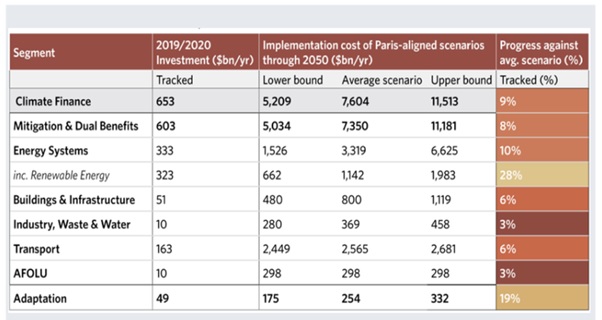
Although climate financing has been growing in recent years, it remains insufficient to meet the investment requirements for realizing Paris-aligned scenarios and achieving net-zero emissions by 2050.According to Figure 2,the amount of climate finance in 2019/2020 accounted only for approximately 9% of the average scenario implementation cost. A significant portion of these investments were directed towards climate mitigation efforts in the energy sector, with only 6% of the investment going towards the transport sector. The several challenges/ barriers hindering the financing and development of green projects are

i) lack of suitable financial instruments and long disbursement procedures
ii) high perceived risk and initial investments required
iii) limited technical capacity of stakeholders to develop green projects
iv) inadequate understanding and use of low-carbon technologies
v) lack of supportive regulatory conditions to drive green investments and others.

This disparity underlines the pressing need for a substantial increase in climate financing to align with net-zero targets. Without sufficient financing, it will be difficult to meet the goals of the Paris Agreement and prevent catastrophic consequences.

In order to successfully transition to a sustainable, net zero emissions, and resilient world within this decade, a significant increase in climate investment is imperative. Unfortunately, as depicted in Figure 3, current finance flows are vastly insufficient and fall far short of the estimated annual investment needs, which are projected to be in the range of $2-2.8 trillion by 2030. Investing in the energy system is crucial for addressing climate change, and prioritizing investments in the power and transport sectors makes sense given their significant contribution to greenhouse gas emissions. In the power sector, investments can be directed towards developing renewable energy sources such as solar, wind, hydro, and others. This will reduce reliance on fossil fuels and decrease carbon emissions. Additionally, investments can be made in energy storage technologies to ensure the stability and reliability of the power grid. In the transport sector, investments can be focused on developing electric vehicles and the necessary charging infrastructure. This will reduce reliance on fossil-fuel powered vehicles and decrease carbon emissions from the transportation sector. Additionally, investments can be made in public transportation systems to encourage the use of mass transit and reduce the number of individual vehicles on the road.

Figure 3. Climate Finance Investment Needs by 2030

Climate finance must increase in speed and scale this decade for a credible transition to a sustainable, net zero, and resilient world. It should count in the trillions annually, whereas fossil fuel investments should dramatically decrease this decade to achieve this transition. Climate finance commitments also need to translate into action in the real economy, requiring all public and private actors to align their investments with Paris goals and net zero, sustainable pathways. This requires coordinated action from all actors:

  • Governments needs to build confidence in key markets with clear policy signals and incentives, with interim goals on net zero, whereas financial regulators should set standardized rules to enforce the targets
  • Development banks and international finance institutions can help build strategy, engage with counterparties, and support policy development, while deploying a wider range of instruments that take on more risk, helping to catalyze more private investment in developing economies
  • Private sector needs to better appreciate new approaches to collaborating and investing, but also needs to mainstream climate considerations by assessing risk and opportunities in a more holistic way

Source

Why Autonomous Vehicles with Electric Powertrains are future?

Autonomous vehicles are one of the most exciting developments in the transportation sector, and their integration with electric power trains is making them even better. In this blog, we will explore why autonomous vehicles powered by electric power trains are the future of goods transportation.

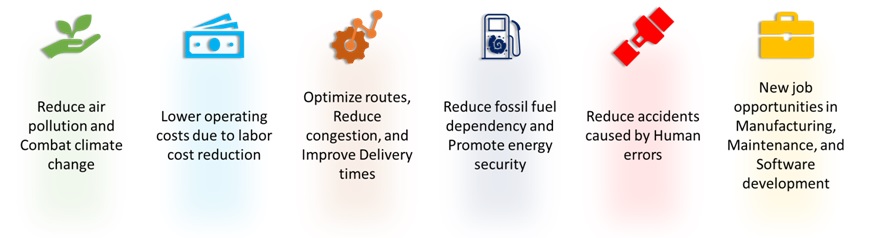
First and foremost, autonomous vehicles are safer than human drivers. They are equipped with advanced sensors, cameras, and software that can detect and respond to potential hazards in real-time. This reduces the risk of accidents caused by human error, such as distracted driving, speeding, and driving under the influence. With the elimination of these risks, autonomous vehicles are helping to make our roads safer for everyone.

Additionally, electric powertrains are much more efficient and environmentally friendly than traditional gasoline-powered vehicles. They produce zero emissions, which helps to reduce the negative impact of transportation on the environment. This results in lower fuel costs, making electric vehicles a more affordable option for consumers. The combination of autonomous vehicles and electric powertrains also has the potential to revolutionize the way goods are transported. Autonomous vehicles can operate around the clock, without the need for rest or breaks, which can significantly increase the efficiency of goods delivery. With electric powertrains, these vehicles can travel longer distances without the need for refueling, making them ideal for long-haul deliveries. Moreover, autonomous vehicles are also more accessible to people with disabilities or mobility challenges. They provide a new level of independence, enabling people who would otherwise be unable to drive to get around more easily. Electric powertrains are also a good fit for these vehicles, as they provide smooth, quiet, and reliable power, making the experience more comfortable for passengers.

Autonomous vehicles powered by electric powertrains can prove to be a game-changer in the transportation sector. They offer many advantages over traditional vehicles, including increased safety, environmental benefits, and greater accessibility. With the rapid growth of this technology, we can expect to see more and more electric autonomous vehicles on the roads in the near future.

As a parting note, it’s important to remember that the integration of autonomous vehicles and electric powertrains is still in its early stages, and there are still many challenges to overcome. Nevertheless, the potential benefits are too great to ignore, and we can look forward to a future where goods transportation is safer, cleaner, and more accessible to everyone.

Going Green and Saving Green: How Carbon Markets Can Drive Economic Growth for India’s DRE Industry?

Climate change has had an overwhelming impact on the planet, and it is now more critical than ever to take measures to reduce greenhouse gas emissions. Carbon markets have emerged as a promising solution to help combat this issue. By providing a platform for trading carbon credits, organizations can buy and sell these credits, which represent the amount of carbon dioxide or other greenhouse gases that have been reduced or eliminated from the atmosphere. In this blog post, we’ll explore the role of carbon markets in driving economic growth in India’s decentralized renewable energy (DRE) industry.

The DRE industry in India presents a unique opportunity for carbon markets to drive economic growth. This is largely due to India’s ambitious target of installing 500 GW of renewable energy by 2030, coupled with the fact that the country is one of the largest energy consumers globally. By embracing carbon markets, India can make significant progress in achieving its goal of reducing its carbon footprint, while simultaneously stimulating economic growth in the DRE sector. The following are ways in which carbon markets can stimulate economic growth in India’s DRE industry:

In India, the National Clean Energy Fund (NCEF) regulates the Carbon Market under the Ministry of New and Renewable Energy (MNRE). The NCEF’s primary objective is to promote the growth of the renewable energy sector by offering financial assistance via different schemes and initiatives, including the Clean Development Mechanism (CDM) and the National Action Plan on Climate Change (NAPCC).
DRE initiatives, such as mini-grids, rooftop solar installations, and biomass power plants, can generate carbon credits under the CDM program by replacing fossil fuel-based electricity production. These credits can be traded in the carbon market, providing additional revenue streams for DRE project developers.

Furthermore, by participating in the Carbon Market, DRE projects can draw the interest of green investors who are seeking sustainable investments with a positive environmental impact. Carbon credits can serve as collateral for these investments, reducing the cost of capital for DRE projects.

In addition, the Carbon Market can incentivize the adoption of energy-efficient strategies in DRE projects, as the resulting emission reductions can generate carbon credits. This can result in the creation of more environmentally friendly and energy-efficient DRE projects that produce additional revenue streams through the sale of carbon credits.

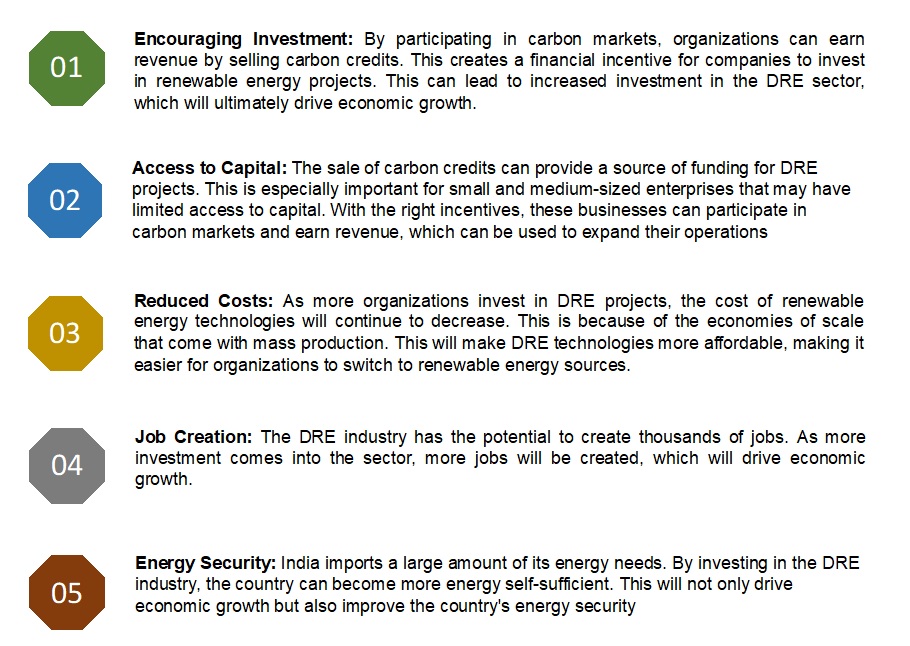
Thus, the utilization of carbon markets presents a viable opportunity for driving economic growth within India’s DRE industry. With the implementation of appropriate incentives, organizations can allocate their investments towards renewable energy projects and simultaneously generate revenue by trading carbon credits. This establishes a financial motivation for businesses to invest in the DRE sector, which would lead to amplified investments, diminished expenses, job creation, and the development of better energy security.
Hydrogen: A Path to a Cleaner Energy Future

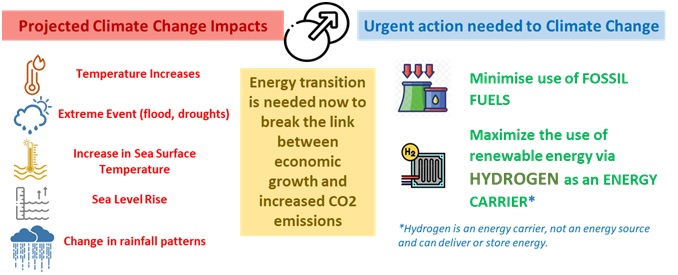
The world is heavily reliant on fossil fuels, accounting for 85% of global energy use. With business-as-usual interventions, this trend is projected to lead to a 50% increase in greenhouse gas (GHG) emissions by 2050, causing harm to the environment and is main contributor to climate change. Energy related CO2 emissions accounts for two-thirds of global GHG emissions.

National governments understand these impacts and risks and are actively working towards a sustainable energy future.

Hydrogen energy is becoming crucial as the world shifts towards cleaner energy. Here’s why:

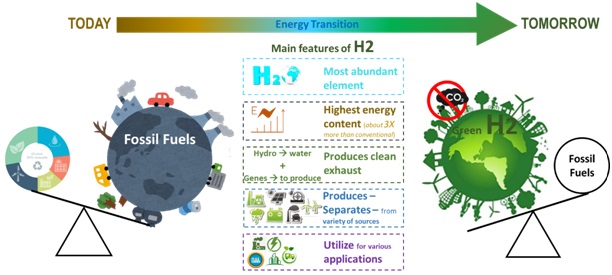
  • It is the simplest and also the most abundant element in the universe(about 75% by mass of the universe is made up of hydrogen and 90% by volume)
  • It has highest energy content of any common fuel by weight (about three times more than gasoline, diesel and natural gas), but it has the lowest energy content by volume (about four times less than gasoline)
  • It produces clean exhaust and by-product obtained is water, when burned and has great potential for decarbonization(Hydro means water and genes means to produce; so, water producer)
  • It, can be produced – separated – from a variety of sources including water, fossil fuels, or biomass, and used as a source of energy or fuel
  • It is Versatile in usage, reducing dependence on fossil fuels and imports and can be utilized from the point of production to the point of consumption including various applications like oil refineries, industries, transport, power generation, domestic, etc. which emit significant amounts of CO2. Hydrogen, can be transformed into electricity to power homes and feed industry, and into fuels for cars, trucks, ships and planes. Thus, it can promote the use of diverse domestic and sustainable energy resources
  • It can be used as an energy storage and can reduce intermittency risks of renewables

However, pure diatomic hydrogen (H2) is not naturally found. It is almost always linked to other elements. So, while hydrogen as a fuel is extremely clean, its production is not. However, several developments are now in place of older alternative hydrogen production technology where green hydrogen is produced from water via electrolysis. Pure hydrogen is a disreputably difficult gas to handle and distribute. It’s the smallest element in the universe, and prone to leak not only through seals and gaskets, but through steel itself. It is highly flammable and forms explosive mixtures with air over a large range of concentrations. To liquefy hydrogen requires chilling to -253˚C, only 20˚C above absolute zero. Where liquefying hydrogen is not practicable, it must be subjected to very significant compression to enable useful quantities to be stored. These are some challenges that need to be addressed before hydrogen can reach its full potential, such as improving production methods, reducing costs, and developing the necessary infrastructure to support a hydrogen-based energy system.

Henceforth, Today, hydrogen is primarily used as a fuel in industrial processes, but there is growing interest in using hydrogen as a clean source of energy for transportation, heating, and power generation.

And Tomorrow, hydrogen is expected to play a larger role in the energy mix, as the demand for clean energy continues to rise and new technologies make it more practical to produce, store, and use hydrogen on a large scale. Hydrogen has the potential to be a game-changer in the transition to a low-carbon future, as it can be produced using renewable energy sources and does not produce harmful emissions when burned.

Here is how, the future of hydrogen energy looks promising, and it is likely to play a crucial role in achieving a more sustainable energy future.

Carbon Market: Why it matters?

Carbon markets are systems that allow for the trading of carbon credits or permits, which represent one metric ton of carbon dioxide (CO2), or an equivalent amount of another greenhouse gas (GHG) that has been reduced or removed from the earth’s atmosphere. It is not necessarily a carbon offset. A carbon credit only becomes a carbon offset when used for carbon offsetting, in other words, compensating for one’s GHG emissions. The idea behind carbon markets is to put a price on carbon emissions, creating an economic incentive for companies and individuals to reduce their emissions and invest in clean energy.

The evolution of carbon markets can be traced back to the 1990s, with the establishment of the first mandatory carbon market, the European Union Emissions Trading System (EU ETS) in 2005. The EU ETS operates as a cap-and-trade system, which limits the total amount of CO2 emissions from power plants and heavy industries and allows companies to buy and sell emissions allowances in order to meet their emissions targets.

In the following years, other countries and regions established their own carbon markets, including the Regional Greenhouse Gas Initiative (RGGI) in the northeastern United States, the Western Climate Initiative (WCI) in North America, and the carbon market established under the United Nations Framework Convention on Climate Change (UNFCCC), known as the Clean Development Mechanism (CDM).
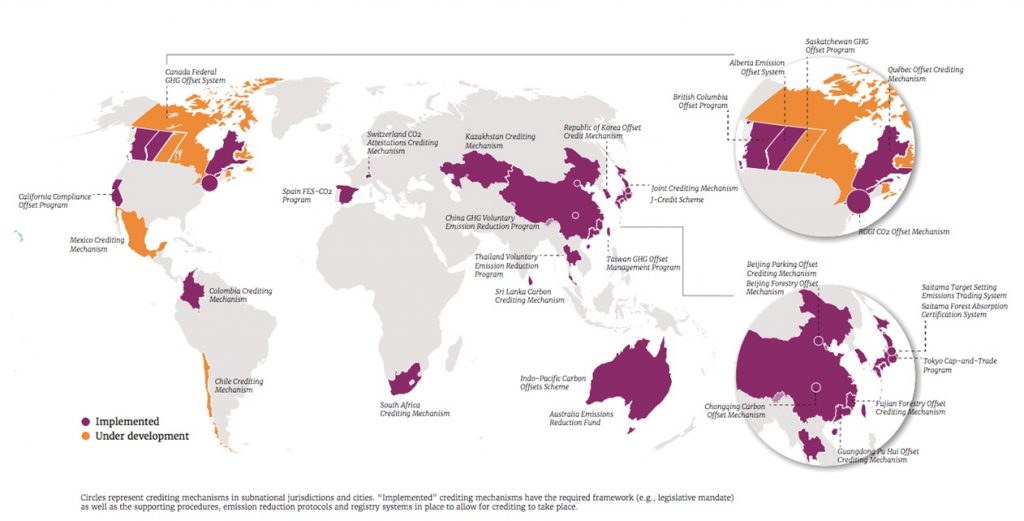
More recently, there has been an increasing interest in using carbon markets as a tool to help countries and regions meet their commitments under the Paris Agreement, which aims to limit global warming to well below 2 degrees Celsius. To this end, various carbon pricing initiatives and schemes have been launched worldwide. Some of them are already operational, such as California Cap and trade, Quebec Cap and trade and in Canada, carbon pricing policies are in place in seven provinces. In addition, there are also voluntary carbon markets, where companies, organizations, and individuals can purchase carbon credits to offset their emissions. These credits represent the reduction or removal of CO2 emissions from projects such as renewable energy or reforestation.

Different carbon pricing initiatives and schemes worldwide | by World Bank: https://openknowledge.worldbank.org/handle/10986/37455

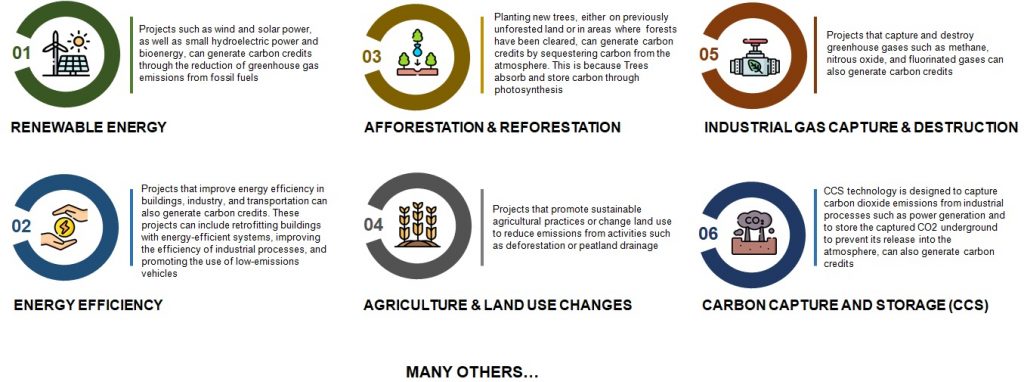
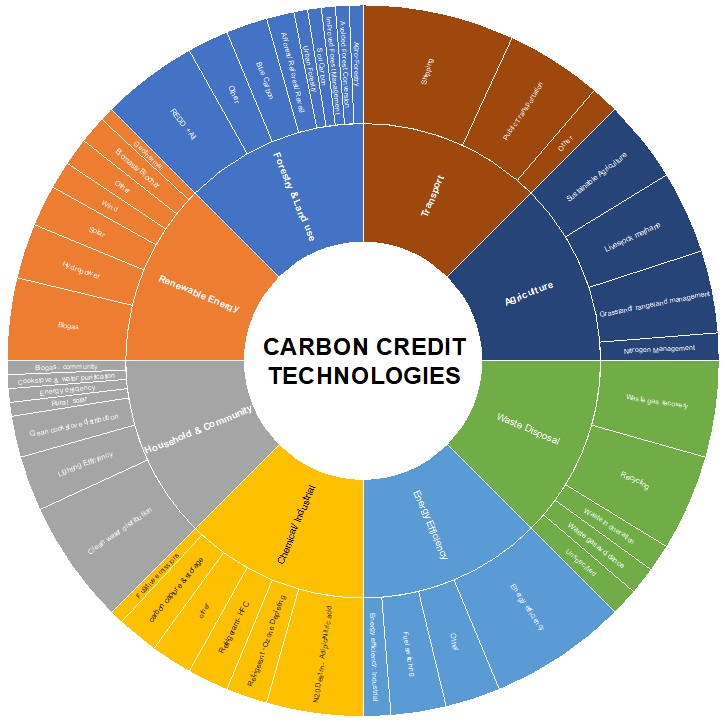
There are several technologies that can be used to generate carbon credits, including:

Different methods can be used to determine the value of a carbon credit, such as market conditions, cost of implementation, or the benefits of the project. The price can also depend on factors such as the type, size, and location of the project. The chart below shows an overview of the prices for different types of credits in the market as of January 2023.[i]

[i]https://8billiontrees.com/carbon-offsets-credits/new-buyers-market-guide/carbon-credit-pricing/

Project TypeVolume Sold (MtCO2e)Average Price ($)Price Range ($)
Wind12.81.90.3 – 18
REDD+113.30.8 – 20+
Landfill Methane7.920.2 – 19
Tree planting37.52.2 – 20+
Clean cookstoves34.92.0 – 20+
Run-of-river hydro1.51.40.2 – 8
Water/purification1.23.81.7 – 9
Improved forest management0.89.62 – 17.5
Biomass/biochar0.730.9 – 20+
Energy efficiency -industrial-focused0.74.10.1 – 20
Biogas0.65.91 – 20+
Energy efficiency-community-focused0.69.43.3 – 20+
Transportation0.5292.2 – 6.8
Fuel switching0.511.43.5 – 20+
Solar0.34.11 – 9.8
Livestock methane0.274.0 – 20+
Geothermal0.142.5 – 8
Agro-forestry0.19.99.0 – 11.0

Globally, carbon markets have evolved significantly over the past two decades and continue to be an important tool for reducing carbon emissions and combatting climate change. There is an increasing recognition of the need for carbon pricing as a mechanism to drive the transition to a low-carbon economy and many countries, regions and cities worldwide are implementing different form of carbon pricing mechanisms or planning to do so in the future.

The State of Carbon Market in India

India is the world’s third largest emitter of greenhouse gases (GHGs), after China and the US. India has been taking steps to implement a carbon market as part of its efforts to reduce greenhouse gas emissions and combat climate change. In India, carbon credits can be traded through various mechanisms, including the Clean Development Mechanism (CDM), which is an aspect of the United Nations Framework Convention on Climate Change (UNFCCC).

The CDM allows organizations in developed countries to invest in carbon reduction projects in developing countries, such as renewable energy projects in India, in order to offset their own GHG emissions. These investments help to fund the development of clean energy projects in developing countries, while also helping developed countries to meet their own emissions reduction targets.

India has been one of the largest recipients of CDM funding, with a large number of CDM projects registered in the country. These projects include renewable energy projects such as wind and solar power, as well as energy efficiency and afforestation projects. However, the CDM mechanism has been criticized for its lack of transparency, lack of long-term commitment, and failure to achieve large-scale emissions reductions.

Apart from CDM, India has started domestic carbon trading as well through its Carbon Emission Trading Scheme (ETS). It is still in early stage but allows companies to buy and sell carbon credits to other companies with the help of government. Between 2010 and June 2022, India issued 35.94 million carbon credits or nearly 17% of all voluntary carbon market credits issued globally.  The market for carbon credits increased by 164% globally in 2021. It is anticipated to reach USD 100 billion by 2030.[i]

However, there are several challenges that need to be addressed in order to establish a functional and effective carbon market in India.

  • One of the main challenges is the lack of a legal and regulatory framework for carbon trading. While India has announced its intent to establish a carbon market, it has not yet developed the necessary regulations and policies to govern the market. As per BEE recent announcement it is expected that in the year 2023, the framework will be rolled out and the voluntary market will be there. The compliance market will take time because targets and timelines need to be given to the industries. It is also expected the current Perform, Achieve and Trade (PAT) scheme would be transitioned into the compliance market. Moreover, Power exchanges which enable the trading of the energy saving certificates (ESCerts) converted from the excess energy savings, are likely to be the trading platform for carbon credits too, under the carbon market framework.[ii]
  • Another challenge is the lack of accurate and reliable data on emissions. To establish a functional carbon market, accurate and verifiable data on emissions is necessary to establish baselines, set emissions targets and monitor compliance. However, in India, the lack of monitoring, reporting and verification (MRV) systems and data is seen as one of the major barriers to the successful implementation of a carbon market.
  • Additionally, the initial setup costs for a carbon market, such as developing and implementing a carbon-pricing mechanism, building the necessary infrastructure and building the necessary systems for monitoring and enforcing compliance, can be substantial, and India lacks the sufficient resources and human capital to fully implement such mechanism. Moreover, the relatively low level of awareness and understanding of carbon markets among stakeholders in India can make it difficult to promote the market and ensure its success.
  • Many sectors in India are still heavily dependent on fossil fuels and the lack of alternative energy sources as well as the lack of appropriate infrastructure to support alternative energy could make it difficult to implement a carbon market that would reduce emissions effectively.

Amidst the challenges, there are several opportunities for the growth of the carbon market in India, such as government support, the growing renewable energy sector, large emitting sectors, increasing corporate interest, international linkages, innovation, digitalization, domestic demand for carbon offsetting, and private sector participation. These factors create a conducive environment for the expansion of the carbon market in India, which can help address climate change and promote sustainable development

In conclusion, carbon market matters as it plays a vital role in addressing climate change by providing a mechanism to reduce greenhouse gas emissions. By creating a market for carbon, they incentivize companies and individuals to reduce emissions and invest in low-carbon technologies, while also allowing countries and companies to meet emissions reduction targets set by international agreements. They also mobilize private sector funding and expertise to support the transition to a low-carbon economy, promoting sustainable development and economic growth. Therefore, it is crucial to continue to develop and support carbon markets as a means to mitigate climate change.

[i]https://www.deccanherald.com/science-and-environment/carbon-credits-and-india-s-carbon-market-1163828.html

[ii]https://www.livemint.com/news/india/voluntary-carbon-trades-to-start-in-2023-11674498997601.html

Five Innovative Business Models for integration of e-Mobility and RE infrastructure

Transport and energy are important for economic growth and social development, but also major emitters of greenhouse gases. Transport emits 23% of energy-related CO2 and power industry emits 40%[1]. Hence, decarbonizing these sectors is necessary to limit global warming. Both sectors’ growth can lead to increased fossil fuel dependence and emissions. Making low-carbon energy and transport a priority for sustainable development can mitigate emissions and prevent investment in fossil fuel technologies that may become unviable before their end of life. Renewables, especially solar, wind, hydro and geothermal will play a major role in decarbonizing the power industry. Electrification of transport is a key strategy for reducing transport’s CO2 emissions.

E-mobility impact on electricity supply

The ability to electrify road transport is determined by the power sector’s capacity to provide reliable electricity, and this, at affordable cost. Beyond the need for additional capacity and grid extension, the two typical challenges of the electricity sector are high losses in transmission and distribution, and grid liability. Transmission and distribution losses are estimated to be roughly 10% (or more in many countries); they often result in either higher consumer prices or higher public expenses to cover utilities’ forgone revenue. Grid reliability is another critical factor and may pose a challenge if many EVs are being charged at the same time.

EV charging loads are anticipated to be very dynamic, with spikes in the demand curve. This can have a serious impact on the distribution network, especially in distribution areas with low available hosting capacity leading to voltage instability, harmonic distortion, power losses and unreliable supply. The impact on the grid can be minimized by introducing discounted tariffs for charging during non-peak hours like Time of Use (ToU) or Time of Day (ToD). Additionally, other EV charging management solutions like battery energy storage system (BESS), smart charging and vehicle-grid integration (VGI) can be used to mitigate the negative impacts of uncontrolled EV charging.

Trends in Renewable Energy and synergies with e-Mobility

In the past decade, renewable energy production per capita has doubled. Bhutan, which is standing out with the highest electricity production per capita in the world (3,026W), sells one hundred percent of their hydropower to neighbouring nations. China, the most populous nation on earth, is the leader in renewable energy. Its RE capacity per capita is 621W, which is 2.5 times the global average. China has six times the RE capacity per capita as India. In Sub-Saharan Africa,’s RE capacity per capita is at 38W.

Increasing renewables’ integration to the grid comes with challenges for the system’s stability such as boosting grid voltage (hampering performance of the connected power equipment like DTs by overloading), injecting harmonics etc. As a result of the intermittent nature of wind and solar generation, capital expenditure in equipment like inverters and storage is needed to reduce peak load, enhance power quality, and store excess power. Integrating storage with RE will increase implementation costs, which could impede the widespread deployment of RE. Employing RE for EV charging further requires additional grid infrastructure leading to increase in grid upgradation costs.

Conversely, integrating a greater proportion of RE sources to the grid for EV charging results in benefits like higher contribution to CO2 emission reductions; it can also help minimize grid impact challenges. RE with BESS can act as an ancillary support to the grid by storing energy during high RE output hours and supplying power during off-peak hours, enhancing system reliability and resiliency. It also provides reactive power that helps with voltage control thereby improving grid stability and minimize AT&C (aggregate technical and commercial) losses. When using V2X technology, batteries from EVs can act as BESS, supporting RE by storing power and reduce additional storage investments.

Opportunities for growing e-Mobility and RE in synergy

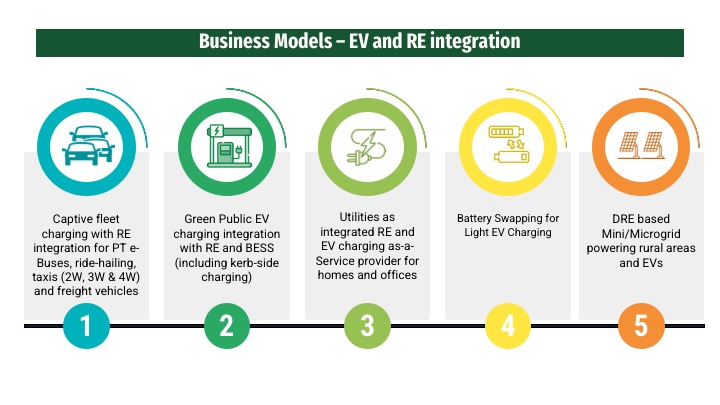
This section outlines opportunities at the intersection of both technologies, and presents various EV charging business models integrating RE. The business models (as shown below), look into different energy models, charging models, vehicle segments and applications.

Business Model 1Captive fleet charging with RE integration for PT e-Buses, ride-hailing, taxis (2W, 3W & 4W) and freight vehicles
Growth rationale· Globally, there is an increasing shift to public transport (PT) bus systems, to drive operational and financial efficiency and increase fleet size with transition to e-Buses. Also, the ride-hailing freight services market is growing globally and making an economic case for their electrification.·  PT e-buses, ride hailing taxis and freight vehicles having access to a dedicated depot in strategic city locations with ample spaces provide easy charging with RE integration opportunity· As the push to freight electrification grows, warehouses make most sense for charging, considering typical logistics profile of hub-and-spoke model or point-to-point, etc. and vehicle’s layover of ~5-6 hours during loading and unloading· Charging fleets with large battery capacities (for buses, trucks) demands more energy which makes a case for integrating with RE to help reduce load on the grid· Big roof tops as well as ground space in depots and warehouses provide opportunities for RE integration for charging. However, given size of fleet and required high MW level charging load (specially in case of e-Buses), captive RE alone may not be sufficient. And there will be a need for remote RE open access or trade offset.
Benefits· Support peak shaving (reducing load on the grid during peak hours) using RE with BESS for charging thereby reducing grid investment cost required to manage peak demand·Reduce impact on the grid by reducing harmonics and voltage instability and thereby reduce losses in the system· e-Bus/e-Truck batteries provide good stationary RE power backup storage (as BESS) at lower cost given higher daily distance run and battery utilization thereby undergoing faster replacement
Limitations · High investment cost when using batteries to store RE to power fleet overnight· Scheduling fleet to match charging pattern and RE generation requires suitable locations to install RE on site, alternatively remote access to the grid
Business Model 2Green Public EV charging integration with RE and BESS (including kerb-side charging)
Growth rationale· Public Charging stations (PCS) gives visibility and confidence to EV users and help curb range anxiety·  More and more PCS are getting integrated in existing matured commercial locations like fuel stations (intracity and highways), malls, restaurants, parking etc. These locations typically have real-estate for RE integration.· With many users doing planned home or office charging, more and more PCS use cases including kerb-side charging are moving towards quick opportunity or top-up charging.·  Real-estate space at PCS and prevailing high electricity commercial tariffs makes a business case for RE integration. Depending on space availability at the site, 100% RE can be supported with a mix of captive, remote generation wheeled through green open access, and/or RE tradable certificates.· RE plus BESS combined with a grid makes PCS greener. It also reduces both its energy and demand charges. This further integrated with smart chargers will allow PCS operators to align pricing signals with utility given ToU/ToD tariffs and drive EV charging user’s behavioural change.·  BESS using repurposed batteries from EVs could further make its deployment with RE more economical
Benefits· Provides better grid stability and reliability by supporting peak load shaving (reducing load on the grid during peak hours) thereby reducing the required grid investments (in equipment like inverters)· BESS at PCS will provide the necessary back-up power system at the time of grid failure/ outages and act as an ancillary support to the grid
Limitations · Requires considerable land/ space for deployment (which is a constraint in urban areas)· Need for smart charging solutions to better manage multiple EV charging which also calls for high investments·  Low utilization of PCS affects the business economics
Business Model 3Utilities as integrated RE and EV charging as-a-Service provider for homes and offices
Growth rationale·  Both RE and EV economics to end-users are becoming attractive for end-users and their fast proliferation is causing high grid impact. Progressive utilities have hence started facilitating their customers to improve energy efficiency, behavioural or automated demand response (through use of ToU or ToD charging) and solar roof top generation.· In many countries, there is a growing trend of providing solar roof top (SRT) as-a-service (long term PPA) to residential and commercial customers as a RESCO model. Private utilities are playing increasing roles in extending this service to their customers.· Many utilities in the developed countries are extending the charging-as-a-service (CaaS) model to home and office customers, where they are extending investment and/or rebates and hence optimising national cost on public charging infrastructure.·  EV charging shifts during high RE output hours for relatively low power e-2Ws and e-cars at home and offices through appropriate ToU and smart charging can optimise further end-user economics and also utility costs for grid expansion.·  Low and middle income countries tend to have a high share of inverter and battery power backup systems at homes and offices. These storage assets can be leveraged to charge from captive SRT and then support EV charging later in the day or night. Increasing new power backup systems allowing such high loads (ACs, EVs) running through RE.
Benefits· Managed and controlled charging can reduce the impact of EV charging on the grid
Limitations · High investment for utilities to deploy smart technological solutions to monitor real-time integration of RE and EVs
Business Model 4Battery Swapping for Light EV Charging
Growth rationale· Battery swapping allows the end-user to run EV with a swap battery· Battery swapping charging station is isolated for only swap batteries charging. This allows RE integration including captive at the fuel stations forming key locations to host battery swapping.
Benefits·  Attractive for vehicle operators as swapping does not require time, as charging does·  In commercial fleets, it increases fleet utilization, improves logistics delivery timelines, and saves time· Allows separation of batteries and EVs ownership, thereby reducing upfront cost of EVs for the end-user· Provides high asset class business model for new energy operators through improved battery life, grid responsive charging and RE integration· Reduces investments in charging network and centralizes electricity consumption· Allows using batteries as a storage (in a managed manner) and to put power back into the grid·  Addresses space constraints in urban areas as multiple batteries can be stack, using less space than parking for charging
Limitations ·  High investment cost, high automation, and high inventory of charged batteries· Battery swapping stations demands high energy from the grid to keep the batteries charged round the clock· Need for standardization of batteries (with different technologies) for interoperability without hampering technology upgradation
Business Model 5DRE based Mini/Microgrid powering rural areas and EVs
Growth rationale· Distributed Renewable Energy (DRE) based Mini/ Micro grids are a solution for supplying 24×7 electricity to many communities without adequate grid service· Financial viability of most mini/ micro grids requires strategies to increase electricity sales· Mini/micro grid need demand loads that can be time-shifted to periods when RE is available else to balance the demand-supply necessitates substantial storage facility· EV having a large on-board energy storage can provide base load to DRE mini/ micro-grids and potentially help mini/micro grid operators improve their economics and expand energy services· DRE based mini/ micro grid can potentially be an EV charging station like a battery swapping station that charges batteries during RE generation and then lease out these batteries to the EV drivers during operations allowing drivers to top up their EVs·  DRE based mini/ micro grids can use sources like solar and biogas or even hybrid source of energy (like grid + DRE)
Benefits· Provide access to affordable and reliable electricity and transport in underserved areas· Reduce loss and wastage of farm produce with increased access to transport· Provide base load to the mini grid improving economics for the operator and low-cost to the end-user· Encourage rural entrepreneurship by powering productive use applications like EVs· Ensure safety by providing power during night using battery storage· Support education by providing access to affordable transportation to schools/ colleges· Ensure seamless delivery of essential services such as healthcare, education (online learning) and internet connectivity due pandemic like situations
Limitations ·High investment cost for deploying minigrids and lack of financing support· Requires regular local maintenance support (skilling) to keep minigrid working for e-Mobility application

(The views expressed in this blog are from a Working Group Paper authored by pManifold team members developed for SUM4All and published at COP27)

More details can be referred from the following link:

Everything you need to know about impact of EV charging on electricity supply in Low-and-Middle-Income Countries (LMICs)

The adoption of electric vehicles (EVs) in low and middle-income countries (LMICs) is largely dependent on the ability of the power sector to provide reliable and affordable electricity. In these countries, access to electricity and a stable supply of it are still major concerns, and therefore it is important to consider both the power and transportation sectors together when planning and developing infrastructure for EVs.

Apart from the need for additional capacity and grid extension, the two most common challenges in the LMIC electricity sector are high transmission and distribution losses and grid reliability. In LMICs, these losses are estimated to be around 10%[1], but they can be much higher in some countries, such as Togo, Haiti, Benin, and the Republic of Congo, where losses can exceed 40%. These losses can result in either higher consumer prices or higher government expenses to compensate utilities for their lost revenue. The adoption of electric vehicles may exacerbate these losses, as they will require additional electricity to charge.

Grid reliability is another important factor to consider in the adoption of EVs in LMICs. If large number of EVs are being charged at the same time, it may strain the grid and cause reliability issues. Experience in countries with a high adoption of EVs has shown that users tend to charge their vehicles during periods of high demand, such as overnight (8pm to 4am) and in the afternoon (11am to 4pm). This may pose a challenge for grid operators in LMICs, as they may need to increase capacity to meet this demand.

The demand curve spike (as a result of EV charging) can have a significant impact on the distribution system and possibly cause voltage instability, harmonic distortion, power losses, and unstable supply. One way to mitigate these negative effects is to implement discounted tariffs, such as Time of Use (ToU) or Time of Day (ToD) tariffs, for charging during off-peak times when demand for electricity is lower. This can help to reduce the impact of EV charging on the grid.

There are also alternative solutions that can be used to reduce the negative effects of uncontrolled EV charging on the grid. These solutions include battery energy storage systems (BESS), smart charging, and vehicle-grid integration (VGI). BESS can store excess electricity generated by the grid or by renewable energy sources and then release it back into the grid when needed, helping to stabilize the supply of electricity. Smart charging involves using algorithms to optimize the timing of EV charging in order to minimize the impact on the grid. VGI involves allowing EVs to act as both a load on the grid (when they are being charged) and a source of electricity (when they are being driven and their batteries are charged).Effective connected load monitoring at the distribution and transmission levels is also critical in managing the difficulties associated with EV charging. This involves monitoring the demand for electricity in real-time and adjusting the supply accordingly in order to maintain stability and reliability.

In the early stages of EV adoption, grid stability may not be a major concern for utilities because the number of EVs on the road will be relatively less. However, as the penetration of EV grows, it will be important for utilities to prioritize load balancing between EV loads and other connected loads in order to reduce the risks of grid instability.

To meet the anticipated growth in demand for both transportation and electricity, it will be necessary to implement integrated policy changes, coordinate planning, and invest in both the energy and transportation sectors. These measures may include requiring the installation of smart meters and allowing the use of EVs for grid services in the commercial sector. By taking a holistic approach to planning and development, it will be possible to ensure that the necessary infrastructure is in place to support the growing demand for EVs.

On the other hand, adoption of EVs offers utilities and Independent Power Producers (IPPs) new business opportunities in the EV value chain. For instance, operators and service providers can use renewable energy (RE) at charging stations, and EV manufacturers can use RE at their facilities. This can aid in decarbonizing the entire EV value chain from manufacturing to recycling. The smart integration of energy storage systems with renewables can increase grid flexibility, reduce fixed demand charges, and make business propositions more attractive by providing low-carbon, reliable, and affordable energy to consumers. Collaboration between the electricity and transportation sectors can also improve energy availability, particularly in rural areas, where the development of renewable-powered micro-grid solutions may be coupled with new demand from electric vehicles.

Although the adoption of EVs may have an impact on the electricity supply in LMICs, there are a number of ways to reduce the risks and fortify the infrastructure with timely government interventions. These interventions may include implementing policies and regulations, providing financial incentives, and investing in research and development to improve technologies and infrastructure.

https://data.worldbank.org/indicator/EG.ELC.LOSS.ZS?locations=XO