



Global mean temperatures are projected to increase by 3.7 to 4.8°C, which would lead to catastrophic and irreversible effects on humanity and Earth’s ecosystems. In December 2015, the first global agreement of its kind was made when governments committed to maintaining the global temperature within this 2°C limit, to keep the temperature rise to 1.5°C – the Paris Agreement. It is a legally binding international treaty that sets long-term goals to guide all nations:
- Substantially reduce global GHG emissions to limit the global temperature increase in this century to 2 degrees Celsius along with efforts to limit the increase even further to 1.5 degrees.
- Review countries’ commitments every five years
- Provide financing to developing countries to mitigate climate change
Industrial emissions are a major contributor to the global emissions landscape. A substantial portion of our electricity continues to be generated through the burning of coal, oil, or gas. These practices release potent greenhouse gases into the atmosphere, creating a heat-trapping blanket that contributes to global warming. Sectors such as manufacturing, food processing, mining, and construction further amplify emissions through various processes, including on-site combustion of fossil fuels for heat and power, non-energy use of fossil fuels, and chemical procedures involved in iron, steel, and cement production.
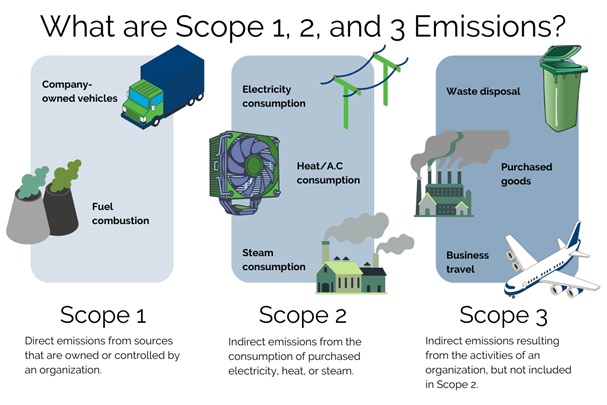
Businesses must reduce their environmental impact. One of the most significant ways to do this is by reducing their carbon footprint, and this starts with monitoring carbon emissions. But what are emission scopes 1, 2 & 3 (as defined by the GHG Protocol)
Often, emissions along the value chain represent the biggest GHG impact. For decades, companies have missed significant opportunities for improvement.
What is Net Zero?
Net zero means becoming carbon neutral. In simple words, net zero means cutting greenhouse gas emissions to as close to zero as possible, with any remaining emissions re-absorbed from the atmosphere, by oceans and forests for instance.
Governments have the biggest responsibility in the transition to net-zero emissions by mid-century. But businesses, investors, cities, states, and regions also need to live up to their net-zero promises.
Scope 1, 2 and 3 emissions
The term first appeared in the Green House Gas Protocol of 2001; Scopes are the basis for mandatory GHG reporting. Scopes provide a framework for categorizing and reporting GHG emissions, helping organizations assess and disclose their environmental impact. The emissions are broadly classified into 3 categories.
Scope 1 emissions— The Green House Gas (GHG) emissions that a company makes directly.
Scope 2 emissions — These are the indirect emissions that a company makes. For example – when the electricity or energy it buys for heating and cooling buildings, is being produced on its behalf. An organisation can source renewable electricity, renewable gas, or electrify its heat demand or transition to electric vehicles.
Scope 3 emissions — This category encompasses all emissions linked not to the company directly, but rather those for which the organization bears indirect responsibility along its value chain. These emissions stem from various sources, such as purchasing products from suppliers and the emissions resulting from customers’ use of the company’s products. In terms of emissions, Scope 3 emissions account for the largest portion.
Companies will normally have the source data needed to convert direct purchases of gas and electricity into a value in tonnes of GHGs. This information may sit with procurement, finance, estate management, or in sustainability functions.
Scope 1 and 2 are most within an organisation’s control and in some cases the solution for net zero is available.
For numerous businesses, Scope 3 emissions make up more than 70 per cent of their total carbon footprint. Take, for instance, an organization involved in manufacturing products; substantial carbon emissions arise from the extraction, manufacturing, and processing of raw materials.
To address these emissions, you can consider collaborating with current suppliers to find solutions that reduce their impact or explore potential changes in your supply chain. However, it’s essential to recognize that suppliers also play a significant role in emission reduction through their own purchasing decisions and product design.
While defining what constitutes net-zero ambition can be complex, businesses striving for best practices will commit to addressing Scope 3 emissions in their plans. A great starting point is mapping your emissions footprint, analysing the scale and the degree of control you have over each source. Prioritizing emissions hotspots that are within your reach will be a practical approach to tackling them effectively.
Building blocks to achieving net-zero
The recent surge in corporate net zero commitments is a vital and promising development, but there is still much more to do. Out of the close to 300 companies with public net zero pledges today, many commitments remain vague in how value chain emissions will be tackled, and downstream emissions from products, services, and investments. These are the largest sources of emissions for most companies (referred to as Scope 3 emissions) and failure to address these emissions will fail to achieve a net zero economy. Furthermore, companies are still at the very early stages of embedding net zero into business and supply chain strategy and transformation efforts. As net-zero requires full value chain transformation, companies cannot act alone, and success will be dependent on a common and accelerated path forward.
Critically, the end goal is not just net zero, but a thriving, socially just, net zero future. Marginalised groups and low-income communities often bear the greatest impacts of climate change and there will be transitional implications for workers, sectors, communities, and regions that will need to be managed. Companies must help enable the conditions needed to achieve effective, just, and sustainable climate solutions for people of all gender, race, and skills. Examples include proactively driving inclusivity and social impact of new net zero products and solutions, upskilling and reskilling to enable an inclusive workforce transition, upskilling and broader support for SME partners and suppliers, integration of social metrics into reporting and disclosure around net zero, and incorporating inclusion and a “just transition” into policy advocacy efforts.
For companies to deliver their net zero commitments, they will need to undertake end-to-end business transformation. This includes understanding the implications of net zero for a company’s growth strategy and operating model and embedding net zero across all business functions from governance, to supply chains, to finance and innovation.
Building blocks for corporate net zero transformation. This ‘blueprint’ seeks to help companies move from willingness to implementation: This blog briefly defines the checklist of critical actions needed to undertake to transform to net zero and explains why these actions are important.
Building ambition – It’s of utmost importance to ensurethat your company has the intention of becoming carbon neutral and to make sure your net-zero targets are aligned with global ambition. The net-zero vision should set out timeframes and accountability, how the company intends to decarbonize emissions from its operations and value chain, its approach too hard to eliminate residual emissions through offsetting, and an enabling investment strategy.
Strategy across the supply chain – To achieve net-zero emissions, companies must develop a comprehensive strategy that addresses emissions throughout their entire supply chain. This means not only focusing on their direct operations (Scope 1 emissions) and energy consumption (Scope 2 emissions) but also tackling emissions associated with their suppliers, customers, and other partners. A well-defined strategy across the supply chain is important to identify and to help mitigate the largest sources of emissions ensuring a holistic approach to achieving net-zero.
Cost effective and sustainable innovation –Net-zero transformation requires innovative solutions that are both environmentally sustainable and economically viable. Companies need to invest in research and development to drive sustainable innovation, finding ways to reduce emissions without compromising the quality and competitiveness of their products and services. Embracing green technologies, renewable energy, and resource-efficient processes will be essential indriving meaningful progress towards the goal.
Engagement and transparent – Open communication and engagement with stakeholders are vital for successful net-zero implementation. Companies should involve employees, customers, investors, suppliers, and local communities in their net-zero journey. Transparent reporting on emissions reduction progress and sharing climate-related data will build trust and accountability. Moreover, engaging with external organizations and industry peers can foster collaboration and shared learning, accelerating the transition to a net-zero economy.
In house capability/ capacity – Achieving net-zero requires skilled professionals who can lead and execute the transformation initiatives effortlessly within the company. Building in-house capability and capacity through training and upskilling employees is crucial to drive change successfully. Companies should invest in developing expertise in sustainability, carbon accounting, and other relevant fields, enabling them to make informed decisions and implement sustainable practices across all business functions.
While these building blocks serve as a starting point for companies to begin their journey towards net-zero, it’s important to recognise that each company’s path will be unique. Flexibility, adaptability, and continuous improvement are essential as companies navigate the complexities of the net-zero transition. By taking decisive actions across their supply chain, fostering innovation, being transparent, and investing in their workforce, companies can contribute to a socially just, thriving, net-zero future for all.