


Leveraging Customer Perspective for a stronger Onsite, Local Due-Diligence in Pre-Bid phase

Leveraging Customer Perspective for a stronger Onsite, Local Due-Diligence in Pre-Bid phase

Consumer centricity has returned or finding its way into most of the businesses in emerging economy like India. Consumer ‘needs’ and ‘willingness to pay’ for good quality products and services is driving a whole new era of competition. It first started in luxury industry with high economy class consumers, where there was established ‘willingness to pay’ for better services and then slowly start penetrating into other sectors and also lower economic classes and raising their ‘aspirations’. These phenomenon is creating a whole new market and driving innovations from bottom-to-top. The aviation, telecom (mobile and internet) and various other industries has seen this Consumer cycle. India’s Power Distribution sector has begin its journey of enabling ‘diversity’ and adding more ‘choices’ to its electricity customers. Like other sectors, the cycle first began with high volume or developed consumers through ‘top-down’ innovation like ‘Open Access’ and now we have started hearing of ‘bottom-up’ innovation like ‘Pre-paid metering’, ‘Net-metering’ and ‘Distributed Generation based Distributed Franchisee (DGBDF)’.

The to-be leaders in the Power Distribution space will soon have to learn this change that is sweeping the country and include the end-consumers into the designing and co-creation of solutions and soon also accept equally the urban and rural consumer mix to drive bottom-top innovation. The new saga is to forgo or overcome references like BPL, APL, agri (or rural), tariff subsidies and free power, but start innovating scalable ventures to meet the needs and challenge. Grameen Micro Financing model first innovated at Bangladesh is now widely accepted and MFI is a very big and fast growing industry with strong developing linkages to the main streamline capital industry through various derivatives.Remember this all begins with a 3 letter word – KYC i.e. ‘Know Your Customer’. Its an important phase after you are done with Market Analysis through KYM i.e. ‘Know Your Markets’. KYC should be a pre-cursor for high confidence KYI i.e. ‘Know Your Investments’.

Our recent discussions with prospective bidders for Distribution Franchisee tenders in 9 districts of Madhya Pradesh (MP) was full of encouragement for our recently conducted ‘Customer Satisfaction study for Electric Utilities’ in those regions.

  • Most companies easily perceived our work’s importance to operating  Distribution Franchisee post the bid win for regular (internal & external) benchmarking of Customer Satisfaction to evaluate and better prioritize their system investments and efforts.
  • Almost all experienced companies in running Distribution extended the applicability of our Customer Satisfaction research also to the pre-bidding phase. They found it will add an important perspective to their already on-ground technical due-diligence and help them validate their assumptions on Capex and Opex plans for bidding.

How does pManifold’s Customer Satisfaction study fit in the Pre-Bidding phase?

In lack of missing information on Asset health in the RFP and low confidence on quality of data, the bidders are left with no choice but to take due-diligence on-site for collecting this information and then estimating Capex, Opex and Load growth across various customer segments.

The study allows bidders to jumpstart on-site due-diligence by pointing location specific key areas of concerns for power delivery services across 28 key business performance indicators. This becomes input to on-site due diligence team for more focused causal analysis of specific locations for specific attributes. Additionally, it is more applicable for the districts of Madhya Pradesh where habitation is scattered and geographic terrain is hard to cover, representatively, to derive any useful consolidation of on-site findings and then defining investment numbers.

The factors used in the pManifold’s Customer Satisfaction model are – Power Quality, Reliability, Metering, Billing, Payments, Information systems, Customer services, Communication, Price and others. (See detailed framework)

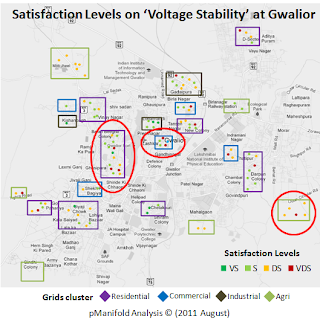
Voltage Stability’ Map of Gwalior city
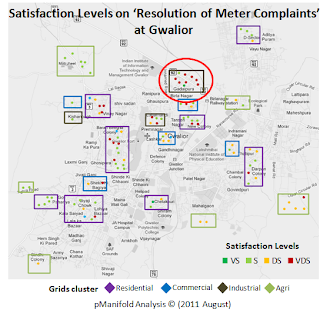
The GIS map indicates the sample respondent’s satisfaction level (in red, orange and green dots) for specific attributes. The consumers are clustered into 4 categories namely Residential, Commercial, Industrial and Agriculture marked by 4 different colored box boundaries. Grids with high relative numbers of Red (Very Dissatisfaction) and Orange (Dissatisfaction) dots should raise a trigger for on-site team to look into causes of dissatisfaction.

  • Voltage stability seems to be problem in Gwalior city with overall more than 50% dissatisfaction. High paying urban consumers including ‘Commercial’ and ‘Residential’ also seems to struggle with the problem. Rural areas outside city limit has aggravated voltage stability issues.
  • Visualizing the results in this GIS form will aid the on-site due-diligence team to go for specific customer segmented pockets and prioritize their time. The ‘voltage stability’ interventions will have major impact on Capex planning for the area.

‘Resolution of Meter Complaints’ Map of Gwalior city:
Industrial consumers are supposedly high return customers for utilities revenue.

  • In Gwalior city, the Industrial belt of Gadaipura seems to suffer with significant ‘customer service’ related problems on ‘Metering Complaint Resolution’ to result into 67% ‘Dissatisfaction’ indicated by red and orange dots.
  • Gwalior has almost 100% Electronic meters for Industrial consumers. The problems if vested into replacing meters then it would result into another huge Capex involvement for the Distribution Franchisee. If problem is more vested into improving processes and protocols for handling customer services and aiding with Meter testing services, then that would have implication on Opex planning for resources, inventory and lab testing.
  • There are more correlation analysis that come as supplements in the CSAT study which indicate customer’s willingness to pay for additional premium services, its sensitivity to ‘Prices’ and ‘Value for Money’ and also its acceptance to privatised distribution. All these together with socio-economic indicators and demographics of the area influence the customer acceptance of the Distribution Franchisee model and initial roll-out of DF operations and hence its associated delays, contingencies and Risks to the Investments (both systemic and idiosyncratic types).

Similar maps and more insights are available for 28+ attributes and can be effectively used to direct on-site due-diligence team, validate results from on-site due-diligence against CSAT results and have more confidence on Capex and Opex estimation. Such comparative information on 9 districts could provide another validation on selection of one district over the other for final bidding. (See pManifold’s earlier blog Distribution Franchisee Attractiveness – Comparison for Madhya Pradesh’s 9 districts)

For individual reports on each region, please get in touch with Rahul Bagdia, +91 956 109 4490, rahul.bagdia@pManifold.com.

Bottom-up innovation: From Micro Grid in Indian villages to Smart Grid for urban Discoms

Bottom-up innovation: From Micro Grid in Indian villages to Smart Grid for urban Discoms

Bringing electricity to rural areas that never may see the grid is a great boon to both people’s quality of life and the region’s economy. Smart Grid Technology or Renewable Microgrid is the topic of this discussion to improve operational and business efficiency of Indian Power Utilities.Grampower, a energy technology company is working on addressing the electrification challenges in India.pManifold recently spoke to Mr. Yashraj Khaitan, Co-founder and CEO of Grampower. The company sets up energy efficient Smart Microgrids in remote areas to provide on-demand, reliable electricity to telecom towers and rural households with an affordable prepaid purchase model. He has been instrumental in raising over USD1.7 million for the company, and leads product and business development and partnership building to scale the company’s operations.The below shared are the author’s personal views and not to be associated with any of his company’s and other associations.

Q1) What is one typical micro grid size/ investment/ returns: # of connections, brief equipment specs, investments, ROI, Payback?

A)

  • A microgrid in an off grid area that is capitally and operationally viable must be 10 kW and above with about 50% of it’s generation capacity dedicated towards guaranteed daytime loads such as telecom towers, shops, cold storages, cottage industries, schools, etc. The remaining 50% needs to be targeted towards domestic loads to provide ‘lifeline power supply’ to consumers during the night. Typically 80-100 families can be served in this configuration and the payback lies between 4-5 years.
  • Equipment specs – On the generation side, we use crystalline solar panels and inverters with maximum power point tracking controllers to maximize power drawn from the solar panels. The storage used is tubular lead acid batteries. The distribution infrastructure is setup by us and comprises cement poles and insulated aluminum cabling till the household level. Each household is given Gram Power’s proprietary Smart Prepaid Meter that we are able to control remotely. These meters ensure 100% payment collection, make consumers aware of their power consumption and allow them to control their monthly expenses, and enable to Gram Power to identify and eliminate any form of meter or distribution line tampering for power theft. Typical, solar generation infrastructure including solar panels, inverters, batteries, structures, etc. is about 60% of system cost. 20% is the smart grid infrastructure including meters, communication, remote monitoring, and payment system. Balance 20% is installation and commissioning expenses.
  • Micro-grids that need to be setup for small hamlets that don’t have much commercial load can be made operationally viable with Gram Power’s Smart Distribution System. Hence for such villages, we work with the State and Central Governments to fund the capital cost of the system. The prepaid meters, theft detection systems, and our payment model ensures that enough revenue is collected so as to keep the plant running for 25 years, i.e., the lifetime of the solar panels.
  • The long term solution however, is grid connected microgrids, which is what we are focusing on now.

Q2) What changes you request to bring scale-up of Generation tied Distribution systems in India – customer behavior, Grid sharing & Tariff regulations, others?

A)

  • Customer behavior will change in the following ways, as already demonstrated in our systems:
    • They will become energy conscious as the meters inform them of their rates of consumption
    • Power consumption will reduce as consumers pay for every unit that is metered
    • This reduction in consumption essentially increases the amount of power available for the DISCOM to sell to industries where revenue is higher
  • I believe the following model should be supported to promote intelligent and sustainable rural electrification:
    • DISCOMs setup DFs in a PPP mode for villages or entire feeders that have over 40% commercial losses and where power supply is erratic
    • The DISCOM and DF jointly fund the replacement of energy meters with Smart Prepaid Meters and theft detection systems in the grid
    • The DISCOM will sell power to the DF at an agreed bulk tariff and the DF will sell power to the consumer at the regulated tariff through multiple retail outlets in the village just as cell phone recharge is sold
    • DF should have the permission that power supply is automatically disconnected to households that tamper the meter or distribution lines or run out of credit
    • Those companies should be selected as DF who are willing to invest in setting up locally installed renewable generation in the village to supplement grid supply and make power supply more reliable
    • The DISCOM will charge the DF for all power consumed at a single point

Q3) What realised efficiency can Micro grids bring to Indian Discoms? What good and immediate market opportunities you see in this space, in addition to rural?

A)

  • A Gram Power Smart Microgrid with solar generation and battery storage for a village of 100 homes is only 30% of the cost of extending the national grid by 15 km. We have demonstrated 100% payment collection and 0% power theft in our systems. Hence the realizable efficiency for DISCOMs in areas where our distribution technology is used on the national grid, can be easily estimated based on what losses DISCOMs are incurring today.
  • For microgrids, I see the following tappable markets:
    • Remote hamlets funded through DDG schemes
    • Urban colonies being privately constructed should have a requirement for have a microgrid to meet its power needs when grid is not available. When grid is available, the microgrid can supplement supply for peak load management
    • Important commercial buildings like airports, data centers, hospitals, etc. should be supported by microgrids
  • Speaking long term, microgrids are the most effective way to combat cyber attacks on our electricity grid. The US is moving ahead in this direction too.

Q4) What unique about Gram power developed Pre-paid smart meters? (Share info on technology, communication protocol, s/w analytics, and field results against some of known challenges with such meter deployment). How does it benchmark with other similar meters in market?

A)

  • Our meter has been developed keeping in mind the end consumer and application. Not as per what existing meters do or standards they comply with. We’re able to do the following with it:
    • Implement a prepaid payment model that does not require internet access for each and every home and that can be easily managed by low skilled local entrepreneurs
    • Provide real time consumption information for each meter with up to 30s intervals in a very reliable manner. We are able to do this because of our proprietary protocol that is light and takes into consideration the village geography and erratic connectivity
    • Automatically create an intelligent local wireless communication network that identifies and stops any kind of meter or distribution line tampering
    • Automatically operate different loads in the area based on their priorities. For example, in a grid-connected microgrid setting, we can program into our meters that when grid supply is not available and there is limited generation, then only the most important loads in the village must be operational
  • With our hardware and software, we provide an end-to-end solution for last mile power distribution management.

Q5) What economics and benefits of your company’s pre-paid meters to lets say a 1Lac customer base private utility for assume 100% adoption? Can you add how current pricing slabs for different consumer categories in your micro grid setup?

A)

  • If the average monthly consumption of power across the 1 Lac households is 150 kWh/month/home, and the commercial losses are over 40%, our meters pay back in less than 1 year. If the private utility or distribution franchisee works with us in a partnership model where the savings are shared over a longer period, the payback can become even quicker
  • Regarding pricing for consumers, our users pay between Rs.150-350/month to run a whole range of household appliances including small water pumps. A generalized capex number for microgrids will be difficult to suggest because the cost depends on a whole range of factors.

Q6) What customer behaviors you have seen supporting and opposing pre-paid meters? How you envisage developing airtel like pre-paid payment retail outlets to encourage wider adoption?

A)

  • Not a single consumer we’ve interacted with has opposed the prepaid meter. What customers don’t want though is the fixed monthly charges. They want a 100% pay-as-you-go model as that gives them full control of their expenses and ensures that they don’t feel cheated when the grid does not supply power to them. This model leads to a lot of energy conservation, which makes a lot of sense in a country like India where power is a scarce resource, and the coal and power sector is heavily subsidized

Q7) What supporting eco-system you think will help young companies like you for quick go-to-market?

A)

  • Openness of DISCOMs to execute pilots without tendering. Access to an advisory panel that can help us understand the nitty gritties of the laws and restrictions in the sector. Access to actual data on real loss levels.

The author can be reached at yashraj@grampower.com for more details. The company website can be viewed at: www.grampower.com

Solar Financial Modeling: 9 points you can’t afford to miss out

Solar Financial Modeling: 9 points you can’t afford to miss out

Any project related to power sector requires a huge amount of investment. Therefore, it is extremely necessary to make financial model and do a thorough analysis for the financial viability of the proposed project prior to any decision regarding the initiation of the project.

Financial Models can be complex and with various elements of Solar projects dependent on policy, financing, resource availability etc. modeling solar projects becomes a significantly complex process.

We, at pManifold, have been working with various project developers, investors and new market entrants involved in grid-scale (both Solar PV and CSP) and rooftop solar projects helping them understand the financials risks and returns of this opportunity. Based on that experience, we have identified 9 points that one should consider while developing a Solar Financial Model. These are,

1. Solar System Specifications

A good solar financial model should capture the technical and geographical information related to solar correctly. The parameters like solar insolation, solar degradation factor over 25 years, cell efficiency, DC-AC rerate factor, etc. plays an important part in defining the project cost and production capacity. This will impact project feasibility and decision making extensively.

2. Project Cost and Subsidies

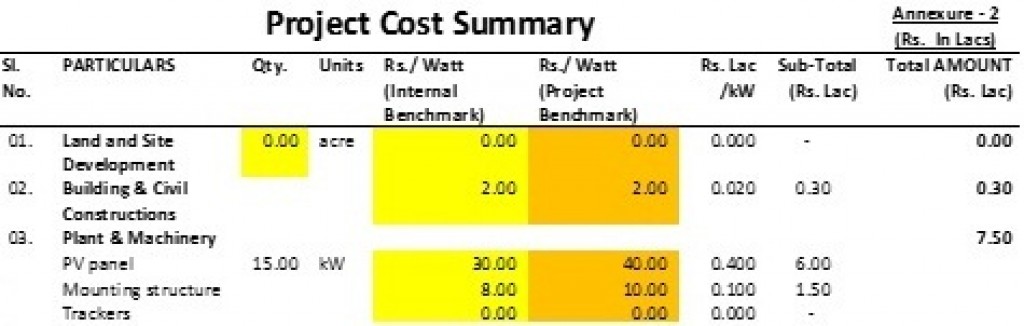
In Solar PV projects, the Solar System is not the only project cost. The model should also account cost towards land, construction, power conditioning and evacuation systems, tracking systems, insurance, project management, pre-financial charges and more.

In recent years, the driving factor for adoption of solar projects is due to the financial support provided by Central and State Government in the form of subsidies. This should also be a part of the financial model.

Following is the snapshot of the project cost summary developed by pManifold’s financial analysts.

3. Financial Structuring

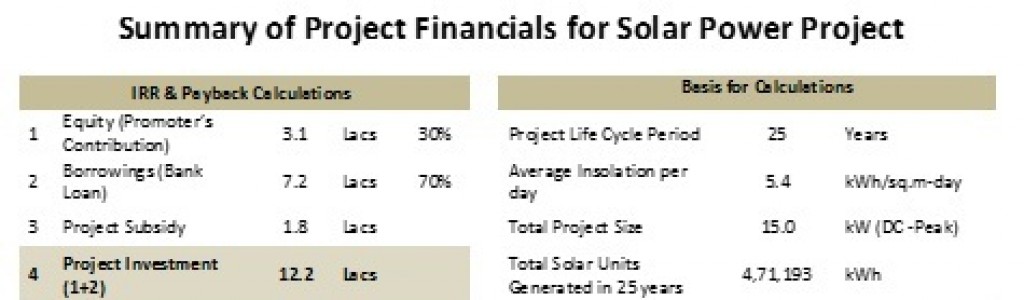
A large Solar PV project requires higher investment and for that the developer needs to opt for various financial products like fixed term loan, working capital loan, bank guarantee.  Hence, a part of the project cost needs to be funded through debt. This debt portion determines the company’s cost of capital and hence the Project IRR and Equity IRR. Financial model should capture debt cost, equity cost, loan period, interest rate and moratorium period.

4. Power Tariff

Power tariff rate is one of the most critical parameters which directly impacts project revenue and payback period. In Solar PV projects, feed in tariff rate and terms and conditions defined as per Power Purchase Agreement (PPA) is vital. The financial model should have the capability to tweak and customize the model to meet power agreements.

In the case of net metering, the consumer category, state and its tariff structure determines the potential saving a consumer can have. As power tariff varies significantly from state to state, hence, the ROI of solar rooftop projects varies across states.

5. Inflation

The typical financial model for Solar project, forecast is generally made for next 25 years. In this period, solar production decreases over time which impacts the project’s top line. In such case, inflation factors like tariff inflation and O&M inflation become key drivers of the model.

6. Accelerated Depreciation Benefit

The biggest advantage solar projects offer to the investor are tax savings. As per Section 32 of Income tax, an investor can claim 80% accelerated depreciation benefit in the first year and remain 20% in a subsequent year. Thus, the solar financial model should account depreciation schedule as per both Income Tax and Companies Act to assess project profitability and tax liability.

7. MAT & Tax Benefits

As per IT Rule, the Solar project developing companies like any other company are liable to pay Minimum Alternative Tax (MAT). A solar financial model should cover calculation of corporate tax, MAT, MAT credit available and MAT credit utilized over 25 years of project life cycle.

8. Scenario Analysis

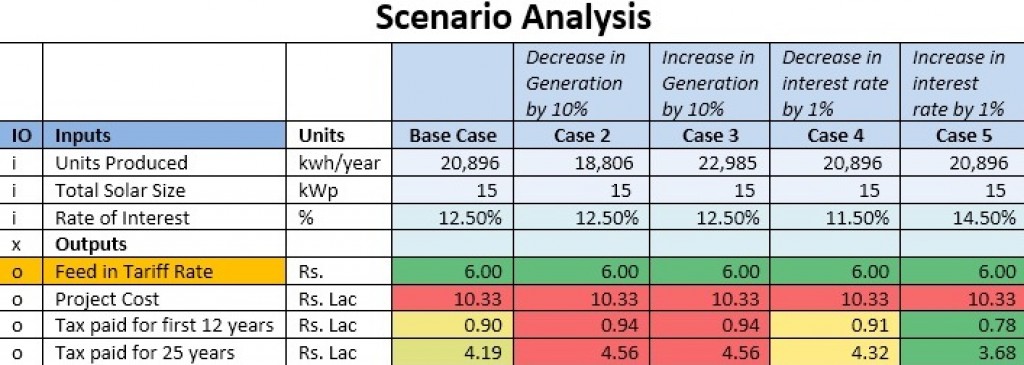
A financial model is robust only if it has the capability to test different business cases simultaneously and then compare the results. A financial model should allow changing multiple input parameters to predict optimistic, pessimistic and average scenario at one go. A tool supported by good visualization and dashboard is a useful feature a management should look for. Here’s a quick snapshot of how we do it.

9. Assumptions

Financial models are built upon a certain set of assumptions. All assumptions should be documented and supported by references to ensure robustness of the model. Vetting by an independent certified professional is also recommended

Market Report on Input based Power Distribution Franchisee Market in India

Market Report on Input based Power Distribution Franchisee Market in India

Brief Summary

Power Distribution Franchisee – evolving Public Private Partnership (PPP) model has picked traction since 2009 after successful demonstration by Torrent Power Ltd. at Bhiwandi, Maharashtra, which got operational in 2007.

The licensee (state utility) appoints a private company on the basis of rationale bidding for distribution of electricity in a specified area for specified years of contract. This Distribution Franchisee model stands midway between licensee and full PPP model and is considered as one of the major energy reforms in power distribution sector that has the potential to turnaround the sector and take electricity to rural areas as well.

Out of the variants available, ‘Input based Distribution Franchisee’ model has recently seen an increase, currently with five cities across India, out of which distribution in three cities was handed over to private companies in 2011. Below shown is the indicative content of the report. Input based Distribution Franchisee, by far, has been mostly used operating model in urban areas.


Investments in this space are driven by the emerging nature of the ‘Input based Distribution Franchisee’ model which promises high returns, has low entry barriers, maintains proximity to end-consumers, involves high Capex with predictable cash flows and easy financial leverage when operating efficiently.

Various experts in power sector are of the opinion that in the coming 5 years, the Distribution Franchisee model is expected to grow manifold, thereby improving the power distribution scenario of the country.

pManifold’s Market Research Report on ‘Input based Power Distribution Franchisee’ in India provides an insights into the current scenario of Power Distribution Franchisee and potential future trends.

Detailed Table of Contents

  1. Terminology / Acronyms
  2. Executive Summary of Power Distribution Franchisee
  3. Power Distribution Scenario in India
    • Energy Value Chain & Leakages
    • Distribution Scenario
    • Why Utilities are making Losses?
    • Need for Reforms – Are the Issues with Utility Solvable?
    • What is the right model of Utility Privatization?
  4. Distribution Franchisee as a Business Model
    • Types of Business Models
    • Distribution Franchisee Segmentation and Applications
    • Why Distribution Franchisee model is attractive over other Privatization models?
  5. Input based Distribution Franchisee Market
    • Key Drivers
    • Distribution Franchisee Projects – Bid Won & Under Implementation
    • Model Uptake – Existing Operators
    • Competitive Landscape Assessment – Existing Operators
    • Future potential: Opportunities & Growth
    • Industry Analysis – Porters 5 Forces Model
  6. Operating Model
    • Stakeholders
    • Stakeholders Analysis
    • Typical Work Flow Map At Distribution Utility
    • Key Challenges With Distribution Franchisee Roll Out
    • Model Risks
  7. Bid Process and RFP Analysis
    • Bid Process
    • Evolution of RFPs
  8. Financial Model – Using Ujjain city as an example
    • Introducing the base Model for Investment Analysis
    • Assumed Capex Distribution
    • Estimated Returns from base model
    • Sensitivity to Input Bid Price
    • Sensitivity to Capex
    • Sensitivity to Opex
    • Sensitivity to Tariff Growth Rate
    • Sensitivity to Load Growth Rate
  9. Past Bid Analysis
    • Connections and Asset information from RFPs
    • Customer Segmentation
    • Winning Bid Comparison
  10. Case Studies
    • Bidding Analytics
    • Bhiwandi, BSES, NDPL
  11. Conclusions
  12. References
  13. Appendix
    • DF Tenders – New and Old Awaiting Decision
    • Suggested States for Distribution Franchisee Model by Shunglu Report
    • Lists of Distribution Companies, SEB’s in India
    • Recent Bid Analysis (Madhya Pradesh – Gwalior, Ujjain and Sagar)
      • MP Bids Quick Characterization
      • DF Attractiveness Matrix
      • Connections and Asset Information from RFPs
      • Customer Segmentation
    • Utility KPIs

Key Highlights of the Report are

  1. Current Market Scenario and Upcoming Opportunities of Distribution Franchisee
  2. Key Functional Roles and Responsibility of Distribution Franchisee Operator
  3. Key Roll Out Challenges for Distribution Franchisee Operator
  4. Case Studies of already existing Operators
  5. Competitive Landscape Assessment (CLA) of Distribution Franchisee Operator
  6. Financial numbers derived using a base financial model for UJJAIN
  7. Sensitivity to different parameters like CAPEX, OPEX, Tariff Rate, Load Growth Rate
  8. Bid process description for distribution franchisees

Key Questions Answered

  1. What is the potential of Distribution Franchisee model?
  2. Which states are looking to adopt the model?
  3. What are the key risks and challenges of the distribution franchisee model?
  4. How is the bid process and how to analyze information in the RFP?
  5. Typical Capex Distribution and Estimated Return?
  6. How is the experience of current distribution franchisee operators?
  7. How is the current competitive landscape in the distribution franchisee space?

Information Sources

  1. Excerpts from industry experts
  2. Opinions and Reviews of various reports in Distribution Franchisee sector
  3. Inputs from Conferences and Workshops
  4. Secondary Research

A Must Buy For

  1. Potential New Entrants in Distribution Franchisee space to get up-to speed on the market
  2. Existing Distribution Franchisee operators to train / update new hires and stay up to date on market trends
  3. Research and Educational Institutes to learn about various aspects of the Distribution Franchisee market
  4. Banks and Financial Institutions to learn about the sector and understand the financial implications of investing in distribution franchisee businesses
  5. Consultants to upgrade their know-how in the distribution franchisee market space

Pricing

Rs. 20,000/- (inclusive of taxes)

(Once payment is received, PDF copy of the report will be shared across email)

Payment
Payable to “pManifold Business Solutions Pvt. Ltd.”
IFSC : HDFC0001786
A/c No. – 17862320000109

Battery Recycling: Market Size, Recyclable Components, and Potential End-Use Applications

Introduction

With the projected demand for Li-ion batteries set to reach 235 gigawatt hours (GWh) by 2030, recycling has become a focal point. This emphasis aims to ensure a sustainable supply of raw materials for cells and decrease reliance on imported resources. Extracting materials through recycling Li-ion batteries is more sustainable than mining. Moreover, the limited availability of key battery materials like lithium, nickel, and cobalt further strengthens the case for recycling.

It was found that recycling has the potential to reduce primary demand compared to total demand in 2040, by approximately 25% for lithium, 35% for cobalt and nickel, and 55% for copper, based on projected demand. This creates an opportunity to significantly reduce the demand for new mining.[1]

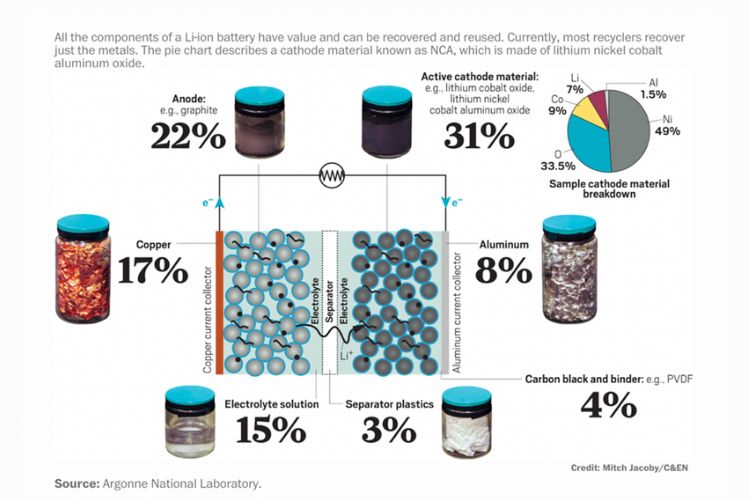
Lithium Ion Batteries (LIBs) have multiple components that contain valuable metals and non-metallic materials that can be recovered during recycling. The materials recovered could be used to make new batteries, lowering manufacturing costs. Currently, those materials account for more than half of a battery’s cost. In many cases, batteries—especially in vehicles­—are retired from their first use but can be repurposed for secondary use, such as stationary storage. The prices of two common cathode metals, cobalt, and nickel, the most expensive components, have fluctuated substantially in recent years.

Market size: Global vs India

The global battery recycling market is valued at USD 26.9 billion in 2023 and is projected to reach USD 54.3 billion by 2030, growing at 10% CAGR during the forecast period.[2]

The figure above illustrates the cumulative demand projections from 2022-30 for lithium-ion batteries in India and the corresponding recycling volumes.

It is estimated that the cumulative potential of lithium-ion batteries in India from 2022-30 across all segments will be around 600 GWh (base case) and the recycling volume coming from the deployment of these batteries will be 128 GWh by 2030. Out of which almost 59 GWh will be from the electric vehicles segment alone.

Components of a Lithium-ion battery that can be recycled

  • Ion cells: These are the primary energy storage components of the battery. Recycling involves extracting materials like lithium, cobalt, nickel, and other metals from these cells. During the Preparation stage of recycling, the battery management system (BMS) containing the Li-ion cells is separated from the battery. Through further dismantling stages and treatments, various materials are recovered from the cells.
  • Cathode: Typically, the cathode contains materials like lithium cobalt oxide (LiCoO2), lithium manganese oxide (LiMn2O4), lithium iron phosphate (LiFePO4), or other metal oxides. It undergoes various steps during recycling including Washing, Filtering, Pressing and Drying. Consequently, the materials of the cathode can be utilised as active material for new cells.
  • Anode: Often made of graphite or other carbon-based materials. Recovering graphite and other materials from the anode is part of the recycling process. Anode scrap that comprises critical materials such as graphite and valuable Cu can be recycled and reintegrated into the battery supply chain. Recovering graphite from anode scraps can provide battery-grade graphite without energy-intensive purification processes and can help support a domestic supply chain. Like the cathode, the anode also undergoes similar steps (Washing, Filtering, Pressing and Drying) during recycling which allow the graphite to be recovered.
  • Electrolyte: Generally, the electrolyte is volatile and cannot be recycled. However, in certain frontier technologies for recycling such as Hydrometallurgy, electrolytes can be recycled as well. Recycling electrolytes requires the use of activated carbons which absorb the electrolyte vapours. There may also be the need for an inert gas environment due to the volatile nature of electrolytes.
  • Separator: A porous membrane that separates the cathode and anode, typically made of materials like polyethene or polypropylene. Removal of the separator is carried out during the Pre-treatment phase of recycling when the cells of the LIBs are Disassembled. The separator can then be recycled and reused.
  • Metal Foils: Thin foils of copper and aluminium are used as current collectors in the anode and cathode, respectively. They are separated from the anode and cathode during the process of Washing. These foils can then be recycled and the extracted Copper and Aluminium are used in the electrical industry.
  • Plastic and Metal casings: The outer casing of the battery is often made of plastic and/or metal. Both materials can be recycled. The casing is removed during the Preparation phase of the recycling process itself when the battery is discharged and dismantled.
  • Bus Bars and Terminals: These conductive components are used to connect the battery to electronic devices. They are often made of metals like copper or aluminium, which can be recycled. Like plastic and metal casings, the bus bars and terminals are separated during the Discharging and Dismantling (Preparation) phases of recycling.

The following chart shows the summary of materials that can be recovered through different recycling processes.

Use Cases of Recycled Battery

  • Usage in grid-connected solar panels: batteries that undergo damage during transportation and manufacturing cannot be used for their primary purpose i.e., EVs. However, they can be refurbished and recycled to yield battery packs to be used alongside solar panels
  • Usage in power banks: Laptop batteries can be repurposed and used for power bank applications.
  • Other industrially valuable materials :
    • Copper and aluminum extracted from batteries’ busbars find use in the electrical components industry
    • Nickel, Cobalt & Manganese are industrially valuable metals finding uses in the electrical, automotive, and housing industries.
    • Plastic extracted from the casings of the batteries also finds various industrial applications

References

More blogs on batteries and recycling-

Why Africa needs to focus on battery recyclingCan Metal-Air Batteries have the potential to revolutionise the automotive industry?

Eco-Farm Innovation: PURE Appliances Drive Sustainable Agriculture in India

Introduction

India, as an agrarian nation, is witnessing a transformative shift in its agricultural landscape with the integration of renewable energy and productive use appliances. In the pursuit of sustainable practices, the adoption of clean energy solutions plays a pivotal role in enhancing agricultural productivity, reducing dependency on traditional power sources, and mitigating environmental impact. In this blog let us explore the significant impact of renewables and productive use appliances on sustainable agriculture in India, supported by compelling statistics.

India’s commitment to renewable energy is evident in its ambitious targets and policies. According to recent statistics, India is among the top countries globally in terms of renewable energy capacity. As of October 2023, the country has 178.98 GW of installed renewable energy capacity, comprising solar, wind, and other sources. This shift towards clean energy aligns with the goal of ensuring energy security and minimizing the carbon footprint associated with traditional agricultural practices.

The integration of productive use appliances, powered by renewable energy, brings about a paradigm shift in agriculture. The key PURE appliances including solar pumps and solar cold storage units are becoming instrumental in enhancing productivity, reducing post-harvest losses, and improving overall efficiency in the agricultural value chain.

Solar Water Pumps: Harnessing abundant sunlight, solar water pumps offer a cost-effective and eco-friendly alternative to traditional energy sources. As per recent statistics 5.5. million SWPs are installed in India, benefiting thousands of farmers and enhancing agricultural productivity. This transformative shift not only reduces dependence on conventional energy but also positively impacts the livelihoods of farmers, particularly in remote areas with limited access to power infrastructure.

Figure 1. SWPs installed by State in India (Source: Statista)

Solar Cold Storage: As per FAO, almost 40% of the fresh fruits and vegetables worth 8.3 billion are lost as post-harvest losses, a longstanding challenge in Indian agriculture. The implementation of solar-powered cold storage units emerges as a promising solution as it not only ensures better income for farmers but also contributes to food security on a larger scale. However, certain challenges like high cost and market linkages need to be addressed to achieve their full potential.

“We urgently need to accelerate the build-up of solar energy, especially in developing countries and in applications that influence the daily lives of those without access to reliable energy – such as getting electricity from solar mini-grids, powering agricultural pumps, and running cold storages.”Director General of International Solar Alliance, Dr. Ajay Mathur at the 6th Session of ISA at New Delhi

The statistics presented underscore the transformative potential of renewables and productive use appliances in Indian agriculture. As the nation strives for sustainable development, the continued adoption of clean energy solutions holds the key to ensuring food security, increasing farmers’ income, and mitigating the environmental impact of traditional farming practices. The power of renewables is not just in generating electricity; it’s in cultivating a greener, more sustainable future for India’s agriculture.

Why Clean Cooking needs to be a Top Priority

Clean cooking, despite its significance, is often overlooked as a policy priority. It must take centre stage on the global energy-climate-development agenda for reasons that go beyond convenience or preference. One third of the global population which is approximately 2.4 billion people worldwide remain without access to clean cooking. In India, nearly 60 percent of the population use traditional cookstoves. The issue of clean cooking is one of mammoth proportions.Unfortunately, millions of people continue to die prematurely each year from household air pollution, which is produced by cooking with inefficient stoves and devices paired with wood, coal, cow dung, crop waste or kerosene.

Clean cooking is an urgent matter of life, health, and environmental preservation. The harsh reality is that traditional cooking methods, relying heavily on fossil fuels and biomass, perpetuate a silent crisis that affects millions, especially women and children, around the world.

At the centre of this narrative lies the undeniable truth of its impact that it has on human lives. Every day, millions of households, primarily in developing nations, endure the burden of archaic cooking practices, where smoky open fires and rudimentary stoves fill their homes with toxic fumes. The World Health Organization estimates that nearly four million people die prematurely due to illnesses caused by indoor air pollution, with women and children being the most vulnerable victims. It is an alarming echo of injustice, a reality that demands immediate attention and substantial solutions. That’s more than the death toll from malaria, tuberculosis, and HIV/AIDS combined. The smoke generated by open fireseeps deep into the lungs, causing respiratory illnesses, lung diseases, and even cancer. It is a scourge that traps communities in a cycle of poverty, perpetuating inequality, and stifling development.

Moreover, traditional cooking methods are driving environmental devastation, amplifying the global climate crisis. As households burn wood and charcoal for cooking, deforestation accelerates, resulting in a loss of vital carbon sinks and increased carbon emissions. This deforestation contributes to climate change, contributing to rising temperatures, erratic weather patterns, and more frequent natural disasters. In developed countries, almost all households have access to clean cooking – electrical or LPG run gas stoves. However, in many developing countries, people cook on open fires and with inefficient stoves that run on wood, dung, or other polluting solid fuels.  In numerous communities, women bear the greatest burden of household duties, including the adverse social and health consequences of lacking access to clean cooking. The lack of clean cooking is also an issue in remote communities that are not well connected to the national energy grid in middle-income countries.

However, hope shines through amidst the darkness. The adoption of clean cooking technologies offers a ray of light that can transform lives, safeguard health, and protect the environment. Clean cooking is a way of cooking which uses sustainable fuels and modern cooking technologies that allows people to cook and heat their homes in a way that does not harm their health and controls the immediate effects on their environment. By replacing polluting fuels with cleaner alternatives such as LPG, electric stoves, or solar-powered cookers, it is possible to reduce indoor air pollution and save millions from the clutches of respiratory diseases. Clean cooking is not just a luxury; it is a basic human right that can empower the women by freeing up their time that can be efficiently utilised for education, revenue-generating activities, rest, or leisure.Enabling them to escape the shackles of energy poverty.

Moreover, embracing clean cooking solutions is a key steppingstone towards achieving the United Nations Sustainable Development Goals. It is a pathway to empowerment, offering opportunities for women to participate in education, entrepreneurship, and the workforce. As women become agents of change, the ripple effects will resonate through entire communities, fostering inclusive growth and social progress. However, taking clean cooking to the forefront of our global priorities requires collaborative efforts from governments, industries, and civil society. We must invest in research and innovation to make clean cooking technologies affordable and accessible for all, regardless of their economic status. Governments should offer incentives and create supportive policies that spur the adoption of clean cooking solutions. And we, as consumers, need to make conscious choices that support sustainability and human well-being.

Clean cooking is not just a matter of convenience; it is a moral imperative. As we strive for a sustainable and equitable future, let us place clean cooking at the heart of our energy, climate, and development agendas. By doing so, we can create a symphony of change that resonates with hope, health, and harmony, for generations to come.

Types of Emissions and Building Blocks of Net-Zero Transformation

Global mean temperatures are projected to increase by 3.7 to 4.8°C, which would lead to catastrophic and irreversible effects on humanity and Earth’s ecosystems. In December 2015, the first global agreement of its kind was made when governments committed to maintaining the global temperature within this 2°C limit, to keep the temperature rise to 1.5°C – the Paris Agreement. It is a legally binding international treaty that sets long-term goals to guide all nations:

  • Substantially reduce global GHG emissions to limit the global temperature increase in this century to 2 degrees Celsius along with efforts to limit the increase even further to 1.5 degrees.
  • Review countries’ commitments every five years
  • Provide financing to developing countries to mitigate climate change

Industrial emissions are a major contributor to the global emissions landscape. A substantial portion of our electricity continues to be generated through the burning of coal, oil, or gas. These practices release potent greenhouse gases into the atmosphere, creating a heat-trapping blanket that contributes to global warming. Sectors such as manufacturing, food processing, mining, and construction further amplify emissions through various processes, including on-site combustion of fossil fuels for heat and power, non-energy use of fossil fuels, and chemical procedures involved in iron, steel, and cement production.

Businesses must reduce their environmental impact. One of the most significant ways to do this is by reducing their carbon footprint, and this starts with monitoring carbon emissions. But what are emission scopes 1, 2 & 3 (as defined by the GHG Protocol)

Often, emissions along the value chain represent the biggest GHG impact. For decades, companies have missed significant opportunities for improvement.

What is Net Zero?

Net zero means becoming carbon neutral. In simple words, net zero means cutting greenhouse gas emissions to as close to zero as possible, with any remaining emissions re-absorbed from the atmosphere, by oceans and forests for instance.

Governments have the biggest responsibility in the transition to net-zero emissions by mid-century. But businesses, investors, cities, states, and regions also need to live up to their net-zero promises.

Scope 1, 2 and 3 emissions

The term first appeared in the Green House Gas Protocol of 2001; Scopes are the basis for mandatory GHG reporting. Scopes provide a framework for categorizing and reporting GHG emissions, helping organizations assess and disclose their environmental impact. The emissions are broadly classified into 3 categories.

Scope 1 emissions— The Green House Gas (GHG) emissions that a company makes directly.

Scope 2 emissions — These are the indirect emissions that a company makes. For example – when the electricity or energy it buys for heating and cooling buildings, is being produced on its behalf.  An organisation can source renewable electricity, renewable gas, or electrify its heat demand or transition to electric vehicles.

Scope 3 emissions — This category encompasses all emissions linked not to the company directly, but rather those for which the organization bears indirect responsibility along its value chain. These emissions stem from various sources, such as purchasing products from suppliers and the emissions resulting from customers’ use of the company’s products. In terms of emissions, Scope 3 emissions account for the largest portion.

Companies will normally have the source data needed to convert direct purchases of gas and electricity into a value in tonnes of GHGs. This information may sit with procurement, finance, estate management, or in sustainability functions.

Scope 1 and 2 are most within an organisation’s control and in some cases the solution for net zero is available.

For numerous businesses, Scope 3 emissions make up more than 70 per cent of their total carbon footprint. Take, for instance, an organization involved in manufacturing products; substantial carbon emissions arise from the extraction, manufacturing, and processing of raw materials.

To address these emissions, you can consider collaborating with current suppliers to find solutions that reduce their impact or explore potential changes in your supply chain. However, it’s essential to recognize that suppliers also play a significant role in emission reduction through their own purchasing decisions and product design.

While defining what constitutes net-zero ambition can be complex, businesses striving for best practices will commit to addressing Scope 3 emissions in their plans. A great starting point is mapping your emissions footprint, analysing the scale and the degree of control you have over each source. Prioritizing emissions hotspots that are within your reach will be a practical approach to tackling them effectively.

Building blocks to achieving net-zero

The recent surge in corporate net zero commitments is a vital and promising development, but there is still much more to do. Out of the close to 300 companies with public net zero pledges today, many commitments remain vague in how value chain emissions will be tackled, and downstream emissions from products, services, and investments. These are the largest sources of emissions for most companies (referred to as Scope 3 emissions) and failure to address these emissions will fail to achieve a net zero economy. Furthermore, companies are still at the very early stages of embedding net zero into business and supply chain strategy and transformation efforts. As net-zero requires full value chain transformation, companies cannot act alone, and success will be dependent on a common and accelerated path forward.

Critically, the end goal is not just net zero, but a thriving, socially just, net zero future. Marginalised groups and low-income communities often bear the greatest impacts of climate change and there will be transitional implications for workers, sectors, communities, and regions that will need to be managed. Companies must help enable the conditions needed to achieve effective, just, and sustainable climate solutions for people of all gender, race, and skills. Examples include proactively driving inclusivity and social impact of new net zero products and solutions, upskilling and reskilling to enable an inclusive workforce transition, upskilling and broader support for SME partners and suppliers, integration of social metrics into reporting and disclosure around net zero, and incorporating inclusion and a “just transition” into policy advocacy efforts.

For companies to deliver their net zero commitments, they will need to undertake end-to-end business transformation. This includes understanding the implications of net zero for a company’s growth strategy and operating model and embedding net zero across all business functions from governance, to supply chains, to finance and innovation.

Building blocks for corporate net zero transformation. This ‘blueprint’ seeks to help companies move from willingness to implementation: This blog briefly defines the checklist of critical actions needed to undertake to transform to net zero and explains why these actions are important.

Building ambition – It’s of utmost importance to ensurethat your company has the intention of becoming carbon neutral and to make sure your net-zero targets are aligned with global ambition. The net-zero vision should set out timeframes and accountability, how the company intends to decarbonize emissions from its operations and value chain, its approach too hard to eliminate residual emissions through offsetting, and an enabling investment strategy.

Strategy across the supply chain – To achieve net-zero emissions, companies must develop a comprehensive strategy that addresses emissions throughout their entire supply chain. This means not only focusing on their direct operations (Scope 1 emissions) and energy consumption (Scope 2 emissions) but also tackling emissions associated with their suppliers, customers, and other partners. A well-defined strategy across the supply chain is important to identify and to help mitigate the largest sources of emissions ensuring a holistic approach to achieving net-zero.

Cost effective and sustainable innovation –Net-zero transformation requires innovative solutions that are both environmentally sustainable and economically viable. Companies need to invest in research and development to drive sustainable innovation, finding ways to reduce emissions without compromising the quality and competitiveness of their products and services. Embracing green technologies, renewable energy, and resource-efficient processes will be essential indriving meaningful progress towards the goal.

Engagement and transparent – Open communication and engagement with stakeholders are vital for successful net-zero implementation. Companies should involve employees, customers, investors, suppliers, and local communities in their net-zero journey. Transparent reporting on emissions reduction progress and sharing climate-related data will build trust and accountability. Moreover, engaging with external organizations and industry peers can foster collaboration and shared learning, accelerating the transition to a net-zero economy.

In house capability/ capacity – Achieving net-zero requires skilled professionals who can lead and execute the transformation initiatives effortlessly within the company. Building in-house capability and capacity through training and upskilling employees is crucial to drive change successfully. Companies should invest in developing expertise in sustainability, carbon accounting, and other relevant fields, enabling them to make informed decisions and implement sustainable practices across all business functions.

While these building blocks serve as a starting point for companies to begin their journey towards net-zero, it’s important to recognise that each company’s path will be unique. Flexibility, adaptability, and continuous improvement are essential as companies navigate the complexities of the net-zero transition. By taking decisive actions across their supply chain, fostering innovation, being transparent, and investing in their workforce, companies can contribute to a socially just, thriving, net-zero future for all.

Cold Chain Infrastructure in Kenya: Challenges and Potential Interventions

Kenya’s domestic market is more than 56 million people and is considered one of East Africa’s core business and logistics hubs. Agriculture is the backbone of Kenya’s economy and central to the country’s development strategy. It accounts for 31.5% of Kenya’s GDP and employs 38% of the population.Despite this, food insecurity persists, with 4 million people facing extreme shortages during the 2022 drought. Limited access to markets and poor post-harvest practices contribute to 40% of food waste. The rising population, climate change, and disruptions in food supply chains pose further challenges, making an effective Cold Chain Infrastructure (CCI) crucial to mitigate many of these challenges.

A well-designed and developed cold chain can prevent food losses and reduce greenhouse gas (GHG) emissions related to food waste. Cold chains also ensure food security by reducing food price inflation, buffering the food supply, and overcoming seasonal shortfalls. This buffering mechanism dampens the price fluctuations that typically put vulnerable communities at risk of poverty and hunger and better supports the growth of farmers’ incomes.

Challenges faced by Kenya in growing CCI:

  • Limited technical skills to provide after-sales services.
  • Affordability – Cooling interventions need to be affordable and add value for farmers operating on thin margins. Usage-based payment models like CaaS, group ownership, and lease-to-own (PAYGO) can help reduce adoption barriers.
  • Consumer awareness: There is limited awareness, especially among rural smallholder farmers, of the benefits of using cold chain solutions.
  • Market dynamics and maturity: In Kenya, most food production is consumed within the country, and informal channels are common for selling products. For instance, over 99% of meat and 96% of fruits and vegetables are consumed locally through farmgate or domestic markets. Unlike export markets, domestic markets typically lack strict regulations and standards that require the use of a cold chain. While some players may use cold chain methods to extend produce shelf life, cooling is not mandatory.
  • Lack of investment: Access to affordable debt and equity for service providers is needed, but the sector is still relatively young, and the financial needs are diverse. More established companies are ready for long-term patient capital and concessional loans. However, there is still a need for grants and programme support for market development activities
  • Weak transportation infrastructure: Poor road conditions and traffic congestion increase travel time and increase the risk of perishable products becoming damaged and spoiled. In addition, poor roads and infrastructure can damage refrigerated trucks/vehicles, resulting in the leakage of high GWP refrigerants
  • Inconsistent policies: Tariff regimes are inconsistent, and agro-based products have a favourable import duty, but it’s unclear if this is applicable to all value chains (e.g., meat and fish) and for components. The lack of national standards for energy performance and food quality also inhibits market growth
  • Availability of equipment and suppliers: The development of a clean cold chain will have to be preceded by policies that encourage the import of cold-chain equipment in the country by local firms or even incentivise foreign firms to set up subsidiaries. That means that an entire industry will have to be developed or at least nurtured, including local manufacturers being encouraged/incentivised to undertake production.

Key recommendations for carious stakeholder Groups in Kenya’s CCI Sector

xr:d:DAFvn3wv324:2,j:29677603515831815,t:23092707

Challenges that Inhibit the Uptake of CCI Solutions

Several factors inhibit the adoption of CCI technologies on the side of both users and manufacturers. These challenges are as follows:

Financing challenges: Financing is challenging for enterprises/service providers and consumers/beneficiaries. Limited financing is available to enterprises creating and providing CCI, as well as to end consumers looking to acquire these technologies

Technological challenges: While technological innovation has been seen in the CCI sector, several challenges still exist. These include the availability of technicians required to manage installation and after-sales services, both critical to adopting new technologies. Meanwhile, poor-quality products negatively impact how customers view the entire sector, while limited local manufacturing capacity hinders local job creation and leads to import substitution.

Market and operational challenges: These include policy gaps regarding supply-side and demand-side incentives at the national and county levels. The immaturity of the market limits economies of scale regarding sector consolidation, bulk procurement, and the ability of individual companies to absorb commercial funding. As a result, most value chains remain primarily informal.

User challenges: The most common user-related challenge is limited familiarity with CCI solutions, including key product features like energy efficiency, usage and maintenance, and temperature control. Since most smallholder farmers are rain-dependent, the seasonality of their produce also impacts the utilisation rates of CCI assets, especially those using CaaS models. This has long-term impacts on technology providers’ margins, leading to more extended payback periods.

Potential Interventions to Increase the Uptake of CCI Solutions

Various strategies could be adopted to increase the uptake of CCI solutions in the country and to ensure they scale by 2030. Some of these strategies are as follows:

Increase patient capital in the sector: To promote CCI adoption, the sector requires more patient and catalytic capital, including long-term equity from commercial investors and grant financing. Targeted recipients are companies involved in CCI solutions and MFIs providing consumer financing for farmers.

  1. A first loss default guarantee programme in which a donor agrees to deploy grant capital as part of the investment to reduce losses in case the ROI is negative, thus catalysing participation from more commercial co-investors.
  2. Results-based or performance-based financing, where an investor or financier provides patient capital to achieve measurable impact; this could be the amount of food the CCI solution “saves” from wastage.
  3. Public Private Partnerships (PPPs) include a mechanism whereby the government provides financing for an asset while the private sector player is responsible for its repair, maintenance, and the technical support required to ensure sustainability.

Re-evaluate the tax regime and reduce prices: The tax regime for CCI parts and components significantly raises their prices, accounting for almost 40% of production costs. This high cost hinders CCI adoption, particularly at the initial stage. Re-evaluating the tax system is crucial, and efforts should be made to provide tax subsidies through multistakeholder taskforces. This will lead to more affordable CCI solutions, incentivizing their uptake in the market.

Increase donor programmes that promote market development activities: Increase donor-sponsored programs to promote market development of CCI assets. Focus on building technical skills, local manufacturing, and after-sales services. Educate farmers and consumers to boost adoption. Fund successful pilots to reduce risk perception among stakeholders.

Increase processing and exports: To promote CCI technologies, Kenya should focus on increasing local food processing and exports, while adhering to Global Agricultural Practices, including cold chain requirements, to meet quality standards for export markets.

To promote CCI technologies, Kenya needs dedicated policy support and full implementation. Specific regulations can cover optimum produce temperature, pricing, and certified technical providers. Publicly funded capacity building for cooling engineers can enhance skills. Tailored recommendations for different markets can further boost CCI adoption.

For the household refrigerator market:

  • Resolve PAYG compatibility, appropriate system controls and improved reliability.
  • Develop financing solutions through micro-finance and PAYG contracts in mini-grid markets.
  • Provide after-sales technical support and the means to deliver appliances to remote regions.

For the small commercial refrigerator market:

  • Encourage development of appliances for target markets and collaborate with regional business associations and SACCOs.
  • Design “solar stalls,” soft drink coolers, and portable coolers for farmers and producers, emphasizing reliability.
  • Develop financial case templates and suitable financing packages for entrepreneurs.
  • Ensure after-sales technical support for sustained operations.

For the commercial ice-maker market:

  • Encourage targeted appliance development and collaboration with farmers’ cooperatives.
  • Focus on small agricultural, meat, fish, and dairy storage and transportation systems.
  • Provide financial case templates and suitable financing options.
  • Establish after-sales technical support.

Although use cases vary across value chains, overall, CCI in Kenya is underdeveloped in the agricultural sector, resulting in significant quantities of food lost yearly due to a lack of cold chain technology. CCI manufacturers and distributors must ensure that their products correspond to the needs and capacities of the first-mile market segment, particularly concerning the power sources they use and the payment models they adopt. In supporting innovations in cold chain technology, there should be a particular focus on products powered by renewable energy.

However, solving this problem requires more than the proper technology; a system-wide approach combining education, financing, and policy changes is needed to fully realise the cold chain market’s potential and for Kenyans to reap its benefits eventually.

Access the full report here

Global Energy Transition: Investment Required and Potential Sources of Financing

Global energy-related greenhouse gas (GHG) emissions remain a significant threat to the climate due to their due to their magnitude and longevity. As per International Energy Agency (IEA) analysis[1], the total energy emissions increased to an all-time high of 41.3 Gt CO2-eq as shown in Figure 1.

Figure 1. Global Energy GHG Emissions

The emissions from energy combustion and industrial processes accounted for nearly 89% of emissions in 2022.Additionally, methane emissions from energy combustion, leaks and venting contributed another10%. These emissions present a stark picture of the climate change situation, as evidenced by recent extreme weather events observed worldwide (e.g., heat waves, floods, droughts, wildfires, etc.).According to the IEA’s World Energy Outlook 2022 analysis[1], global greenhouse gas (GHG) emissions are on track for a significant increase if investments in climate change mitigation are reduced and strict policies are not implemented. The projections indicate that energy related GHG emissions could surpass 55 GtCO2-eqby 2050.

This situation underscores the pressing need for immediate investment in energy transition technologies, encompassing both the supply side (renewable energy, nuclear power, energy storage, hydrogen, etc.) and the demand side (e-mobility, electrified heat, etc.). Historically, countries have predominantly directed significant investments towards fossil fuels to bolster energy security. However, energy transition investments matched fossil fuel investments for the first time in 2022, reaching USD 1.1 trillion, as depicted in theFigure 2. This represents a notable increase of USD 261 billion from the previous year.The shift in investment towards cleanenergy is a historic change that is unlikelyto be reversed, as low-carbon industriescontinue to grow.

[1]CO2 Emissions in 2022, IEA

[2]World Energy Outlook 2022, IEA

[3]Energy Transition Investment Trends 2023, BNEF

Figure 2. Investment Comparison: Energy Transition (ETI) vs. Fossil Fuels (FF)

Figure 3. Energy CO2Emission Reductions by 2050 in 1.5°C Scenario

It is important to note that the current investment levels, although encouraging, are insufficient to propel towards the ambitious goals of1.5°C pathway.To set a course on a 1.5°C pathway, the energy transition urgently needs to accelerate; therefore, a holistic, multi-faceted approach is necessary.International Renewable Energy Agency (IRENA) analysis shows that a combination of renewables (both power and end use, electrification and fuels such as hydrogen) and energy efficiency, can provide 80% of the CO2 reductions needed to align the world on a 1.5°C pathway, as shown in Figure 3.To achieve this target, it is estimated that an annual average investment of USD 4.4 trillion will be required, which is equivalent to about 5% of global gross domestic product (GDP).

Potential sources of this funds

Climate finance investments have seen contributions from both public and private sources. Public sources, such as governments themselves; a combination of national Development Financial Institutions (DFIs), multilateral and bilateral DFIs; state-owned financial institutions; and others have played a significant role by providing grants and debt financing. Similarly, private sources, including commercial banks and corporations, have been at the forefront of financing climate-related initiatives. Some of the potential sources are explained below:

  • Many governments are establishing the banks as National Development Financial Institutions (DFIs) that focuses on raising and investing fundsacross different industry sectors of the country. This is becoming governments most important financial institution to support and mobilise capital to develop productive investments. Many countries like Germany (kfW), Singapore (DBS), Brazil (BNDES), India (SIDBI), South Africa (DBSA), etc. has their own DFIs established and are promoting and supports the development of innovation, a green economy and sustainable projects.
  • Green Bondsare a form of debt instrument and were developed in 2008 in response to growing concern about climate change and sustainability. When an entity issues a green bond, it is essentially borrowing money from investors who purchase the bond. The issuer agrees to pay back the principal amount of the bond along with periodic interest payments over a specified period of time.As of January 2023, green bonds have raised $2.5 trillion globally[1] to support green and sustainable projects.The World Bank, known for issuing the inaugural green bond in 2008, has continued its leadership in this field. To date, they have issued over 200 green bonds in 25 currencies, making significant contributions to the development of sustainable finance. Their efforts have also resulted in the establishment of the Green Bond Principles (GBP), which have emerged as international best practices for transparency and disclosure in the green bond market. [4]Low-cost Finance for the Energy Transition, IRENA 2023
  • International financial entities likeGlobal Environment Facility (GEF), Green Climate Fund (GCF), etc.have a primary goal of providing support for global environmental and climate-related projects. These entities place a strong emphasis on country ownership and alignment with national priorities and plans. They support projects and programs that include technical assistance and investments (typically for pilot implementation), which are in line with recipient countries’ national climate strategies and objectives. These funds are intended to mobilize additional resources and leverage investments from various stakeholders within the respective countries. So far, the GEF has disbursed over $22 billion in grants and blended finance, while also mobilizing an additional $120 billion in co-financing for over 5,000 national and regional projects[2]. Likewise, GCF has raised USD 10.3 billion equivalent as of July 2020[3].
  • Innovative financing tools such ‘debt-for-climate-swaps’ in which international creditors will agree to reduce debt, either by converting it into local currency, lowering the interest rate, writing off some of the debt, or through a combination of all three. The debtor will then redirect the saved money towards initiatives aimed at increasing climate resilience, lowering GHG emissions or others.
  • The expansion of blended finance refers to the increasing use and promotion of innovative financing mechanisms that combine public and private resources to address development challenges and mobilize additional investment. It can play an important role in derisking investments, attracting private capital, etc. to projects and initiatives that contribute to sustainable development.Public resources alone are often insufficient to address the vast financing needs required for sustainable development. By blending public and private resources, governments, development finance institutions, and other stakeholders can leverage the strengths of both sectors.

The above discussion highlights the importance of investments in energy transition technologies. Countries need to not only increase their own investments but also facilitate greater financing in developing and emerging economies. It is essential to recognize that relying on just a few financing solutions will not be sufficient. Instead, countries must explore multiple financing options to create economies of scale for emerging energy transition technologies.

[5]Green Bond, World Bank

[6]GEF funds

[7]GCF Funds