

Leveraging Customer Perspective for a stronger Onsite, Local Due-Diligence in Pre-Bid phase

Leveraging Customer Perspective for a stronger Onsite, Local Due-Diligence in Pre-Bid phase

Consumer centricity has returned or finding its way into most of the businesses in emerging economy like India. Consumer ‘needs’ and ‘willingness to pay’ for good quality products and services is driving a whole new era of competition. It first started in luxury industry with high economy class consumers, where there was established ‘willingness to pay’ for better services and then slowly start penetrating into other sectors and also lower economic classes and raising their ‘aspirations’. These phenomenon is creating a whole new market and driving innovations from bottom-to-top. The aviation, telecom (mobile and internet) and various other industries has seen this Consumer cycle. India’s Power Distribution sector has begin its journey of enabling ‘diversity’ and adding more ‘choices’ to its electricity customers. Like other sectors, the cycle first began with high volume or developed consumers through ‘top-down’ innovation like ‘Open Access’ and now we have started hearing of ‘bottom-up’ innovation like ‘Pre-paid metering’, ‘Net-metering’ and ‘Distributed Generation based Distributed Franchisee (DGBDF)’.

The to-be leaders in the Power Distribution space will soon have to learn this change that is sweeping the country and include the end-consumers into the designing and co-creation of solutions and soon also accept equally the urban and rural consumer mix to drive bottom-top innovation. The new saga is to forgo or overcome references like BPL, APL, agri (or rural), tariff subsidies and free power, but start innovating scalable ventures to meet the needs and challenge. Grameen Micro Financing model first innovated at Bangladesh is now widely accepted and MFI is a very big and fast growing industry with strong developing linkages to the main streamline capital industry through various derivatives.Remember this all begins with a 3 letter word – KYC i.e. ‘Know Your Customer’. Its an important phase after you are done with Market Analysis through KYM i.e. ‘Know Your Markets’. KYC should be a pre-cursor for high confidence KYI i.e. ‘Know Your Investments’.

Our recent discussions with prospective bidders for Distribution Franchisee tenders in 9 districts of Madhya Pradesh (MP) was full of encouragement for our recently conducted ‘Customer Satisfaction study for Electric Utilities’ in those regions.

  • Most companies easily perceived our work’s importance to operating  Distribution Franchisee post the bid win for regular (internal & external) benchmarking of Customer Satisfaction to evaluate and better prioritize their system investments and efforts.
  • Almost all experienced companies in running Distribution extended the applicability of our Customer Satisfaction research also to the pre-bidding phase. They found it will add an important perspective to their already on-ground technical due-diligence and help them validate their assumptions on Capex and Opex plans for bidding.

How does pManifold’s Customer Satisfaction study fit in the Pre-Bidding phase?

In lack of missing information on Asset health in the RFP and low confidence on quality of data, the bidders are left with no choice but to take due-diligence on-site for collecting this information and then estimating Capex, Opex and Load growth across various customer segments.

The study allows bidders to jumpstart on-site due-diligence by pointing location specific key areas of concerns for power delivery services across 28 key business performance indicators. This becomes input to on-site due diligence team for more focused causal analysis of specific locations for specific attributes. Additionally, it is more applicable for the districts of Madhya Pradesh where habitation is scattered and geographic terrain is hard to cover, representatively, to derive any useful consolidation of on-site findings and then defining investment numbers.

The factors used in the pManifold’s Customer Satisfaction model are – Power Quality, Reliability, Metering, Billing, Payments, Information systems, Customer services, Communication, Price and others. (See detailed framework)

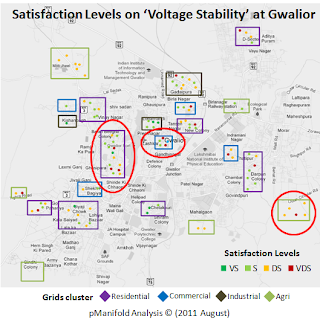
Voltage Stability’ Map of Gwalior city
The GIS map indicates the sample respondent’s satisfaction level (in red, orange and green dots) for specific attributes. The consumers are clustered into 4 categories namely Residential, Commercial, Industrial and Agriculture marked by 4 different colored box boundaries. Grids with high relative numbers of Red (Very Dissatisfaction) and Orange (Dissatisfaction) dots should raise a trigger for on-site team to look into causes of dissatisfaction.

  • Voltage stability seems to be problem in Gwalior city with overall more than 50% dissatisfaction. High paying urban consumers including ‘Commercial’ and ‘Residential’ also seems to struggle with the problem. Rural areas outside city limit has aggravated voltage stability issues.
  • Visualizing the results in this GIS form will aid the on-site due-diligence team to go for specific customer segmented pockets and prioritize their time. The ‘voltage stability’ interventions will have major impact on Capex planning for the area.

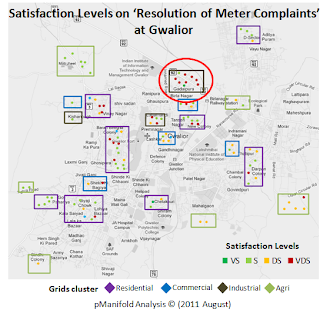
‘Resolution of Meter Complaints’ Map of Gwalior city:
Industrial consumers are supposedly high return customers for utilities revenue.

  • In Gwalior city, the Industrial belt of Gadaipura seems to suffer with significant ‘customer service’ related problems on ‘Metering Complaint Resolution’ to result into 67% ‘Dissatisfaction’ indicated by red and orange dots.
  • Gwalior has almost 100% Electronic meters for Industrial consumers. The problems if vested into replacing meters then it would result into another huge Capex involvement for the Distribution Franchisee. If problem is more vested into improving processes and protocols for handling customer services and aiding with Meter testing services, then that would have implication on Opex planning for resources, inventory and lab testing.
  • There are more correlation analysis that come as supplements in the CSAT study which indicate customer’s willingness to pay for additional premium services, its sensitivity to ‘Prices’ and ‘Value for Money’ and also its acceptance to privatised distribution. All these together with socio-economic indicators and demographics of the area influence the customer acceptance of the Distribution Franchisee model and initial roll-out of DF operations and hence its associated delays, contingencies and Risks to the Investments (both systemic and idiosyncratic types).
Similar maps and more insights are available for 28+ attributes and can be effectively used to direct on-site due-diligence team, validate results from on-site due-diligence against CSAT results and have more confidence on Capex and Opex estimation. Such comparative information on 9 districts could provide another validation on selection of one district over the other for final bidding. (See pManifold’s earlier blog Distribution Franchisee Attractiveness – Comparison for Madhya Pradesh’s 9 districts)

For individual reports on each region, please get in touch with Rahul Bagdia, +91 956 109 4490, rahul.bagdia@pManifold.com.
Bottom-up innovation: From Micro Grid in Indian villages to Smart Grid for urban Discoms

Bottom-up innovation: From Micro Grid in Indian villages to Smart Grid for urban Discoms

Bringing electricity to rural areas that never may see the grid is a great boon to both people’s quality of life and the region’s economy. Smart Grid Technology or Renewable Microgrid is the topic of this discussion to improve operational and business efficiency of Indian Power Utilities.Grampower, a energy technology company is working on addressing the electrification challenges in India.pManifold recently spoke to Mr. Yashraj Khaitan, Co-founder and CEO of Grampower. The company sets up energy efficient Smart Microgrids in remote areas to provide on-demand, reliable electricity to telecom towers and rural households with an affordable prepaid purchase model. He has been instrumental in raising over USD1.7 million for the company, and leads product and business development and partnership building to scale the company’s operations.The below shared are the author’s personal views and not to be associated with any of his company’s and other associations.

Q1) What is one typical micro grid size/ investment/ returns: # of connections, brief equipment specs, investments, ROI, Payback?

A)

  • A microgrid in an off grid area that is capitally and operationally viable must be 10 kW and above with about 50% of it’s generation capacity dedicated towards guaranteed daytime loads such as telecom towers, shops, cold storages, cottage industries, schools, etc. The remaining 50% needs to be targeted towards domestic loads to provide ‘lifeline power supply’ to consumers during the night. Typically 80-100 families can be served in this configuration and the payback lies between 4-5 years.
  • Equipment specs – On the generation side, we use crystalline solar panels and inverters with maximum power point tracking controllers to maximize power drawn from the solar panels. The storage used is tubular lead acid batteries. The distribution infrastructure is setup by us and comprises cement poles and insulated aluminum cabling till the household level. Each household is given Gram Power’s proprietary Smart Prepaid Meter that we are able to control remotely. These meters ensure 100% payment collection, make consumers aware of their power consumption and allow them to control their monthly expenses, and enable to Gram Power to identify and eliminate any form of meter or distribution line tampering for power theft. Typical, solar generation infrastructure including solar panels, inverters, batteries, structures, etc. is about 60% of system cost. 20% is the smart grid infrastructure including meters, communication, remote monitoring, and payment system. Balance 20% is installation and commissioning expenses.
  • Micro-grids that need to be setup for small hamlets that don’t have much commercial load can be made operationally viable with Gram Power’s Smart Distribution System. Hence for such villages, we work with the State and Central Governments to fund the capital cost of the system. The prepaid meters, theft detection systems, and our payment model ensures that enough revenue is collected so as to keep the plant running for 25 years, i.e., the lifetime of the solar panels.
  • The long term solution however, is grid connected microgrids, which is what we are focusing on now.

Q2) What changes you request to bring scale-up of Generation tied Distribution systems in India – customer behavior, Grid sharing & Tariff regulations, others?

A)

  • Customer behavior will change in the following ways, as already demonstrated in our systems:
    • They will become energy conscious as the meters inform them of their rates of consumption
    • Power consumption will reduce as consumers pay for every unit that is metered
    • This reduction in consumption essentially increases the amount of power available for the DISCOM to sell to industries where revenue is higher
  • I believe the following model should be supported to promote intelligent and sustainable rural electrification:
    • DISCOMs setup DFs in a PPP mode for villages or entire feeders that have over 40% commercial losses and where power supply is erratic
    • The DISCOM and DF jointly fund the replacement of energy meters with Smart Prepaid Meters and theft detection systems in the grid
    • The DISCOM will sell power to the DF at an agreed bulk tariff and the DF will sell power to the consumer at the regulated tariff through multiple retail outlets in the village just as cell phone recharge is sold
    • DF should have the permission that power supply is automatically disconnected to households that tamper the meter or distribution lines or run out of credit
    • Those companies should be selected as DF who are willing to invest in setting up locally installed renewable generation in the village to supplement grid supply and make power supply more reliable
    • The DISCOM will charge the DF for all power consumed at a single point

Q3) What realised efficiency can Micro grids bring to Indian Discoms? What good and immediate market opportunities you see in this space, in addition to rural?

A)

  • A Gram Power Smart Microgrid with solar generation and battery storage for a village of 100 homes is only 30% of the cost of extending the national grid by 15 km. We have demonstrated 100% payment collection and 0% power theft in our systems. Hence the realizable efficiency for DISCOMs in areas where our distribution technology is used on the national grid, can be easily estimated based on what losses DISCOMs are incurring today.
  • For microgrids, I see the following tappable markets:
    • Remote hamlets funded through DDG schemes
    • Urban colonies being privately constructed should have a requirement for have a microgrid to meet its power needs when grid is not available. When grid is available, the microgrid can supplement supply for peak load management
    • Important commercial buildings like airports, data centers, hospitals, etc. should be supported by microgrids
  • Speaking long term, microgrids are the most effective way to combat cyber attacks on our electricity grid. The US is moving ahead in this direction too.

Q4) What unique about Gram power developed Pre-paid smart meters? (Share info on technology, communication protocol, s/w analytics, and field results against some of known challenges with such meter deployment). How does it benchmark with other similar meters in market?

A)

  • Our meter has been developed keeping in mind the end consumer and application. Not as per what existing meters do or standards they comply with. We’re able to do the following with it:
    • Implement a prepaid payment model that does not require internet access for each and every home and that can be easily managed by low skilled local entrepreneurs
    • Provide real time consumption information for each meter with up to 30s intervals in a very reliable manner. We are able to do this because of our proprietary protocol that is light and takes into consideration the village geography and erratic connectivity
    • Automatically create an intelligent local wireless communication network that identifies and stops any kind of meter or distribution line tampering
    • Automatically operate different loads in the area based on their priorities. For example, in a grid-connected microgrid setting, we can program into our meters that when grid supply is not available and there is limited generation, then only the most important loads in the village must be operational
  • With our hardware and software, we provide an end-to-end solution for last mile power distribution management.

Q5) What economics and benefits of your company’s pre-paid meters to lets say a 1Lac customer base private utility for assume 100% adoption? Can you add how current pricing slabs for different consumer categories in your micro grid setup?

A)

  • If the average monthly consumption of power across the 1 Lac households is 150 kWh/month/home, and the commercial losses are over 40%, our meters pay back in less than 1 year. If the private utility or distribution franchisee works with us in a partnership model where the savings are shared over a longer period, the payback can become even quicker
  • Regarding pricing for consumers, our users pay between Rs.150-350/month to run a whole range of household appliances including small water pumps. A generalized capex number for microgrids will be difficult to suggest because the cost depends on a whole range of factors.

Q6) What customer behaviors you have seen supporting and opposing pre-paid meters? How you envisage developing airtel like pre-paid payment retail outlets to encourage wider adoption?

A)

  • Not a single consumer we’ve interacted with has opposed the prepaid meter. What customers don’t want though is the fixed monthly charges. They want a 100% pay-as-you-go model as that gives them full control of their expenses and ensures that they don’t feel cheated when the grid does not supply power to them. This model leads to a lot of energy conservation, which makes a lot of sense in a country like India where power is a scarce resource, and the coal and power sector is heavily subsidized

Q7) What supporting eco-system you think will help young companies like you for quick go-to-market?

A)

  • Openness of DISCOMs to execute pilots without tendering. Access to an advisory panel that can help us understand the nitty gritties of the laws and restrictions in the sector. Access to actual data on real loss levels.

The author can be reached at yashraj@grampower.com for more details. The company website can be viewed at: www.grampower.com

Solar Financial Modeling: 9 points you can’t afford to miss out

Solar Financial Modeling: 9 points you can’t afford to miss out

Any project related to power sector requires a huge amount of investment. Therefore, it is extremely necessary to make financial model and do a thorough analysis for the financial viability of the proposed project prior to any decision regarding the initiation of the project.

Financial Models can be complex and with various elements of Solar projects dependent on policy, financing, resource availability etc. modeling solar projects becomes a significantly complex process.

We, at pManifold, have been working with various project developers, investors and new market entrants involved in grid-scale (both Solar PV and CSP) and rooftop solar projects helping them understand the financials risks and returns of this opportunity. Based on that experience, we have identified 9 points that one should consider while developing a Solar Financial Model. These are,

1. Solar System Specifications

A good solar financial model should capture the technical and geographical information related to solar correctly. The parameters like solar insolation, solar degradation factor over 25 years, cell efficiency, DC-AC rerate factor, etc. plays an important part in defining the project cost and production capacity. This will impact project feasibility and decision making extensively.

2. Project Cost and Subsidies

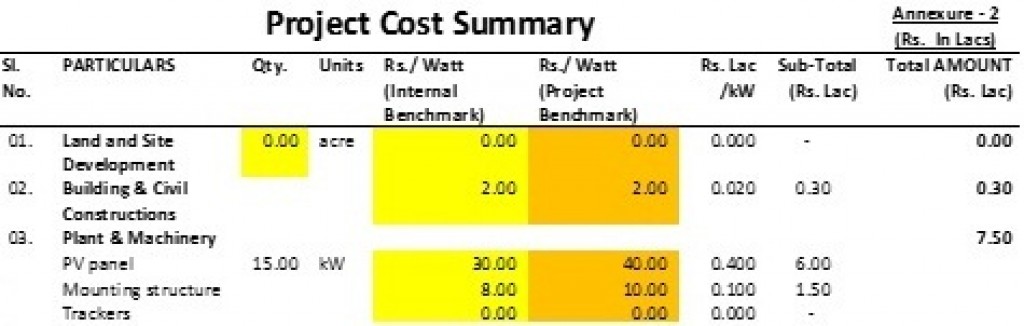
In Solar PV projects, the Solar System is not the only project cost. The model should also account cost towards land, construction, power conditioning and evacuation systems, tracking systems, insurance, project management, pre-financial charges and more.

In recent years, the driving factor for adoption of solar projects is due to the financial support provided by Central and State Government in the form of subsidies. This should also be a part of the financial model.

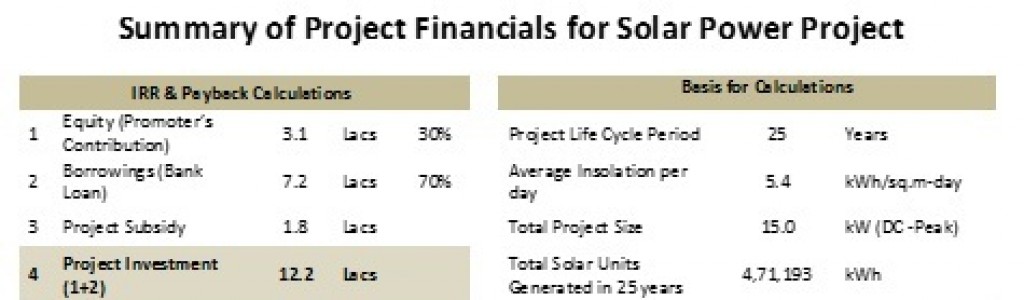
Following is the snapshot of the project cost summary developed by pManifold’s financial analysts.

3. Financial Structuring

A large Solar PV project requires higher investment and for that the developer needs to opt for various financial products like fixed term loan, working capital loan, bank guarantee.  Hence, a part of the project cost needs to be funded through debt. This debt portion determines the company’s cost of capital and hence the Project IRR and Equity IRR. Financial model should capture debt cost, equity cost, loan period, interest rate and moratorium period.

4. Power Tariff

Power tariff rate is one of the most critical parameters which directly impacts project revenue and payback period. In Solar PV projects, feed in tariff rate and terms and conditions defined as per Power Purchase Agreement (PPA) is vital. The financial model should have the capability to tweak and customize the model to meet power agreements.

In the case of net metering, the consumer category, state and its tariff structure determines the potential saving a consumer can have. As power tariff varies significantly from state to state, hence, the ROI of solar rooftop projects varies across states.

5. Inflation

The typical financial model for Solar project, forecast is generally made for next 25 years. In this period, solar production decreases over time which impacts the project’s top line. In such case, inflation factors like tariff inflation and O&M inflation become key drivers of the model.

6. Accelerated Depreciation Benefit

The biggest advantage solar projects offer to the investor are tax savings. As per Section 32 of Income tax, an investor can claim 80% accelerated depreciation benefit in the first year and remain 20% in a subsequent year. Thus, the solar financial model should account depreciation schedule as per both Income Tax and Companies Act to assess project profitability and tax liability.

7. MAT & Tax Benefits

As per IT Rule, the Solar project developing companies like any other company are liable to pay Minimum Alternative Tax (MAT). A solar financial model should cover calculation of corporate tax, MAT, MAT credit available and MAT credit utilized over 25 years of project life cycle.

8. Scenario Analysis

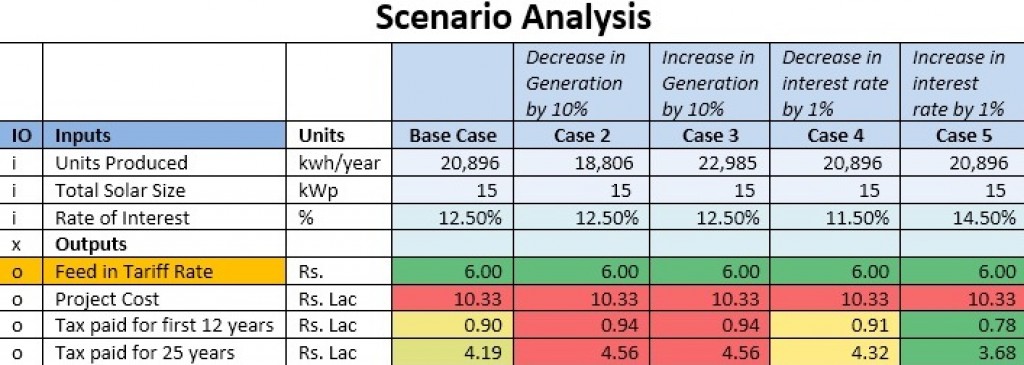
A financial model is robust only if it has the capability to test different business cases simultaneously and then compare the results. A financial model should allow changing multiple input parameters to predict optimistic, pessimistic and average scenario at one go. A tool supported by good visualization and dashboard is a useful feature a management should look for. Here’s a quick snapshot of how we do it.

9. Assumptions

Financial models are built upon a certain set of assumptions. All assumptions should be documented and supported by references to ensure robustness of the model. Vetting by an independent certified professional is also recommended

Market Report on Input based Power Distribution Franchisee Market in India

Market Report on Input based Power Distribution Franchisee Market in India

Brief Summary

Power Distribution Franchisee – evolving Public Private Partnership (PPP) model has picked traction since 2009 after successful demonstration by Torrent Power Ltd. at Bhiwandi, Maharashtra, which got operational in 2007.

The licensee (state utility) appoints a private company on the basis of rationale bidding for distribution of electricity in a specified area for specified years of contract. This Distribution Franchisee model stands midway between licensee and full PPP model and is considered as one of the major energy reforms in power distribution sector that has the potential to turnaround the sector and take electricity to rural areas as well.

Out of the variants available, ‘Input based Distribution Franchisee’ model has recently seen an increase, currently with five cities across India, out of which distribution in three cities was handed over to private companies in 2011. Below shown is the indicative content of the report. Input based Distribution Franchisee, by far, has been mostly used operating model in urban areas.

Investments in this space are driven by the emerging nature of the ‘Input based Distribution Franchisee’ model which promises high returns, has low entry barriers, maintains proximity to end-consumers, involves high Capex with predictable cash flows and easy financial leverage when operating efficiently.

Various experts in power sector are of the opinion that in the coming 5 years, the Distribution Franchisee model is expected to grow manifold, thereby improving the power distribution scenario of the country.

pManifold’s Market Research Report on ‘Input based Power Distribution Franchisee’ in India provides an insights into the current scenario of Power Distribution Franchisee and potential future trends.

Detailed Table of Contents

  1. Terminology / Acronyms
  2. Executive Summary of Power Distribution Franchisee
  3. Power Distribution Scenario in India
    • Energy Value Chain & Leakages
    • Distribution Scenario
    • Why Utilities are making Losses?
    • Need for Reforms – Are the Issues with Utility Solvable?
    • What is the right model of Utility Privatization?
  4. Distribution Franchisee as a Business Model
    • Types of Business Models
    • Distribution Franchisee Segmentation and Applications
    • Why Distribution Franchisee model is attractive over other Privatization models?
  5. Input based Distribution Franchisee Market
    • Key Drivers
    • Distribution Franchisee Projects – Bid Won & Under Implementation
    • Model Uptake – Existing Operators
    • Competitive Landscape Assessment – Existing Operators
    • Future potential: Opportunities & Growth
    • Industry Analysis – Porters 5 Forces Model
  6. Operating Model
    • Stakeholders
    • Stakeholders Analysis
    • Typical Work Flow Map At Distribution Utility
    • Key Challenges With Distribution Franchisee Roll Out
    • Model Risks
  7. Bid Process and RFP Analysis
    • Bid Process
    • Evolution of RFPs
  8. Financial Model – Using Ujjain city as an example
    • Introducing the base Model for Investment Analysis
    • Assumed Capex Distribution
    • Estimated Returns from base model
    • Sensitivity to Input Bid Price
    • Sensitivity to Capex
    • Sensitivity to Opex
    • Sensitivity to Tariff Growth Rate
    • Sensitivity to Load Growth Rate
  9. Past Bid Analysis
    • Connections and Asset information from RFPs
    • Customer Segmentation
    • Winning Bid Comparison
  10. Case Studies
    • Bidding Analytics
    • Bhiwandi, BSES, NDPL
  11. Conclusions
  12. References
  13. Appendix
    • DF Tenders – New and Old Awaiting Decision
    • Suggested States for Distribution Franchisee Model by Shunglu Report
    • Lists of Distribution Companies, SEB’s in India
    • Recent Bid Analysis (Madhya Pradesh – Gwalior, Ujjain and Sagar)
      • MP Bids Quick Characterization
      • DF Attractiveness Matrix
      • Connections and Asset Information from RFPs
      • Customer Segmentation
    • Utility KPIs

Key Highlights of the Report are

  1. Current Market Scenario and Upcoming Opportunities of Distribution Franchisee
  2. Key Functional Roles and Responsibility of Distribution Franchisee Operator
  3. Key Roll Out Challenges for Distribution Franchisee Operator
  4. Case Studies of already existing Operators
  5. Competitive Landscape Assessment (CLA) of Distribution Franchisee Operator
  6. Financial numbers derived using a base financial model for UJJAIN
  7. Sensitivity to different parameters like CAPEX, OPEX, Tariff Rate, Load Growth Rate
  8. Bid process description for distribution franchisees

Key Questions Answered

  1. What is the potential of Distribution Franchisee model?
  2. Which states are looking to adopt the model?
  3. What are the key risks and challenges of the distribution franchisee model?
  4. How is the bid process and how to analyze information in the RFP?
  5. Typical Capex Distribution and Estimated Return?
  6. How is the experience of current distribution franchisee operators?
  7. How is the current competitive landscape in the distribution franchisee space?

Information Sources

  1. Excerpts from industry experts
  2. Opinions and Reviews of various reports in Distribution Franchisee sector
  3. Inputs from Conferences and Workshops
  4. Secondary Research

A Must Buy For

  1. Potential New Entrants in Distribution Franchisee space to get up-to speed on the market
  2. Existing Distribution Franchisee operators to train / update new hires and stay up to date on market trends
  3. Research and Educational Institutes to learn about various aspects of the Distribution Franchisee market
  4. Banks and Financial Institutions to learn about the sector and understand the financial implications of investing in distribution franchisee businesses
  5. Consultants to upgrade their know-how in the distribution franchisee market space

Pricing

Rs. 20,000/- (inclusive of taxes)

(Once payment is received, PDF copy of the report will be shared across email)

Payment
Payable to “pManifold Business Solutions Pvt. Ltd.”
IFSC : HDFC0001786
A/c No. – 17862320000109