


Putting your best foot forward – Best Practices in Consumer Indexing

As the operator tries rolling out the services, the foremost task at-hand is creating the base-line for the utility. This, typically, is collated using a consumer survey called consumer indexing (CI). The operator main aim is to collect the information required for consumer demography and demand estimation.

The figure below shows the variety of data the consumer indexing, if designed properly, can yield:

Here’s the catch though.

Since the consumer indexing process is an extensive full-city activity, our observation has been that it becomes extremely important for the operator to monitor the survey process continuously and ensure data accuracy.

Some of the Critical Factors for Success (CFS) for successful consumer indexing survey are listed below:

  1. Design and Deployment of Project Management Techniques: The CI activity usually spans a substantial period of time. This necessiates deployment of a Project Management team which is well versed with the DRD and Data Collection methodology. A well formed PM team with participation across stakeholder teams forms one of the important CFS for CI Process. The KRAs of the PM team should include Unitization of Work, Timeline planning, Progress monitoring, etc.
  2. Vendor Selection and Engagement: Identifying a vendor capable of delivering the DRD as per the pre-set data standards becomes the core of the CI project execution. As much important it is to identify the correct vendor, it is also the operator’s responsibility to engage the vendor in a manner where the CI process can be handled in a smooth and timely manner.
  3. Appropriate Data Validation Rules (DVR): Once the DRD and Technical spcs are frozen, the operator should identify for itself the validation rules he needs to apply to check the data being collected by the CI vendor. Inappropriate or too rigid validation rules lead either to mass rejection or too poor quality of data being collected.
  4. Well Defined Technical Specifications: The geo-spatial information being collected in the consumer indexing requires high end technical inputs to be ready for the survey before the start of the survey. These specifications include the likes of a high resolution satellite image of the area under survey, clear definitions of boundaries of zones and sub-zones (if any), etc.
  5. Data collection methodology and medium: The operator should identify all the options available to select the best suited methodology to collect the data identified in the goals of the CI process. In the same step, the operator should also develop and design the medium, usually a survey form, for the CI process. The “wow” effect of the survey form design changes and improved efficiency of the consumer interview was observed when we re-designed the survey form from a functional flow question to a consumer interaction flow.
  6. S.M.A.R.T. Goals: It is very important for the operator to upfront decide the data he wants to collect as a part of the consumer indexing process. The goals need to be identified across the teams which are going to be the users of the data collected. At the same time, the goals need to be clearly defined to the survey vendor so as to apprise him of the data usage. During our engagement with our clients, we have noticed that not much is done in documenting all the teams’ requirements right in the beginning. We strongly recommend writing up a  well defined Data Requirement Document (DRD). It not only becomes one of the most important pillars of the CI Process but also avoids endless discussions between teams on what is required, by whom and by when.
  7. Business Process Management: The operator should be engaging in monitoring of not just the data being collected, but also the vendor processes. This, in the long term, helps the operator to achieve more accurate and timely data. Independent audits of internal as well as vendor processes always helps.

The data collected through CI process forms the base-line for the operator to put its plans (CapEx, OpEx, Revenue Planning) in place. Therefore, we believe, the onus of successful execution of the CI process is as much on the operator as it is for the survey vendor.
Strategic Communications – A tool towards better customer engagement and loss reduction

The high risks in the complex, unpredictable and highly political process of water sector reforms are unavoidable given the “essential goods” perception of water. However, what the utility operators need to understand is that investing time and money in “strategic communications” early in the engagement of water reforms and that it leads to a much smoother operations and success of the project. A World Bank report (2006) suggests that an understanding of public perceptions leads to better adoption of strategic communications help in improving the efficiency of the public utility.

The key challenges arising due to lack of strategic communications can be listed as:

  1. Social conflict due to lack of information or misinformation or a communications vacuum that creates uncertainty
  2. Power struggles leading to project delays
  3. Consumer Opposition due to (justified or unjustified) fears about tariff, service levels and affordability
  4. Customer dissatisfaction when hyped expectations are not met, or are not right sized at appropriate time

The idea behind this post is to try and identify areas where communication tools can support reform process and mitigate risks.

The three principles which can be applied to use communications as a strategic tool towards better utility management are discussed here:

  1. Principle #1: Know-Your-Customer: Instead of making assumptions about what the customers want or how they would react, it is advisable to undertake a Communication-Based-Assessment (CBA) to gauge the support for utility reforms within the stakeholders. (See pManifold’s unique COPS Case Study). The CBA uses a mixture of conventional and unconventional data collection methodologies (including socio-economic parameters, Willingness-To-Pay, opinion polls, etc.) and establish baselines for stakeholders’ perceptions, interests and priorities.
  2. Principle #2: Creating Awareness about the Need for Utility Reform: Once the CBA has captured the perspectives of customers and stakeholders, the Utility Management may determine what about the reforms need to be communicated, through which messenger to communicate the same and how to garner political support with other political groups and agencies. The Utility Operator should:
    • create awareness regarding the “state of the utility” in terms of challenges and opportunities for reforms and what it means to the customers
    • communicate the effects/challenges that lie ahead, if reforms are not implemented. At the same time, if not communicated correctly, the Utility might risk being looked upon as non-transparent
    • make the stakeholders understand their rights and responsibilities in the reforms process
  3. Principle #3: Building Support and System for Change: Once the reforms are enacted, the communications does not stop there. The Utility should continuously use communications as a tool to build a culture of transparency and openness

The Utility, to leverage the strength of strategic communications as a tool, should make use of the following best practices:

  1. The communications strategy should integrally be linked with the organizational strategy & goals and be in line with the utility operations
  2. The Operator should take sufficient effort to make the information available and accessible to all the stakeholders. Establishing web portal and maintaining it constantly is critical to promote transparency.
  3. Correctly identify the most trusted messengers or champions through early use of CBA
  4. The Utility Operator should right size the expectations of customers as well as other stakeholders in order to mitigate the non-financial risks. Only when the beneficiaries believe that the project has met the set expectations, the Utility Operator can claim that the project has realized its full value
  5. More often that not, in our typical environment, project delays occur. And when they do occur, the Utility Operator should be taking care to communicate the reasons behind the delay. This creates an environment of openness and credibility.
  6. Whatever positive results are achieved by the Operator, the results should be communicated to the customers and other beneficiaries
  7. Empowering the media is one of the best methods to spread word about the good work the Utility is carrying out. The media also serves as a tool to educate the consumers.
  8. Collaborate with local governmental and non-governmental agencies to drive the Information-Communications-Education (ICE) campaigns to build a positive image for itself
  9. Utility should invest in creating and maintaining an in-house professional communications capacity to avoid the inefficiencies in the governmental / state agencies’ communications program

=========================================================================

*Source: Communication for Water Sector Reform: Obstacles and Opportunities, (2012), The World Bank

=========================================================================

Interview with Mr. Ajai Nirula, COO at TP-DDL on PPP models for Power Utilities in India

Mr. Ajai Nirula, Chief Operating Officer (COO) at Tata Power – Delhi Distribution Limited (TP-DDL) was one of the sessions moderator in recently concluded IUKAN 2013. As a veteran in the Power industry, he shared his inputs on various distribution reforms and the challenges associated with it.

Q1) What are the current trends in PPP models for Power Utilities in India?

  • Presently, three business models are in existence i.e. Privatization, Franchisee Based (Unit Based Input Model) & Concession Based (Now recommended by Planning Commission)
    • Franchisee Based Model: Operates in designated areas, responsible for network maintenance, for a fixed period (generally 15 Yrs.), Bidding is done on price you pay for per unit power purchased
    • Concession Based Model: Fix tenure for 25 Yrs., Bidding party gets a license to operate in the area, bidding is done on viability gap funding concept
    • Privatization Model (Delhi/Orissa): Responsible for AT&C Reduction & maintaining reliability of network, licenses to operate in designated areas, asset valuation at a notional value, incentivization on overachievement of targets, Governed through a regulator

Q2) What are the challenges in PPP models in India?

  • Privatization Model (Delhi/Orissa)
    • No political will to take it forward in-spite of a being a successful model in Delhi
    • Asset valuation for future models to be re-looked
  • Concession Based Model
    • Not started yet. States are slightly hesitant to go ahead with this
    • Requires calculation of CAPEX etc. for next 25 years
    • No standard bidding guidelines in place
  • Franchisee Based Model
    • How to handle customers if you can’t but power as it is in the hands of  utility
    • How to carry-out enforcement raids (don’t have legal powers to conduct raid)
    • Long term sustainability
    • Quality of material / specifications being used
    • Governance issues as there is no regulator

Q3) What is the future outlook for PPP projects in India’s (Power and/or Water)Utilities

  • Franchisee Based Model: Though in few cases, this model has been adopted; its results on long term basis are yet to be seen. In Bhiwandi, initial results were good but now, pace has slowed down. Agra is yet to show the results. Kanpur has still not been handed over to the party. This model is bankable but only with the support of parent company
  • Concession Based Model: This model can work with few modifications. Needs to be properly explained along-with the problems being faced in franchisee model
  • Privatization Model (Delhi/Orissa): Good model to work for. Some political will is required. It is a win-win situation for private party & Govt. as there is an independent regulator to check the performance and govt. also gets benefitted through better revenue realization in the form of AT&C reduction.

The above views are respondent’s personal views, and not to be associated with his company in any other ways.

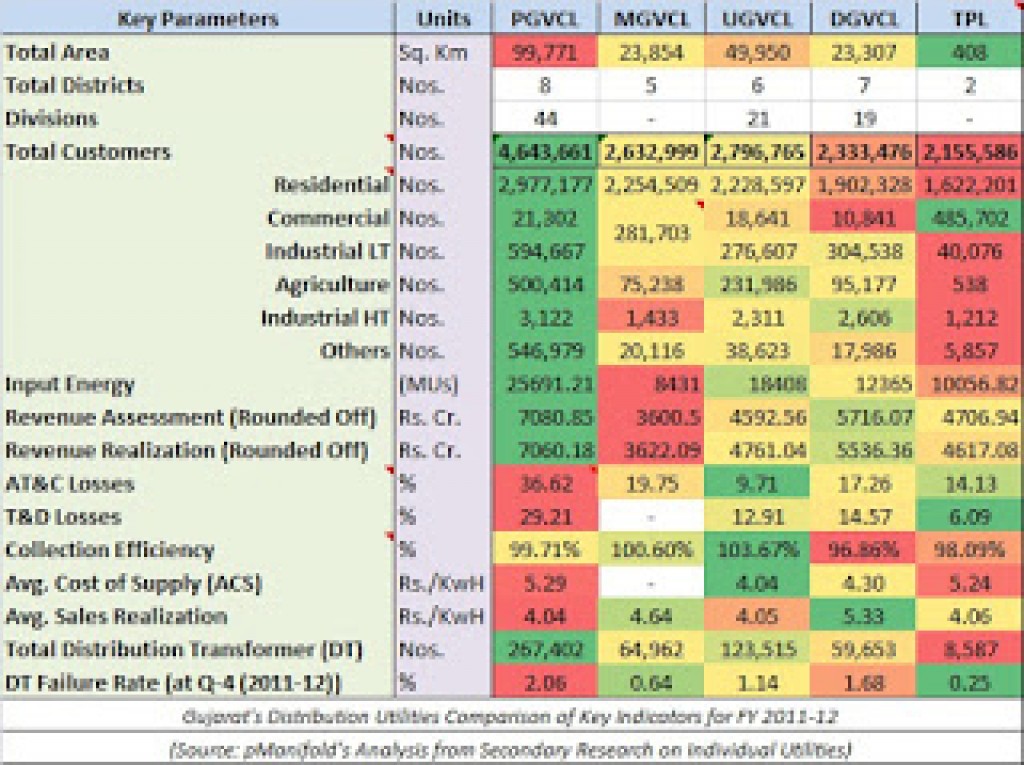
Comparative View of Key Performance Indicators across Gujarat’s Power Distribution Utilities

Paschim Gujarat Vij Company Ltd. (PGVCL), the largest Power Distribution Utility, compared to other distribution utilities in Gujarat, is serving more than 47 lakhs customers, across 8 districts and 44 divisions. The utility PGVCL has considerable losses (both Aggregate Technical & Commercial (AT&C) and Transmission & Distribution (T&D)) compared to other utilities and hence, is evaluating different options of Public Private Partnership (PPP) models to improve the operational efficiency and performance monitoring. They are evaluating various models including the Input Based Distribution Franchisee (IBDF), Light Capex new Orissa model and others. To have a detailed understanding of IBDF model, a team of PGVCL recently visited MSEDCL’s office in Mumbai for a deeper study on the model.

pManifold has done a quick market research to understand the performance of Gujarat’s distribution utilities on key parameters using its DF Attractiveness Matrix. The data used is of the FY 2011-12.

Key excerpts are mentioned below:

  • PGVCL has highest area compared to other utilities, covering scattered geography with 8 districts and 44 divisions.
  • Total number of customers is double in PGVCL as compared to others, with highest percentage of Agricultural customers (i.e. ~11%) followed by UGVCL with (~8%).
  • Losses are highest in PGVCL, compared to others due to larger proportion of agriculture sales. Due to this, the state regulatory has set trajectory of 2% loss reduction per year for PGVCL and 1% for others.
  • Average cost of supply (ACS) is highest for PGVCL and its sales realization is least.
  • Quarterly Transformer Failure rate is also highest for PGVCL.

Apart from the above points, based on the analysis of tariff reports, it is observed that the tariff for domestic and agriculture customer categories has remained at 70-80% and 20-30% of the average cost of supply, while the non-domestic and industrial categories pay in the range of 120-150% respectively, across different utilities. Thus, non-domestic and industrial revenues continue to cross subsidize agriculture and domestic categories.

With a view to reduce the losses and improve the overall system efficiency, PGVCL has taken a good initiative to understand more on the Distribution Franchisee model. We hope that the preliminary thoughts picks up more traction in coming time period so that the DF model develops further and reach to its potential.

Embedding Financier’s & Lenders perspective in design of Power Distribution Franchisee

One recent success for Distribution Franchisee model in the country was first debt funding to Essel DF project at Nagpur. SBI Caps was involved in Debt Syndication partner role. Rahul Bagdia from pManifold Team recently spoke to Mr. Sudarshan Mohotta, VP Project Advisory & Structured Finance Division, SBI Capital Markets. Mr. Mohotta and his team were instrumental in closing this deal. He has around 17 years of experience in project & corporate finance and banking including financing of infrastructure projects. At SBI Caps, he has been actively involved in structuring and evaluating infrastructure projects and arranging funds with focus on power, port and road sector.

This interview focuses upon ‘What will bring confidence amongst investors to invest in Power Distribution Franchisee models?’ The below shared are the author’s personal views and not to be associated with any of his company’s and other associations.

  1. How are Bankers seeing about investing in DF model?
    • PPP projects in power distribution sector are plagued by the stereotyping of PPP models in place with the current bleeding distribution utilities, especially among the commercial banks. The PPP models proposed in power distribution space are generally Input based Power Distribution Franchisee models, wherein the appointed Distribution Franchisee (DF) purchases power from state Discoms and bills and collects revenue directly from the end consumer. Thus, the DF is dependent on end consumer for revenues and not the bleeding discoms as against the misconception of the banks arising due to their lack of awareness of the DF model in this space.
    • Banks are only now beginning to appreciate the key differences in the business models of DFs and Discoms. Also, amongst most banks, the overall power exposure (which includes generation, transmission and distribution sectors) have either reached or crossed the internal prudential sector exposure limits creating further roadblocks in access to bank funding in power distribution space. Irrespective of these hurdles, banks do take on projects with strong Sponsors, however, small players or weak sponsors would find it difficult to access bank funding inspite of the merit of the projects being funded.
  2. What are key elements of their appraisal consideration?
    • The key considerations by the banks during any appraisal would typically include the following:
      • Sponsor strength and track record in DF experience or related areas
      • DFA provisions and restrictions
      • Security cover available
      • Political and prevailing power scenario of the relevant state
      • Consumer mix and willingness to pay in the particular DF
      • Implementation strategy
      • Historical track record of the Discoms in terms of regular tariff revisions, prevailing state demand – supply situation, commitment to loss reduction, etc.
  3. What specific best practices and challenges have you seen while evaluating any particular state DF (Maharsahtra, MP, Jharkhand, Bihar etc.)?
    • While states like Maharashtra, MP with a good track record of collection efficiency and therefore willingness to pay pose lesser challenges in terms of load shedding and load growth support by respective discoms; states like Jharkand and Bihar which lack the willingness to pay, find lower acceptability amongst bankers, when it comes to any strategies in improving collection efficiency in such areas besides reduction in technical losses.
    • Also an indication of smooth takeover of operations by the DF in the circle by way of acceptability and / or minimal resistance among key stakeoholders including existing employees, consumers, etc plays an important role in the initial success of the project.
  4. Essel Nagpur DF financial closure is seen as a good start in the industry. Can you share top view on the deal, and how do you see DF market evolving?
    • With financial closure of Nagpur DF with a consortium of 5-6 lenders with SBI taking the lead, banks have started deriving confidence in the business model and acceptability of the same is expected to improve in the future.
    • Capex light models evolved in Orissa is a positive development to allow easier entry for smaller players with B2C expertise, which would help in bringing down commercial losses which typically accounts for a significant portion of the AT&C losses in a bid out DF area
  5. What minimum but necessary design change you will suggest in current RfP and DFA?
    • RfPs need to necessarily provide visibility on the other miscellaneous taxes, duties, subsidies, etc that have been paid in each year upto the year of bidding. Also certain DFAs need to provide a clearer security structure as to the extent of first claim of the relevant Discom in the event of enforcement. The DFA should provide the DF with the right to create first charge on all DF receivables in favour of Working capital lenders funding receivables of the DF
    • In order to provide comfort to Lenders to a DF project, DFAs also need to provide for the following:
      • Adequate termination payment for all the assets created by the DF till the date of termination, irrespective of the cause of termination.
      • Substitution Right for an DF event of default as well as Lenders right to trigger termination of DFA in event of default by DF on Financing Agreement provisions
  6. Please elaborate an ideal Escrow Mechanism from Bankers view point?
    • An ideal escrow mechanism between would typically stipulate the following:
      • A range of 50-60% of daily collection paid to Discoms towards part settlement of payables of Discoms would leave some room for banks funding the project
      • The payables invoicing cycle of Discoms should be aligned as far as possible to thr 45 – 60 days receivables cycle of the DF. A 30 days Discom invoicing cycle would be ideal, especially when a partial cash sweep escrow mechanism is in place with the Discom
      • Escrow mechanism should have provisions for invocation of SBLCs without any delays / concessions
  7. Any further financing innovation you see could expedite DF model scale-up?
    • With a operational track record of DF operations, securitization opportunities could arise in the event of better than forecasted operational metrics (eg: achieved AT&C loss reduction, other cost savings, etc.) and increasing consumption / load growth in DF circles. This would help generate incremental free cash for Sponsors for further investments in other DF circles.

Posted by: Kunjan Bagdia @ pManifoldThese expert interviews are part of pManifold and IUKAN initiative to bring new ideas and help overall Indian Utility industry to grow strong and sustainable. Please bring to our attention if you would have interest to share your views with broader utility professionals and help drive this change. You can write us at contact@pManifold.com. 

Leveraging EE programmatic financing for expediting AT&C loss reduction

While Indian Discoms continue to focus on AT&C loss reduction, which in many cases stands to the order of greater than 60%, and lot of private efforts is getting attracted in, it is clear that this is a massive Energy Efficiency (EE) drive. There are various talked instruments for EE financing, but not much has been realised by Indian Discoms. With this Rahul Bagdia from pManifold team spoke to Mr. Vinod Kala, Founder & MD, Emergent Ventures India. He has over 25 years of industry experience, centered on Clean Energy, Strategic Management and Finance. Over the years, he has helped launch a number of new businesses in Clean Technologies including Renewable Energy Aggregators in wind, hydro and bio-mass energy, LED Appliances, Sustainable Farming etc.

This interview focuses upon ‘If and how Indian Discoms could leverage & possibly expedite their AT&C loss reduction drive through potential financing from EE programmatic interventions’. The below shared are the author’s personal views and not to be associated with any of their company’s association.

  1. What are key Green House Gas mitigation related opportunities you see in Indian Discoms?
    • AT&C loss reduction is of course one of the key areas of GHG mitigation for  Discoms. EVI has successfully registered a Program of Activities (PoA) for Punjab State Electricity Board (PSEB). This was supported by World Bank. The PoA focused on transmission and distribution infrastructure up-garadtion in rural areas, which resulted in reduction of transmission losses.
    • Other significant areas for Discoms, wherein Discom could play Aggregator or Program Manager role:
      • ‘Reduction of leakages of SF6’: a high impact GHG substance used in circuit breakers because of its excellent insulating properties. UNFCCC AM35 is the approved methodology for designing carbon projects for reducing SF6 leakages.
      • Demand- side management programs. Energy efficiency programs for residential customers (e.g replacement of light bulbs, fans etc). Energy efficiency programs for commercial and industrial customers (lighting, HVACs, process effy etc).
      • Distributed renewable energy generation programs on customer premises (e.g solar roof tops, solar co-generation etc).
    • Apart from Certified or Verified Emission Reductions (CERs or VERs), some of these initiatives could also qualify for other types of environmental credits such as RECs (Renewable Energy Certificates) / ECERTs (Energy Efficiency Certificates). The benefits could flow to users, investors or the Discom, depending on the structure of the Program.
    • As far as Carbon Credits go, it is important to note that for projects registered after 2012, the saleability of carbon credits is low. The prices are also depressed. Hence the benefit of carbon credits can be meaningful only under bilateral mechanisms (e.g the mechanism with Japan).
  2. How did the PSEB CDM transaction work and what is current status?
    • World bank had supported this initiative and Punjab State Electricity Board was the Managing Entity for the Program. The Program was registered in Dec 2012. The Program is still under implementation although it can go for verification for first year credits in 2013.
  3. AT&C loss reduction is one pointed goal for Indian power discoms. Any ideas on raising a programmatic intervention for raising useful finance? Will the new emerging private Distribution Franchisees benefit and look upon this as funding source?
    • As I outlined earlier, new PoAs for CERs may not realise any significant monetary value because of sales restrictions on such credits from projects registered after 2012. However, an interesting possibility might to be extend the PSEB program to cover other Discoms as well. This will require further work by the interested Discoms with World Bank and learning from experience of PSEB.
  4. With RPOs enforcement getting stricter, what various market driven instruments are finding applications in Indian Discoms?
    • RPO mechanism as it stands today is not very friendly to Programs integrating numerous, small sized project activities. Concept of Program of Activities under CDM is well designed for such integration.  Also because of strict rules regarding who can buy (only Obligated Entities can) or sell (Only generators can) RECs, there are constraints on aggregation roles such as Program Managers. This needs further discussions with CERC.
    • The current approach to meet RPO is therefore simple- either buy Renewable Energy under Preferential or Feed-in-Tariff or buy equivalent RECs. With slight modifications, if Program friendly provisions can be brought in, Discoms can  meet their obligations partly through designing and implementing distributed Renewable Energy generation Programs.
    • The other option for Discoms may be to devolve the RPO targets to  large customers in Residential, Commercial and Industrial Segments. This will require working with SERCs and CERC for enabling provisions
  5. Indian Power discoms are seriously struggling with financial viability. Are ‘financial viability’ and ‘sustainability’ different dimensions, or are they interrelated?
    • Sustainable development has become a national priority and therefore slew of policies are coming up, with inbuilt incentives or penalties to encourage sustainability initiatives.
    • Therefore, sustainability should be looked with a fresh perspective. It is a business opportunity, with costs and risks if you lag behind and enhanced business value if you lead. It is no longer a feel- good activity undertaken only for reasons of conscience. Therefore sustainability and financial performance are not contradictory.  Dis-coms can either be good at sustainability initiatives and benefit from related incentives or face the penalties.
    • Discoms must also consider that Energy Sustainability is critical from the State perspective and would continue to be pursued. Both renewable energy and energy efficiency help reduce long term costs of energy, improve energy security and improve energy access, crucial for India’s development ambitions.
    • Indian Discoms have three domains of sustainability work, which also positively influence financial performance:
      • Technical efficiency and up-time improvement of transmission and distribution infrastructure, which reduces losses and improves throughput of energy in the system. Both positively impact the bottomline.
      • Demand side management: efficiency improvement at customers end and flattening of peak load. Efficiency improvement by customers, specially in segments which are subsidized (such as agriculture or low income customers),        will reduce the subsidies and release the energy capacity for high paying customers. Flattening of peak load will help the Discoms reduce average pooled cost of purchased power and thus improve the financials.
      • Renewable energy generation – Long term cost of energy comes down. Present costs can also be brought down, if RPOs are implemented at customer level. Program management role can also unleash value for the Discom.
  6. What suggestions you will make to Discom and Franchisee Top Mgmt to pursue sustainability in true meaning?
    • With sustainability thrust, new opportunities in Demand Side Management, Renewable Energy Generation etc. open up for Discoms or Distribution Franchisees. New revenue models, cost reduction opportunities and new ways of financing can be developed.

Posted by: Kunjan Bagdia @ pManifoldThese expert interviews are part of pManifold and IUKAN initiative to bring new ideas and help overall Indian Utility industry to grow strong and sustainable. Please bring to our attention if you would have interest to share your views with broader utility professionals and help drive this change. You can write us at contact@pManifold.com, and our team shall get in touch with you.

Mr. Ajoy Mehta shared his vision on Power Distribution Franchisee models in India

Mr. Ajoy Mehta, MD, MSEDCL, in a recent Business Technology Conclave of IUKAN extended strong support to Power Distribution Franchisee model, for country to build sustainable power utilities. He shared his experience and vision for further strengthening of the Power DF model. A brief excerpt in form of Q&As from his Vision session at IUKAN is shared below. (The views here are personal views, and not to be associated with any company in any forms)

Q1) What role of privatization you see in Indian Discoms?

A) Electricity Act, 2003 made Generation de-licensed, opening to private participation, but in T&D continued to require Licensing, opening it to part-privatization, but not allowing complete private ownership of assets.

  • A Discom performs following core functions 1) sourcing of power 2) tariff filing and reporting to Regulators 3) various customer services like MBC etc. 4) distribution and fault management 5) and HR management.
  • Out of above, sourcing of power & tariff filling and reporting are broadly considered as prerogative of Licensee only, and hence not kept in scope of Franchisee.
  • The strength of private company is to handle customer relationship and bring operational efficiency, and hence remaining above activities including like MBC, IT, and Customer services, O&M, HRM etc. were made in scope of DF.

As Discoms are reeling under the high distribution loss and revenue deficit, the one way of improving the Distribution of electricity is to rightly involve private companies in the sector.

Q2) What experiences and challenges you see with operating franchisees?

A) Some key challenges which need overcoming for the DF model to grow:

  • Secondary attention to Customer services: Franchisees by far start focusing more about revenue collection from day one, and quality customer services become secondary. This is primarily because still in Franchisee model, there is monopoly of the operator, and customers do not have any choice. Stronger checks and balances has to be put to increase timely answerability to the end-customers.
  • Lower Transparency: Most franchisee operators have opposed to transparently sharing their performance with their Licensee. More trust and governance need to be in place for improved performance monitoring.
  • Shallow pockets & experience: Tightening the tender document, with further stringent QR to involve only serious bidders with deep pockets and relevant experience. At this point of time, industry needs good performing DFs for model to stand and grow. Investors and promoters should have good intent and have patience for min. 5 years for useful returns.
  • Resistance from Unions: There is atleast no unfair labour practices involved with PSUs including Discoms. Sometimes the private operators cut thin on this dimension, inviting resistance and tension in their employees and unions.
  • Political buying: Both Discom and Franchisee needs to work closely to get this one important piece right, as otherwise it can thwart overall project success. One case study is of MSEDCL’s reduced AT&C losses, by convincing the stakeholders to allow proportionate load shedding in areas with more than 60% losses.

Q3) Currently there is monopoly in the distribution sector. Can competition be introduced in this sector in the near future?

A) It is a very valid and important question. The biggest problem that is faced is cross-subsidy. True competition cannot come unless cross subsidy is removed and everybody pays the same rate. But that is very difficult in India because we have a tendency to stick to the socialist philosophy. Unless this exists, and the regulatory framework does not change, true competition cannot be introduced in the electricity sector.

Q4) Is the government thinking of introducing power retail?

A) Although the government is thinking on it, I believe it would take nothing less than 10 years to make it a reality. The government should make tariffs equal for all and if subsidy is to be given it can be given directly to the consumer who needs it. We are still a little distance away from achieving that.

Q5) During the qualification of a bid can we allow partners consortium to ensure all relevant experience and resource for running Power Distribution system is present – Network/EPC/O&M; Metering & Energy Auditing; Finance and CRM/IT? What is your view in allowing this kind of consortium bidding with the pre condition that it is functionally relevant in running the entire distribution business?

A) This is a classical debate between consortium bidding and one big bidder. It is a difficult question and cannot have one simple answer. One rhetorical would be whether a movie with Salman Khan will become hit, or with 3-4 new heroes – both has their chances with right ingredients.

Q6) Where do you think is the distribution sector heading? Will competition come in this sector or not; do we need it or not?

A) Competition will come with privatization. According to me, privatization is when the consumer has a choice.  And the only thing that can subject itself to privatization is consumer services. We have to find out ways to get the consumer services out of the hand of the government and give it to the private sector. That is something on which we have to work as policy makers now.

Q7) A lot of generation capacity is stranded. Why don’t we have a target for load increase? Why is that not being pushed?

A) I agree with you that a lot of generation capacity is stranded, and that we need to push it. How do you push consumption when people don’t want to pay for consumption? Unfortunately, since we got independence, we have made people believe that whatever government gives is for free, be it electricity, water, roads or government hospitals. Since 50-60 yrs, people have got used to the idea that ‘paisa na bharne se bhi kaam chalta hai’. That has to change and is gradually changing. Unless this change occurs, there is no sense in increasing consumption. People must learn to pay.

Q8) There is no specific standard of performance given for customer satisfaction. There is no benchmark available. Do you see customer satisfaction being measured by a licensee, becoming a governance tool for the franchisees?

A) There is a great place in business for statistical tools for measuring satisfaction. But at the end of the day, customer satisfaction is the softer aspect of the business and you are trying to gain harder monetary aspect out of distribution business. It has a lot to do with the mindset of the person running the business. Measurement does have a lot of meaning, and this could be one paradigm change in attitude if the franchisee business is to go ahead.

Q9) Do you feel that setting up a measurement would drive that mindset change?

A) Yes it would. Definitely.

Q10) Is there any clarity in policy making forums on the way in which the franchisee affair can be included in Tariff and Fixation Regulation exercise?

A) Various models are being looked at. But every state should be allowed to find its own model. I feel that we should define the larger parameters and let the states innovate on other aspects. The only thing I am requesting the Government of India is that they finalize the QR by conducting a larger debate and let the states decide their own models.

Q11) What sort of support do you envisage that Discom could provide or add upon to further facilitate the scale-up of the Franchisee model? From your experience, what kind of support would further augment their service delivery?

A) Many people come to us to ask about the Franchisee model and I tell them very clearly that Franchisee is not a fashion statement. I advise them to get into Franchisee business only if they have the following three things: (1) You are truly and fully convinced (2) You have managed to a get the political support from your state, and (3) You are sure that you will take on your unions.

Full commitment of the utility is essential. It needs the time and effort of the number one man in the organization.

Ten twin cities to come up for Distribution Franchisee in Bihar

Bihar is one of the fastest growing States in the Country and has acquired considerable attention throughout the country and even abroad for its remarkable performance on the development front. The requirement for an enhanced Transmission and Distribution (T&D) infrastructure has ensured a firm commitment from the State Government, for transforming the present power sector scenario, in the form of assured finance through grants or various Government schemes and availability of resources in the region.

In order to expedite the reforms process, the management of the newly formed Bihar State Power Holding Co Ltd (BSPHCL) has organized a conference to update potential private sector participants on the developments in the T&D sector and understand the expectations of Developers, EPC Contractors and Manufacturers through the conference – ‘Destination Bihar: Opportunities in Bihar State’s Transmission and Distribution Sector’. The conference was organized by Feedback Infra Pvt Ltd in different cities of India with the top management of BSPHCL with the following Agenda:

  • Overview of the new initiatives taken by Governments of Bihar in the Power Sector
  • Update on reforms in the T&D sector through Government  support / investments through various Schemes
  • Discussion on private sector investment opportunities in Bihar’s Power (T&D) sector
  • Information for the  private sector  on Distribution Franchisee Model opportunities in the State
  • Understanding the expectations of all stakeholders in order to create an investment friendly environment in the T&D sector

The dynamic team from the State sector was led by Shri. Sandeep Poundrik, I.A.S, CMD, BSPHCL along with:

  • Shri Sanjay Kumar Singh I.A.S. (MD, BSPTCL)
  • Shri Sanjay Kumar Agarwal I.A.S. (MD, NBPDCL)
  • Smt. Palka Sahani, I.A.S. (MD, SBPDCL)
  • Shri. N.K.P. Sinha (CE(RE), NBPDCL)
  • Shri. S.K.P. Singh (CE(Comm.), SBPDCL)
  • Shri. Y.K.Thakur (CE(Trans), BSPTCL)

The conference saw more than 130 delegates from 80 firms meet to discuss the issues that have hindered the sector’s progress in the State and suggest possible solutions and recommendations to the officials present. The conference also highlighted key initiatives that are being undertaken by Bihar State in the Transmission & Distribution Sectors. With more than INR 28,000 Crores of incoming funding in the next 4 years, opportunities abound for private sector organizations.

Please see below the conference presentation:

https://www.slideshare.net/slideshow/embed_code/24933975

Destination Bihar : Opportunities in Bihar State’s Transmission and Distribution Sector Presentation

Key excerpts from the presentation, focusing on Power Distribution opportunities are:

  • Distribution sector are set to receive projects to the tune of INR 20,137 Cr. (including rural electrification schemes like RGGVY and RAPDRP).
  • Approx 40 lacs electricity consumers across the 2 distribution companies, after unbundling in 2012, as per EA-2003.
  • Demand of the state growing at a CAGR of 8%.
  • Industrial and Domestic consumers contribute to about 50% of the total sales.
  • Areas to come up for Distribution Franchisee are:
    • North Bihar
      • Bettiah – Motihari
      • Gopalganj – Siwan
      • Chapra – Hazipur
      • Darbhanga – Samastipur
      • Begusarai – Barauni
      • Purnia – Kathikar
    • South Bihar
      • Lakhisarai – Munger
      • Bihar Sharif – Rajgir
      • Arrah – Buxar
      • Sasaram – Dehri
  • Above mentioned areas have AT&C losses in the range of 40%-78%.

Its a good initiative taken by Bihar Government & its Discoms, as part of their stakeholder engagement initiative to apprise of the potential opportunities in T&D in the State. Thanks to Feedback Infra team for sharing above presentation.

Avoiding mistakes with GIS implementation in Power Distribution Utilities

Noida Power Company Ltd (NPCL), a joint venture between the RP-Sajiv Goenka Group, a leading business house in India and Greater Noida Industrial Development Authority, distributes power in Greater Noida, near Delhi in Uttar Pradesh. The Company started its operations in December 1993 under a 30-year license from U.P. Government and is among the leading companies to use GIS technology with vast experience.pManifold team spoke to Mr. Rajiv Goyal, Head (Projects and Power Trading) and Mr. Vikas Gupta, Manager (GIS) to understand their experience in GIS implementation and the best practices adopted by NPCL. The below shared are the author’s personal views and not to be associated with any of his company’s and other associations.

Q1) What has been NPCL experience with its GIS implementation?

A)

  • To make GIS successful, it should be a part of mandate in process life-cycle of utilities.
  • The main problem that we face after Implementation is timely updation of data on periodic basis but we had overcome by making the process starting from Planning, Implementation and billing of any New Connection, Network Augmentation, Network Changes vetted with GIS Department before Implementation.
  • We have formulated an end-to-end GIS solution for analysing and optimizing the power distribution network, initiating this project right from conceptualization phase and completed the same by integrating with other OSS (Operational Support Systems) systems like SCADA, billing systems etc. The scope of the GIS implementation included the creation of land base data, network mapping over the land base, data modelling, implementation of GE Smallworld software as a core GIS, Network Analysis tools for Load flow Analysis and finally, the integration of the GIS system with other OSS. The add-ons specifically developed by us for the Indian conditions might be of good value to other utilities.
  • NPCL is amongst India’s first Companies to implement GIS within organisation. We have vast experience and rich technical expertise in implementing best of the updated technology on periodic basis.

Q2) What top venues to optimise GIS execution and save cost and time overruns?

A)

  • Although in Utility GIS has lot of possible integrations with other systems, but basic fact is that, utilities deviate in their focus in maintaining Data quality by not making clear and mandatory processes for data updations, which is a prime important criterion for accurate results with any Integration.
  • Since NPCL Licence Area, Greater Noida is one of the biggest emerging areas in terms of Infrastructure Development and population density. The future planning and Construction of 220/33 kV Substations is a continuous process which includes:
    • Planning of Network Development
    • New Substation Location Planning
    • Customer planning services for new connections
    • Analysis of performing/non performing areas using Satellite Imagery
  • To achieve the same we would have to:
    • To maintain positionally accurate data as a repository to manage our assets digitally using high-end GIS software specially meant for utilities.
    • GIS is to be used as a decision making tool for further network planning, network augmentation, O&M Planning and commercial applications as well as new service connections, helps in managing deployment of resources in a cost effective manner.
    • Data in GIS will also be used in carrying out the Network Analysis like Load Flow Analysis on our feeders.
  • NPCL started technology-aided utility mapping and utility locating solutions like GPS PDA’s for positional data collection. We have observed that utility mapping provides proactive, accurate solutions to aid in their construction and planning projects, without straining their financial resources and wasting their time and budget.
    • We are adhering to gathering accurate and real-time data in the form of digital maps.
    • Integrate GIS with SAP, OMS, SCADA and DMS. Perform technical optimization of network design as well as analyze real time data from SCADA/DMS for network performance /fault analysis.
    • Utilize GIS in daily asset management and other utility business processes.
    • Outage management System integrated with GIS to optimize call closure time.
    • Employ network tracing and supply re-routing information from GIS & OMS, respectively, to improve accuracy of Energy Audit at 11 kV/LT level.

Q3) What RoI to look from GIS implementation and integration? What commitments required from Utility operator to manage useful GIS implementation?

A)

  • The GIS solution was envisaged in order to model their physical workspace into a digital workspace. An enterprise-wide integrated GIS solution was planned in order to maximise the benefits from various IT systems like SAP, IS-U CCS, SCADA, DMS, AMR and Network Analysis. The ultimate purpose was to help utilities solve business problems and achieve international level of customer service. Sustainable enterprise wide initiatives like GIS are dependent on obtaining senior management’s buy-in. This, in turn, depends on the performance evaluation of the investment. Return on investment (ROI) is calculated to evaluate the efficiency of the investment.
  • The goal of the cost-benefit analysis process is to permit a fair determination of the worth of an investment in GIS technology. The cost-benefit analysis should cover the projected life-cycle or the portion of the projected life-cycle up until the pay back is reached, whichever is shorter.
  • The GIS Costing Implies with in following line Items:
    • Software and Hardware Procurement: 25%
    • Implementation of Data Model/Customisation of Applications/Reports: 20%
    • Electrical and Landbase Data Creation/Updation, Consumer Indexing and Data  Ingestion: 35%
    • Customisation/Interface Development with other systems: 20%
  • There are many benefits to implementing a GIS. However, it is understood that none of these benefits are real unless the products provided by the GIS in mapping and modeling the system result in a change in the operation of the utility. What this means is that if the map products delivered from the GIS are mirror duplications of the manually drawn product the project team has not tapped the potential for flexibility, accuracy, standardization, and clarity which a GIS offers. Also, modeling an electrical network for fuse coordination or phase balancing has no inherent value in and of itself. The model must be accurate and the changes must be implemented in the field before there is a quantifiable benefit. Assuming that the project team has accomplished their task of applying the GIS to all of its potential, there are really several benefits that the utility can derive. This includes:
    • Increased productivity in map updating and information handling.
    • Map accuracy which equates to crew safety and productivity.
    • One source data updates which mean fewer errors and less redundancy of effort.
    • Improved archiving and retrieval of information which improves utility responsiveness to the customer.
    • Accurate and timely information which is the basis for improving operations.
    • System modeling which is the basis for improved system reliability.
    • Company-wide accessibility to information.
  • Utility operators will need a GIS-based view of their utility in order to make   the best decisions about key issues such as managing meters and customers, and incorporating renewable energy. Field crews will depend even more heavily on GIS for implementing an advanced metering infrastructure (AMI) and keeping current with data collection.

Q4) While all focus has been on GIS first data collection, very little has been organised around keeping GIS data updated, and integrable & useful for decision support to Asset Mgmt., O&M, CRM and other modules etc. What are best practices recommendations for Indian utilities here?

  • After building the GIS, data maintenance is another major issue an organization needs to address. The questions that need to be asked are who, when and how to maintain the GIS data. Many organizations have existing data maintenance procedures for the CAD database. These procedures are good starting points. Because most CAD systems only allow single-user editing, one department in the organization normally handles all data maintenance. Because GIS provides multi-user access and has complex relationship rules, it is more efficient to decentralize the data maintenance responsibilities to multiple departments and maintain a centralized approval process.
  • Beside GIS deployment and data maintenance, other issues also need to be addressed to ensure a thorough GIS implementation. These issues include: system integration, user training, data backup, future upgrades strategies, etc.
  • In order for a GIS to adequately serve the needs of multiple departments, its design should also adhere to five basic principles, as appropriate:
    • The GIS should contain a complete and accurate inventory of the utility’s field-based assets.
    • GIS and Computerized Maintenance Management System (CMMS) integration is essential to obtain accuracy work histories / maintenance costs of each asset throughout their life-cycle.
    • The GIS should offer an accurate network model (i.e. able to trace Electrical networks upstream and downstream) and easily export data into modeling software packages supporting daily O&M activities as well as long-term planning projects.
      • As much as possible, GIS data layers should be cartographical adept (e.g. symbology, labeling, annotation) supporting (web) map production at multiple scales.
      • With time-enabled Software features, a possible emerging industry best practice is to consistently include an installation or acceptance date across all asset classes to give a correct historical viewing of the GIS database and integrated datasets.

Q5) With various organised and non-organised solutions and service providers around GIS solutions and services in Indian market, what best practices you would recommend in choosing right implementation partner(s)?

A)

  • There are multiple players needed to make GIS happen. They are:
    • Hardware Vendors: Choose right system, servers as per requirement of software. There specs should meet the software requirement.
    • Software Vendors: Choose right software with five year Integration plan with other systems.
    • GIS Data Model Implementation Vendor: Freeze all your business requirements in conjunction with operation, commercial, projects and other departments and decide the field data collection templates.
      • Data Collection Vendor: To see the competence of vendor with earlier experience in Implementations in utilities and feedbacks.
      • Data QA/QC and Data Ingestion to GIS System.
      • Testing of all tools and Application working with this Data.
    • There are lots of tasks that can be outsourced…, but these task needs to be closely monitored also. This can include:
      • Coordination with the Data Model Vendor to correctly freeze and ingest all requirements.
      • Data Collection vendor Data to be monitored and Supervised by in house utility team.
      • QA/QC of Data to be done by random sampling of 3% of Data by in house utility team.
      • Testing of Application by in house team after Data Ingestion.
    • There are lot of utility specific GIS solutions in the market but one has to adhere with following requirements before taking decision. They are:
      • Open platform: Selecting GIS technology that is based on an open platform enables a utility to easily integrate asset location information with other systems.
      • Scalability: The utility should look for a system that is scalable within a single database instance, making it easier to locate, analyze, integrate and manage data with other legacy corporate information systems such as a CIS or enterprise resource planning (ERP) system.
      • Mobile capabilities: Field automation offers proven ROI across the enterprise. The ability to share the same visual image between engineering, operations and the field is a critical component of a complete enterprise GIS strategy.
      • Industry standards: When a system meets international standards, a utility can work with data from multiple systems and have the benefit of interoperability. An open architecture based on industry standards is the foundation for interoperability across disparate data sources, formats and systems. A system that supports Open Geospatial Consortium (OGC), Web Map Service (WMS) and other standards enables a utility to ingest spatial information from multiple systems and does not limit it to one vendor.
      • Ability to share data: A GIS-solution vendor should enable a utility to leverage the Internet to seamlessly share data with other departments, organizations and the public. A Web based GIS application is an ideal tool for the viewing and distribution of existing data to both internal and external parties. This provides quick and easy online access to real-time data in a user-friendly environment.
      • Security: An often forgotten component of GIS implementation…, any utility data should be handled as securely as possible. This is because the “data” not only contains spatial information but also complete asset details including end consumer details. The adherence of the GIS solution vendor to the utilities own security standards is of at most importance.

Q6) What changes in business model you see emerging to allow utility to have one integrated Managed service provider in GIS space? What will be an ideal GIS service partner to you for your utility operations?

A)

  • In general, GIS departments are staffed with a mix of developers, system administrators, business analysts, data ‘specialists’ and so forth. Many utilities are now finding that more and more of these specialist spatial competencies (which involve core database skills, web services, a mix of industry software architectures and languages etc.) are difficult to come by and even harder to retain within their organisation.
  • From a delivery point of view, we have found that a hybrid Service Management Organization (SMO) model for GIS support can successfully deliver value and service excellence to the GIS user community. If properly designed and implemented, the SMO can also provide value to the organisation through:
    • Cost management: Through the SMO model, services are delivered based on clear commercial contracts, that can be accurately budgeted for in financial forecast
    • Resource management: The SMO model allows peaks and troughs in business, and change in business requirements, to be absorbed by service providers, alleviating the need for a growth and/or reduction internal staff size
    • Quality control: Quality of service is rigorously monitored and measured to ensure service excellence with enforceable SLA’s providing leverage to negotiate service costs and performance expectations
    • Strategic positioning: the SMO allows the organisation to be flexible enough to align with future outsourcing or insourcing direction for services.
  • When designing a GIS support infrastructure, an organisation ultimately needs to decide how to position its own resources – as an internal team specializing in GIS technology support, or a customer-focused team managing the delivery of services from a flexible menu of external service providers.

ARE DEVELOPING ECONOMIES AT RISK DUE TO POWER QUALITY ISSUES AND CHALLENGES?

Asia Power Quality Initiative (APQI) aims to create and build awareness on issues related to Power Quality (PQ). APQI was ‘Power Quality’ partner to IUKAN 2014 earlier this year. The group continues spreading the essential message of PQ to various stakeholders, helping businesses and industries with improved understanding and insights.

Recently, they published a very interesting blog on ‘ARE DEVELOPING ECONOMIES AT RISK DUE TO POWER QUALITY ISSUES AND CHALLENGES?’

This blog underlines the importance of PQ in today’s fast growing power electronics and IT driven businesses. Developing economies like India continue to struggle for 24×7 power supply and are lagging in terms of their PQ expectations though striving hard for energy efficient economy. The blog focuses on the associated economic impact due to PQ issues and challenges borne by developing countries. Can we afford to ignore that risk by remaining ignorant!

For detailed blog, please see following link: http://www.apqi.org/blog/are-developing-economies-at-risk-due-to-power-quality-issues-and-challenges.html