

Performance Analysis of Distribution Franchisee – Bhiwandi Case study by Torrent Power Limited

Bhiwandi, Maharashtra saw the first successful pilot of Power Distribution Franchisee (DF), with Torrent Power Ltd. (TPL) as selected Franchisee and MSEDCL the original licensee.

The model adopted was Input based franchisee – with TPL agreeing to purchase power from MSEDCL at the input point to Bhiwandi circle at year-wise fixed input energy rate (Rs./kWh) for a contract period of 10 years and executing distribution responsibilities including metering, billing, revenue collection, repair, maintenance, O&M cost of network, consumer service, capital expenditure, allocating new connections etc.

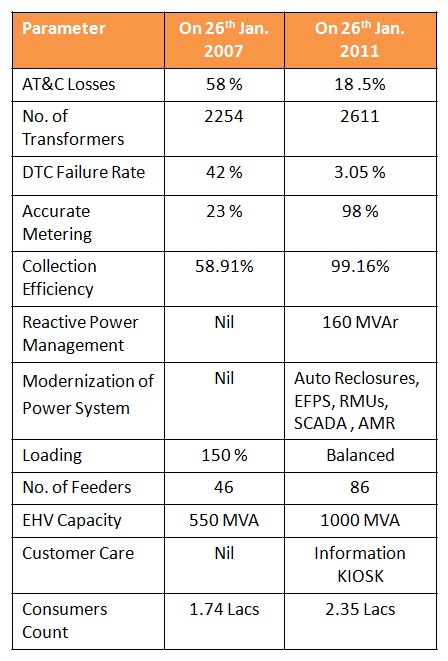
With operations commenced from 26th Jan 2007, TPL has completed a successful milestone of 3 years of its operations with ATC loss reduction from 58% to now 18.5%.

Pre-DF & Post-DF Performance Benchmarking

The table below summarizes the status on Key Performance Indicators (KPI’s) in Pre & Post Distribution Franchisee.

Power Distribution Franchisee – Bhiwandi Performance Data (Source: From M.Kele’s presentation @ IIES)

Improved management, consumer & repair services, collection efficiency led to increase in revenue from Rs. 272 cr. in FY2007 to Rs. 618 cr. in FY2009. A Customer Satisfaction Survey conducted by Prayas Energy Group revealed that approximately 68% of the representative consumers felt satisfied with the quality of supply due to system improvements under Distribution Franchisee.

Key findings going forward with Distribution Franchisee

Prayas Energy Group, Pune published a research report reviewing performance of Bhiwandi Franchisee operations and brought some considerations going forward to scale the model

  1. Improved quality of base line data is essential for to provide confidence to prospective bidders & expect rationale bidding. This will also increase accountability of licensee as well as of successful bidder for post franchisee performance.
  2. To support smooth and effective change management from utility to Franchisee and raise confidence in end-consumers on franchisee operations, a strongly enforced regulatory framework of performance monitoring and audits are very essential including the correctness of new meters and billing.

Surely, Bhiwandi model has many things to be improved upon, but it has set an inital right tone in all stakeholders – utility, businesses and end-consumers about Distribution Franchisee. MSEDCL has repeated with improvements similar model in Nagpur, Jalgaon, Shil, Mumbra and Kalwa. Many other states like Uttar Pradesh, Madhya Pradesh, Haryana, Gujarat, etc are considering this option & are at different stages of execution. Our earlier blog has covered these opportunities.

Please share your opinion on performance metrics you perceive important for evaluating Power Distribution Franchisee through comments.

Post by: Kunjan Bagdia @ pManifold

Impact that could come from Utility Measurements, Analytics and Monitoring

There are ongoing lot of controversies about Power Distribution Franchisee (DF) applications and transparency of businesses running them. While some of them are definitely right and need to be intervened, but many of them are arising from missing information. Our earlier blog ‘Lack of good baseline data & reporting leads to irrational Power Franchisee bidding‘ discussed the impact of this missing information on all stakeholders connected to Distribution Franchisee.

A perspective ‘What’s there in Distribution Power Franchisee?‘ was shared earlier. In line to that and at an abstraction level of a model, DF is about driving Measurements & Analytics, establishing baseline and monitoring performance to excel baseline and set a new one. The transition to a private ownership is one approach, which is believed to yield faster results. But it is not impossible to drive efficiency through state utilities by strict enforcement of driving interventions based on Measurements and Analytics. R-APDRP is one such attempt, but the gaps in handling the associated change management has led to increasing questions on real impact of the scheme – ‘R-APDRP: Missing understanding on usability of technology by utility people

Below is a visualization of positives that could come in the Indian power distribution sector through deeper acceptance and embedding of philosophy of measurements, analytics and monitoring.

For Utility:

  • Demonstrable benefits to the utilities in terms of increased revenue and setting on overall profit track.
  • Better integration of R-APDRP funding for building IT infra and use real-time information of network and load consumption to exert better control in terms of load management and sourcing of power.
  • With better signaling of load consumption and consolidation of information – improved load management techniques (DSM) and optimal sourcing techniques (including from external purchase or also Distributed Generation under DGBFD model) could be developed furthering utility profits.
  • Satisfaction and delight of end-consumers

For End-consumers:

  • Better quality and choice of power (conventional vs. renewables) at affordable tariffs for the end consumers.
  • Easy self-consumption monitoring of electricity would drive awareness and efficiency in consumption
  • An integrated model of DGBFD (Distributed Generation Based Franchisee for Electricity Distribution) could come live, changing the game for rural electrification in India.

Its above System benefits that drive passion in pManifold team to contribute to improving and scaling-up reforms in Indian Power Distribution sector.

Post by: Rahul Bagdia @ pManifold

Limitations of existing baseline data shared for Power Distribution Franchisee bidding

The current approach to furnish baseline information for Distribution Franchisee (DF) RFP undertaken by the utility has following limitations:

  1. Very high level indicators (on distribution losses; collection efficiencies; customer mix and connected load distribution, arrear’s for each consumer class, brief count of network assets) are shared with no systematic causal analysis to allow bidders to diagnose network’s status-quo for capital investment projection. This hampers calculated and informed bidding to happen.
  2. With highly fragmented databases and lack of integrated measurements & good practices on utility’s side, the integrity of the top-level data provided is looked upon with doubt, thus making it highly risky investment for the bidders.
  3. In lack of measurements and system level analysis before bidding, the utilities themselves do not have right judgment about the required expenditure and potential revenue increase the area could give under able DF project time. The arising low confidence let them compromise on various aspects of good contract design and post monitoring and not able to get full benefits of the DF model.
  4. Under missing information, the contract is not aptly designed thereby risking future violation or controversies endangering end-customer interests. Some elements of existing poor design:
    • Competitive bidding done purely on the basis of one parameter only – the input rate (purchase price per unit of power from the utility valid for one full year), completely missing upon the aspect of innovations that each bidder could bring and sharing those benefits with the utility
    • The benchmarked input rates quoted by the utility is function of projected AT&C loss reductions over years only and does not account for utility’s own cost of supply and time plan of invested capital expenditure and arising benefits.
    • Subsidy benefit from government is passed on completely to the franchisee increasing their revenue share. Under this the DF will be incentivized to sell more power to the subsidized customers to increase its revenue share.
    • Since DF revenue is based upon number of units used/sold, it does not have incentive to take upon DSM or load management activities and signal appropriately to the utility to help him with optimal sourcing and also support lower/no load shedding in DF area
    • Both utility and bidders do not have clear projected returns from this engagement over the project years. A clear risk-return analysis for both involved parties does not exist.

It is suggested that the utility appoints a third party to do a good baseline data preparation – integrating real-time measurements and all secondary data already with the utility. This information could go as common information to all interested bidders (at separately charged fees by third party vendor or made inclusive of utility application fees) to avoid each of them trying to secure some insiders information through parallel means. In any case with winning bidder, utility takes up a parallel joint audit for validating baseline and it is just that this process could be done before the bidding.

pManifold’s Distribution Franchisee practice could offer such DF site-intelligence report to better estimate load growth, capex roll out plan, and investment viability.

Post by: Rahul Bagdia @ pManifold.