

Five Innovative Business Models for integration of e-Mobility and RE infrastructure

Transport and energy are important for economic growth and social development, but also major emitters of greenhouse gases. Transport emits 23% of energy-related CO2 and power industry emits 40%[1]. Hence, decarbonizing these sectors is necessary to limit global warming. Both sectors’ growth can lead to increased fossil fuel dependence and emissions. Making low-carbon energy and transport a priority for sustainable development can mitigate emissions and prevent investment in fossil fuel technologies that may become unviable before their end of life. Renewables, especially solar, wind, hydro and geothermal will play a major role in decarbonizing the power industry. Electrification of transport is a key strategy for reducing transport’s CO2 emissions.

E-mobility impact on electricity supply

The ability to electrify road transport is determined by the power sector’s capacity to provide reliable electricity, and this, at affordable cost. Beyond the need for additional capacity and grid extension, the two typical challenges of the electricity sector are high losses in transmission and distribution, and grid liability. Transmission and distribution losses are estimated to be roughly 10% (or more in many countries); they often result in either higher consumer prices or higher public expenses to cover utilities’ forgone revenue. Grid reliability is another critical factor and may pose a challenge if many EVs are being charged at the same time.

EV charging loads are anticipated to be very dynamic, with spikes in the demand curve. This can have a serious impact on the distribution network, especially in distribution areas with low available hosting capacity leading to voltage instability, harmonic distortion, power losses and unreliable supply. The impact on the grid can be minimized by introducing discounted tariffs for charging during non-peak hours like Time of Use (ToU) or Time of Day (ToD). Additionally, other EV charging management solutions like battery energy storage system (BESS), smart charging and vehicle-grid integration (VGI) can be used to mitigate the negative impacts of uncontrolled EV charging.

Trends in Renewable Energy and synergies with e-Mobility

In the past decade, renewable energy production per capita has doubled. Bhutan, which is standing out with the highest electricity production per capita in the world (3,026W), sells one hundred percent of their hydropower to neighbouring nations. China, the most populous nation on earth, is the leader in renewable energy. Its RE capacity per capita is 621W, which is 2.5 times the global average. China has six times the RE capacity per capita as India. In Sub-Saharan Africa,’s RE capacity per capita is at 38W.

Increasing renewables’ integration to the grid comes with challenges for the system’s stability such as boosting grid voltage (hampering performance of the connected power equipment like DTs by overloading), injecting harmonics etc. As a result of the intermittent nature of wind and solar generation, capital expenditure in equipment like inverters and storage is needed to reduce peak load, enhance power quality, and store excess power. Integrating storage with RE will increase implementation costs, which could impede the widespread deployment of RE. Employing RE for EV charging further requires additional grid infrastructure leading to increase in grid upgradation costs.

Conversely, integrating a greater proportion of RE sources to the grid for EV charging results in benefits like higher contribution to CO2 emission reductions; it can also help minimize grid impact challenges. RE with BESS can act as an ancillary support to the grid by storing energy during high RE output hours and supplying power during off-peak hours, enhancing system reliability and resiliency. It also provides reactive power that helps with voltage control thereby improving grid stability and minimize AT&C (aggregate technical and commercial) losses. When using V2X technology, batteries from EVs can act as BESS, supporting RE by storing power and reduce additional storage investments.

Opportunities for growing e-Mobility and RE in synergy

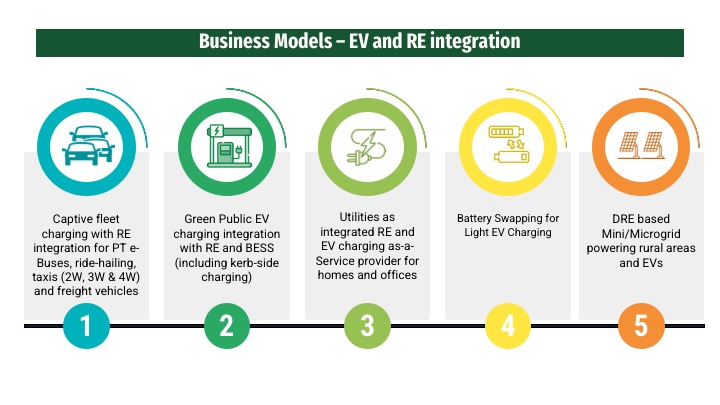
This section outlines opportunities at the intersection of both technologies, and presents various EV charging business models integrating RE. The business models (as shown below), look into different energy models, charging models, vehicle segments and applications.

Business Model 1Captive fleet charging with RE integration for PT e-Buses, ride-hailing, taxis (2W, 3W & 4W) and freight vehicles
Growth rationale· Globally, there is an increasing shift to public transport (PT) bus systems, to drive operational and financial efficiency and increase fleet size with transition to e-Buses. Also, the ride-hailing freight services market is growing globally and making an economic case for their electrification.·  PT e-buses, ride hailing taxis and freight vehicles having access to a dedicated depot in strategic city locations with ample spaces provide easy charging with RE integration opportunity· As the push to freight electrification grows, warehouses make most sense for charging, considering typical logistics profile of hub-and-spoke model or point-to-point, etc. and vehicle’s layover of ~5-6 hours during loading and unloading· Charging fleets with large battery capacities (for buses, trucks) demands more energy which makes a case for integrating with RE to help reduce load on the grid· Big roof tops as well as ground space in depots and warehouses provide opportunities for RE integration for charging. However, given size of fleet and required high MW level charging load (specially in case of e-Buses), captive RE alone may not be sufficient. And there will be a need for remote RE open access or trade offset.
Benefits· Support peak shaving (reducing load on the grid during peak hours) using RE with BESS for charging thereby reducing grid investment cost required to manage peak demand·Reduce impact on the grid by reducing harmonics and voltage instability and thereby reduce losses in the system· e-Bus/e-Truck batteries provide good stationary RE power backup storage (as BESS) at lower cost given higher daily distance run and battery utilization thereby undergoing faster replacement
Limitations · High investment cost when using batteries to store RE to power fleet overnight· Scheduling fleet to match charging pattern and RE generation requires suitable locations to install RE on site, alternatively remote access to the grid
Business Model 2Green Public EV charging integration with RE and BESS (including kerb-side charging)
Growth rationale· Public Charging stations (PCS) gives visibility and confidence to EV users and help curb range anxiety·  More and more PCS are getting integrated in existing matured commercial locations like fuel stations (intracity and highways), malls, restaurants, parking etc. These locations typically have real-estate for RE integration.· With many users doing planned home or office charging, more and more PCS use cases including kerb-side charging are moving towards quick opportunity or top-up charging.·  Real-estate space at PCS and prevailing high electricity commercial tariffs makes a business case for RE integration. Depending on space availability at the site, 100% RE can be supported with a mix of captive, remote generation wheeled through green open access, and/or RE tradable certificates.· RE plus BESS combined with a grid makes PCS greener. It also reduces both its energy and demand charges. This further integrated with smart chargers will allow PCS operators to align pricing signals with utility given ToU/ToD tariffs and drive EV charging user’s behavioural change.·  BESS using repurposed batteries from EVs could further make its deployment with RE more economical
Benefits· Provides better grid stability and reliability by supporting peak load shaving (reducing load on the grid during peak hours) thereby reducing the required grid investments (in equipment like inverters)· BESS at PCS will provide the necessary back-up power system at the time of grid failure/ outages and act as an ancillary support to the grid
Limitations · Requires considerable land/ space for deployment (which is a constraint in urban areas)· Need for smart charging solutions to better manage multiple EV charging which also calls for high investments·  Low utilization of PCS affects the business economics
Business Model 3Utilities as integrated RE and EV charging as-a-Service provider for homes and offices
Growth rationale·  Both RE and EV economics to end-users are becoming attractive for end-users and their fast proliferation is causing high grid impact. Progressive utilities have hence started facilitating their customers to improve energy efficiency, behavioural or automated demand response (through use of ToU or ToD charging) and solar roof top generation.· In many countries, there is a growing trend of providing solar roof top (SRT) as-a-service (long term PPA) to residential and commercial customers as a RESCO model. Private utilities are playing increasing roles in extending this service to their customers.· Many utilities in the developed countries are extending the charging-as-a-service (CaaS) model to home and office customers, where they are extending investment and/or rebates and hence optimising national cost on public charging infrastructure.·  EV charging shifts during high RE output hours for relatively low power e-2Ws and e-cars at home and offices through appropriate ToU and smart charging can optimise further end-user economics and also utility costs for grid expansion.·  Low and middle income countries tend to have a high share of inverter and battery power backup systems at homes and offices. These storage assets can be leveraged to charge from captive SRT and then support EV charging later in the day or night. Increasing new power backup systems allowing such high loads (ACs, EVs) running through RE.
Benefits· Managed and controlled charging can reduce the impact of EV charging on the grid
Limitations · High investment for utilities to deploy smart technological solutions to monitor real-time integration of RE and EVs
Business Model 4Battery Swapping for Light EV Charging
Growth rationale· Battery swapping allows the end-user to run EV with a swap battery· Battery swapping charging station is isolated for only swap batteries charging. This allows RE integration including captive at the fuel stations forming key locations to host battery swapping.
Benefits·  Attractive for vehicle operators as swapping does not require time, as charging does·  In commercial fleets, it increases fleet utilization, improves logistics delivery timelines, and saves time· Allows separation of batteries and EVs ownership, thereby reducing upfront cost of EVs for the end-user· Provides high asset class business model for new energy operators through improved battery life, grid responsive charging and RE integration· Reduces investments in charging network and centralizes electricity consumption· Allows using batteries as a storage (in a managed manner) and to put power back into the grid·  Addresses space constraints in urban areas as multiple batteries can be stack, using less space than parking for charging
Limitations ·  High investment cost, high automation, and high inventory of charged batteries· Battery swapping stations demands high energy from the grid to keep the batteries charged round the clock· Need for standardization of batteries (with different technologies) for interoperability without hampering technology upgradation
Business Model 5DRE based Mini/Microgrid powering rural areas and EVs
Growth rationale· Distributed Renewable Energy (DRE) based Mini/ Micro grids are a solution for supplying 24×7 electricity to many communities without adequate grid service· Financial viability of most mini/ micro grids requires strategies to increase electricity sales· Mini/micro grid need demand loads that can be time-shifted to periods when RE is available else to balance the demand-supply necessitates substantial storage facility· EV having a large on-board energy storage can provide base load to DRE mini/ micro-grids and potentially help mini/micro grid operators improve their economics and expand energy services· DRE based mini/ micro grid can potentially be an EV charging station like a battery swapping station that charges batteries during RE generation and then lease out these batteries to the EV drivers during operations allowing drivers to top up their EVs·  DRE based mini/ micro grids can use sources like solar and biogas or even hybrid source of energy (like grid + DRE)
Benefits· Provide access to affordable and reliable electricity and transport in underserved areas· Reduce loss and wastage of farm produce with increased access to transport· Provide base load to the mini grid improving economics for the operator and low-cost to the end-user· Encourage rural entrepreneurship by powering productive use applications like EVs· Ensure safety by providing power during night using battery storage· Support education by providing access to affordable transportation to schools/ colleges· Ensure seamless delivery of essential services such as healthcare, education (online learning) and internet connectivity due pandemic like situations
Limitations ·High investment cost for deploying minigrids and lack of financing support· Requires regular local maintenance support (skilling) to keep minigrid working for e-Mobility application

(The views expressed in this blog are from a Working Group Paper authored by pManifold team members developed for SUM4All and published at COP27)

More details can be referred from the following link:

Everything you need to know about impact of EV charging on electricity supply in Low-and-Middle-Income Countries (LMICs)

The adoption of electric vehicles (EVs) in low and middle-income countries (LMICs) is largely dependent on the ability of the power sector to provide reliable and affordable electricity. In these countries, access to electricity and a stable supply of it are still major concerns, and therefore it is important to consider both the power and transportation sectors together when planning and developing infrastructure for EVs.

Apart from the need for additional capacity and grid extension, the two most common challenges in the LMIC electricity sector are high transmission and distribution losses and grid reliability. In LMICs, these losses are estimated to be around 10%[1], but they can be much higher in some countries, such as Togo, Haiti, Benin, and the Republic of Congo, where losses can exceed 40%. These losses can result in either higher consumer prices or higher government expenses to compensate utilities for their lost revenue. The adoption of electric vehicles may exacerbate these losses, as they will require additional electricity to charge.

Grid reliability is another important factor to consider in the adoption of EVs in LMICs. If large number of EVs are being charged at the same time, it may strain the grid and cause reliability issues. Experience in countries with a high adoption of EVs has shown that users tend to charge their vehicles during periods of high demand, such as overnight (8pm to 4am) and in the afternoon (11am to 4pm). This may pose a challenge for grid operators in LMICs, as they may need to increase capacity to meet this demand.

The demand curve spike (as a result of EV charging) can have a significant impact on the distribution system and possibly cause voltage instability, harmonic distortion, power losses, and unstable supply. One way to mitigate these negative effects is to implement discounted tariffs, such as Time of Use (ToU) or Time of Day (ToD) tariffs, for charging during off-peak times when demand for electricity is lower. This can help to reduce the impact of EV charging on the grid.

There are also alternative solutions that can be used to reduce the negative effects of uncontrolled EV charging on the grid. These solutions include battery energy storage systems (BESS), smart charging, and vehicle-grid integration (VGI). BESS can store excess electricity generated by the grid or by renewable energy sources and then release it back into the grid when needed, helping to stabilize the supply of electricity. Smart charging involves using algorithms to optimize the timing of EV charging in order to minimize the impact on the grid. VGI involves allowing EVs to act as both a load on the grid (when they are being charged) and a source of electricity (when they are being driven and their batteries are charged).Effective connected load monitoring at the distribution and transmission levels is also critical in managing the difficulties associated with EV charging. This involves monitoring the demand for electricity in real-time and adjusting the supply accordingly in order to maintain stability and reliability.

In the early stages of EV adoption, grid stability may not be a major concern for utilities because the number of EVs on the road will be relatively less. However, as the penetration of EV grows, it will be important for utilities to prioritize load balancing between EV loads and other connected loads in order to reduce the risks of grid instability.

To meet the anticipated growth in demand for both transportation and electricity, it will be necessary to implement integrated policy changes, coordinate planning, and invest in both the energy and transportation sectors. These measures may include requiring the installation of smart meters and allowing the use of EVs for grid services in the commercial sector. By taking a holistic approach to planning and development, it will be possible to ensure that the necessary infrastructure is in place to support the growing demand for EVs.

On the other hand, adoption of EVs offers utilities and Independent Power Producers (IPPs) new business opportunities in the EV value chain. For instance, operators and service providers can use renewable energy (RE) at charging stations, and EV manufacturers can use RE at their facilities. This can aid in decarbonizing the entire EV value chain from manufacturing to recycling. The smart integration of energy storage systems with renewables can increase grid flexibility, reduce fixed demand charges, and make business propositions more attractive by providing low-carbon, reliable, and affordable energy to consumers. Collaboration between the electricity and transportation sectors can also improve energy availability, particularly in rural areas, where the development of renewable-powered micro-grid solutions may be coupled with new demand from electric vehicles.

Although the adoption of EVs may have an impact on the electricity supply in LMICs, there are a number of ways to reduce the risks and fortify the infrastructure with timely government interventions. These interventions may include implementing policies and regulations, providing financial incentives, and investing in research and development to improve technologies and infrastructure.

https://data.worldbank.org/indicator/EG.ELC.LOSS.ZS?locations=XO

Why Africa needs to focus on Battery Recycling?

In Africa itis estimated that stationary battery capacity could grow by 22% annually through 2030 due to demand from energy access applications, and mini grids alone could represent 40% of the 2030 market. Market forecasts by the World Economic Forum show that as more Africans gain access to energy over the coming years, the demand for batteries will grow to 83 GWh by 2030.

While there is a growing demand for batteries in Africa, currently it has very little capacity to produce or recycle batteries and is not as well-established as in other parts of the world. This appears to be a huge opportunity for the continent to take control of its destiny by investing in developing these capabilities and reducing reliance on foreign imports. This has the added benefit of creating local jobs and elevating the continent’s economic productivity. Additionally, battery recycling is also an important way to reduce the environmental impacts of battery production and disposal, as well as to conserve resources.

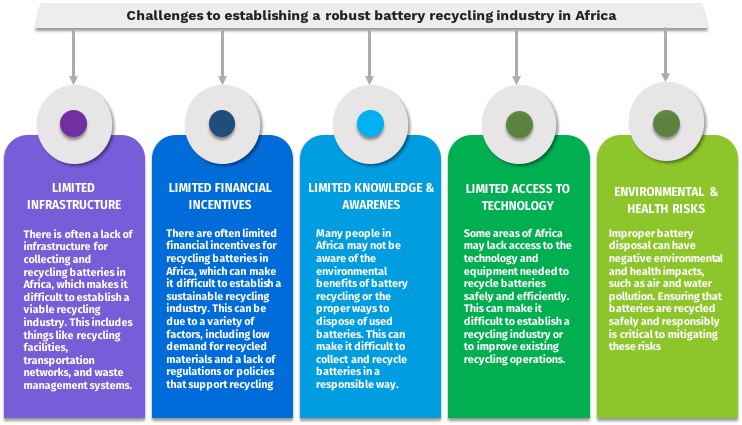
However, there are several challenges to establishing a robust battery recycling industry in Africa. Some of the main challenges include:

Despite these challenges, there are a number of efforts underway to improve battery recycling in Africa. For example, the Africa Battery Alliance is a partnership between the African Union and the International Renewable Energy Agency (IRENA) that aims to accelerate the development of a sustainable battery value chain in Africa. This includes efforts to promote battery recycling as well as to increase the use of renewable energy storage systems.

Other organizations, such as the African Battery Recycling Association, are working to raise awareness about the importance of battery recycling and to establish best practices for battery collection and recycling in Africa.

Overall, while battery recycling in Africa is still in the early stages of development, there are a number of efforts underway to improve the situation and reduce the environmental impacts of battery production and disposal.

Factors influencing future of battery recycling in Africa

One of the key factors that will influence the future of battery recycling in Africa is the increasing demand for batteries in the region. As the adoption of electric vehicles, renewable energy systems, and other battery-powered technologies continues to grow in Africa, there will be a need for more batteries to meet this demand. This could create new opportunities for battery recycling in the region.

Another factor that could influence the battery recycling in Africa is the development of new technologies and business models. As battery technology continues to evolve, it is likely that new approaches to battery recycling will emerge, which could make it more economically viable to collect and refurbish used batteries in Africa.

The future of battery recycling in Africa will also be influenced by regulatory and policy developments. Governments in the region will have a role to play in establishing frameworks and incentives that support the collection, treatment, and recycling of used batteries, and in promoting the use of recycled batteries in various applications (Distributed Renewable Energy(DRE) applications like solar fridges)

All in all, the future of battery recycling in Africa is likely to be shaped by a combination of economic, technological, and regulatory factors. As these factors evolve, it is likely that battery recycle will become an increasingly important aspect of the region’s efforts to manage its e-waste and reduce its environmental impact.

Financing India’s Electric Two & Three – Wheeler Fleets

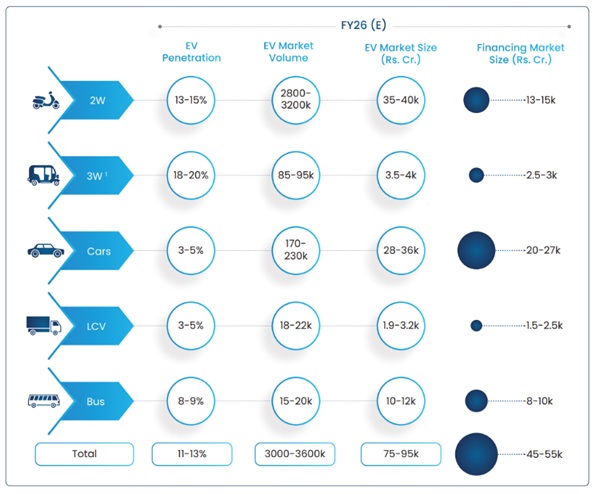
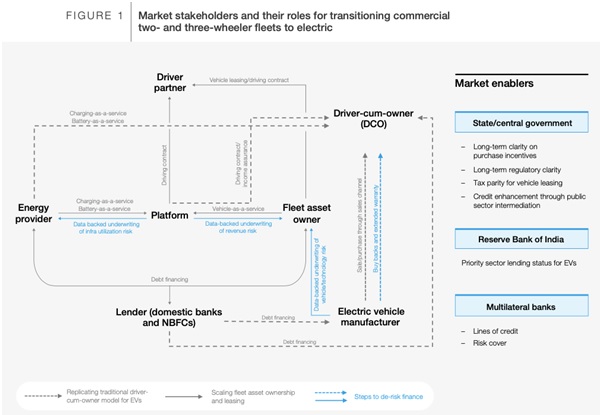
In collaboration with NITI Aayog, the World Economic Forum (WEF) published a report on the financing options in India’s Electric Vehicle (EV) industry. The report highlights capital pools and their lending status in the EV ecosystem, as well as a multi stake holder approach to market de-risking for transitioning two- and three-wheeler fleets to electric.

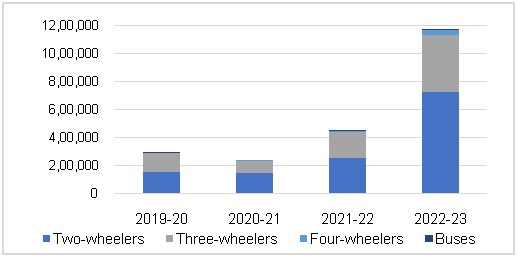
Two-wheelers (2W) and three-wheelers (3W) account for over 80% of vehicle sales in India.

The adoption of electric 2W (or e-2W) and 3W (or e-3W) has been rising steadily, supported by government policies like Faster Adoption and Manufacturing of Electric Vehicles (FAME), 40+ vehicle manufacturers, others and an impressive cumulative sales of 1 million units has been achieved. However, this is still just 1 million out of India’s total 2W and 3W fleet stock of 250 million – leaving enormous room for continued growth. Achieving 100% electrification of India’s 2W and 3W stock is estimated to require a capital allocation of approximately $285 billion.

Although initial purchase cost of EVs is higher, their running or operational cost is much lower than its counterpart Internal Combustion Engine (ICE) vehicle. Total cost of ownership (TCO) metrics show that they are already ideal for last-mile delivery and ride-hailing fleets, both of which have high daily utilization rates. For instance,

  • TCO of e-2W is INR 0.52/km (after accounting FAME incentives and specific Delhi fleet scenario) in comparison to its ICE as INR 2/km
  • The TCO of e-3W is INR 1.94/km in comparison to its ICE as INR 2.25/km for the similar scenario of Delhi fleet and accounting FAME incentives

These markets are pioneering the use of e-2Ws and e-3Ws in India and are probably among the first to make the full switch to electric. The ecosystem needs to see a multi-fold increase in capital flow if fleets are to transition quickly. De-risking the market will require improved stake holder collaboration and business model innovation in order to open large capital pools. The different capital pools and their status in EV lending are listed below and divided into three categories.

  1. Unlocked
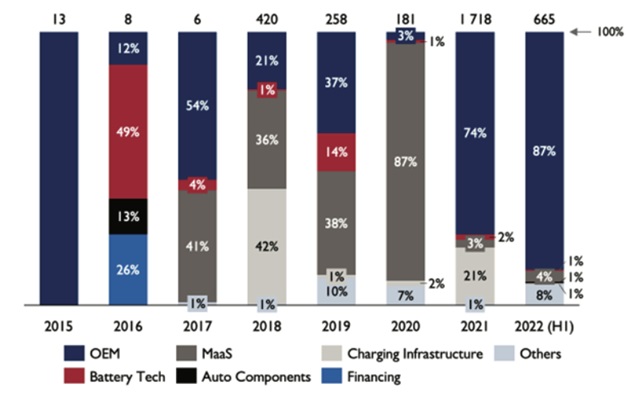
    1. Private equity has been the first pool of capital that has been unlocked and in 2021, the sector received USD 1.8 billion investments by OEMs, fleet owners, fleet operators and infrastructure providers
  2. Partially Unlocked
    1. Non-banking Financing Companies (NBFCs) are currently the main source of debt financing in this sector. NBFCs backed by Original Equipment Manufacturers (OEMs) and those specializing in vehicle financing are expected to play a greater role in financing EV fleets.
    2. Dedicated climate funds like Green Climate Fund(GCF) and Global Environment Facility (GEF) Trust Fund have approved a fund of 1.5 million USD and ~172 million USD. Such funds are being channeled through multilateral banks and other implementation partners.
    3. Other capital options that are anticipated to encourage and draw investments in green projects in the nation over the coming years include multilateral banks, venture capital, and green bonds.
  3. Locked
    1. Most domestic banks and international banks with commercial operations in India have largely stayed away from financing electric two- and three-wheeler commercial fleets.

Multi stake holder Approach to Market de-risking

No individual stakeholder can de-risk adoption for e-2W and e-3W fleets. Key stakeholders need to collaboratively engineer and test solutions. Traditionally, the driver-cum-owner (DCO) model has dominated the two- and three-wheeler commercial fleets in India, but DCOs of commercial fleets are not yet comfortable to purchase EVs due to the higher upfront cost of acquisition, lack of confidence in new technology, unassured reliability and unestablished resale value.

  • Tripartite agreements to spread the risk
    • To de-risk lending and cost of finance for large fleets, a tri-partite lending agreement between lenders, OEMs and fleet asset owners can spread the risk across parties. OEMs can underwrite technology risk, assure buy-back value and ensure after-sales service. Platforms can issue longer-term contracts to driver-partners, aggregators, etc. for deployment of EVs to underwrite risk of insufficient demand – enabling higher asset utilization for vehicle-as-a-service partners – resulting in consistent revenue stream that allows lenders to underwrite EVs for commercial operations and provide low-cost debt-funding to EV fleets.
  • Residual value and performance of EVs to be established
    • Residual value of EVs is not yet established, which increases uncertainty, affects purchasing decisions, and availability and cost of financing. OEMs can set expectations on residual value of used vehicles through buy-back programmes, or battery and product warrantees. Through use of data and analytics, vehicle manufacturers can track usage-based battery and vehicle health and can make that data available for stakeholders involved in resale.
  • Risk underwriting for lending needs to be able to leverage data
    • Unlike conventional vehicles, EVs and the supporting charging infrastructure

are in equal part connected devices generating real-time data. These data sets can be leveraged to facilitate data-backed risk underwriting for lending. For example, OEMs can make available anonymous and aggregated data sets on asset utilization and data on health of battery as the vehicle ages. The banks understanding of the technology is limited and provision of these type of insights can introduce competitive financing products.

  • Support to vehicle leasing vis-à-vis individual ownership
    • India has among the smallest share of 0.8% of leasing-based commercial fleets among large economies. Even as DCOs acquaint themselves with EV, fleet asset owners that rely on vehicle leasing can drive EV adoption in India’s commercial fleets. Leasing of commercial vehicles for fleets has a higher tax burden as compared to individual ownership – parity in tax structures for EVs can help scale up EVs on the road.
  • Preferential access to finance is required
    • It has been a long-standing demand from the industry that the Reserve Bank of India provide priority sector lending (PSL) status to EVs, on the lines of PSL for renewable energy projects to help channel flow of funds to the sector. Priority sector lending mandates certain banks to direct a specified percentage of credit to priority sectors.
  • Government push for setting up of risk-sharing facilities for consumer and fleet finance
    • To accelerate the market and steepen the learning curve for lenders, the government can work with multilateral banks and/or deploy its own special purpose vehicle (SPV) to provide sufficient first-loss risk guarantee to lenders. SIDBI-World Bank Electric Vehicles – Risk Sharing Program (EV- RSP) is an example of this.

More details can be referred from the following link:

All EV segments are Green: A myth or reality?

Electric Vehicles (EVs) are fundamentally 5-6 times more efficient than Internal Combustion Engines (ICEs) because they convert energy directly into motion, as opposed to ICEs, which must first burn fuel to produce heat before converting that heat into motion. Furthermore, the use of EVs and charging stations is expected to increase overall energy efficiency in the transportation sector while reducing fossil fuel use and improving energy security. EVs have a high potential for reducing greenhouse gas emissions because increasing energy efficiency reduces GHG emissions significantly. Many countries have pledged to reduce their GHG emissions[1] by adopting EVs in a variety of vehicle categories. But are all EV segments green? A thorough examination of each variable reveals that they are, butthe answer is nuanced and includes asterisks.

It is highly debatable whether all EV segments are environmentally friendly, owing to the reliance on the electrical source used to charge the vehicle. EVs, for example, are easily justifiable in countries where the majority of electricity is generated using cleaner, fossil-fuel-free technologies (such as nuclear and hydroelectricity).

Power generation in European countries has recently shifted its emphasis to greener technology. The majority of energy produced in developing countries such as China and India, on the other hand, is produced using coal, and as a result of their rapidly expanding economies, they have grown to play a significant role in global CO2 emissions. To better understand the eventual reduction of GHG emissions from various EV categories, it is necessary to investigate their implementation in developing countries. Because increasing the number of EVs without first assessing their GHG emissions could have a negative impact on climate mitigation efforts.

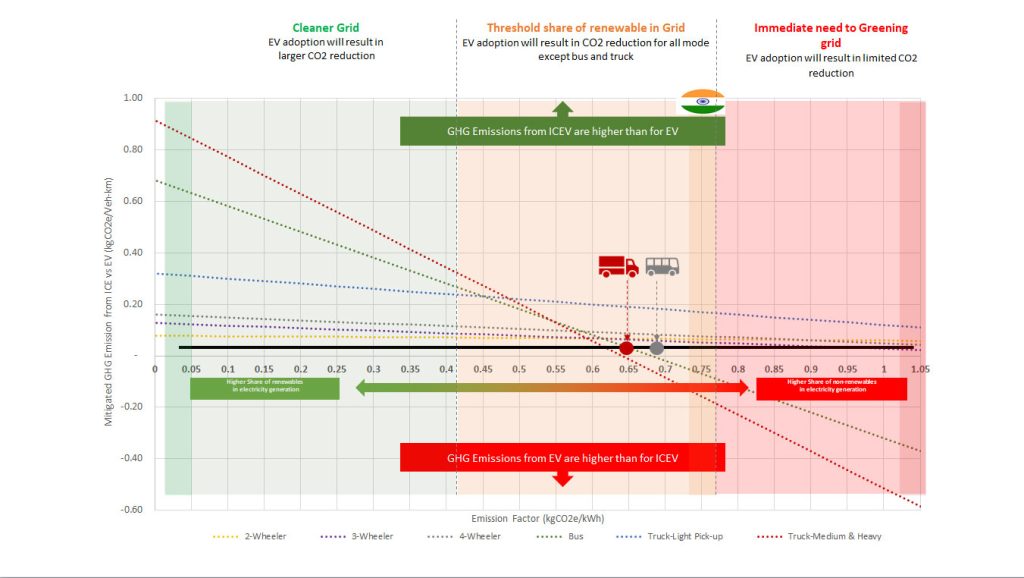
Vehicle emissions are produced during the production process (manufacturing), while the vehicle is being driven (in-use), and after it has finished its useful life. Only in-use emissions will be covered in this article; later articles will go into greater detail about lifecycle emission assessments. As indicated in the figure below, mitigation of GHG emissions from ICE vs. EV is done nationwide using all grid parameters.

A nation’s grid factor is a crucial metric to consider when evaluating emissions across various EV segments (GHG emission per unit of electricity production). Higher grid factors are associated with greater non-renewable energy use in a nation, and vice versa (as plotted on x-axis of diagram below).

In the case of India, with a grid factor of 0.75, the GHG mitigation potential is positive for all EV segments except buses and trucks as shown in the figure.

[1] GHGs included under UNFCCC are carbon dioxide (CO2), methane, nitrous oxides, perfluorocarbons, hydrofluorocarbons, sulfur hexafluoride, and trifluoride nitrogen. Only CO2, methane, and nitrous oxide are relevant to the transport sector. However, according to UNFCCC methodologies for determining emissions from the transport sector, nitrous oxide emissions are very marginal. Therefore, only CO2 emissions are included and, in addition for gaseous fuel-powered engines, emissions of methane

* kgCO2e/Veh-Km: kilogram of carbon dioxide equivalent emission per Vehicle kilometre travelled * kgCO2e/kWh: kilogram of carbon dioxide equivalent emission per kilowatt-hour * ICEV: Internal combustion engine vehicle*EV: Electric vehicle *Fuel efficiency of ICE vehicle segment: 2Wheeeler – 25 kms/litre; 3-Wheeler – 25 kms/litre; 4-Wheeler – 20 kms/litre; Bus – 5 kms/litre; Truck Light pick-up – 10 kms/litre; Truck-Medium & Heavy – 4kms/litre *Fuel efficiency of EV segment: 2Wheeeler – 52 kms/kWh; 3-Wheeler – 10 kms/kWh; 4-Wheeler – 9 kms/kWh; Bus – 1 kms/kWh; Truck Light pick-up – 5 kms/kWh; Truck-Medium & Heavy – 0.7 kms/kWh *Only In-use vehicle emissions has been accounted

Source: pManifold Analysis

It should also be noted that in countries with a grid factor greater than 0.8 kgCO2e/kWh, decarbonizing the grid should be the top priority. Because the impact of EVs on GHG reduction in such countries will be small, with high marginal abatement costs. According to experts, starting with EVs and decarbonizing the grid in parallel to promote EVs is not an effective strategy because grid decarbonization, in general, takes a long time due to the long life span of energy production units.“EVs are green for most of the vehicle segments except bus and medium & heavy-duty truck in terms of in-use GHG emissions”

Asian countries with a high share of renewable electricity production, such as Armenia, Bhutan, Georgia, the Kyrgyz Republic, the Lao People’s Democratic Republic, Nepal, and Tajikistan, will see the greatest CO2 reductions from EV deployment, whereas India, Indonesia, Kazakhstan, Mongolia, and Turkmenistan will see limited CO2 reductions.[1]

Thus, it is discovered that EVs are green in terms of in-use GHG emissions for the vast majority of vehicle segments, with the exception of buses and medium and heavy-duty trucks[2], even when the electric grid is heavily reliant on fossil fuels.

[1] Country-wise list of Grid emission factors is given by IGES

[2] Bus and medium & heavy-duty truck will result in significant GHG reductions if the grid factor is below 0.7 kgCO2e/kWh

What are the causes and mitigation measures of fire incidents in Electric Vehicles?

Recent incidents of fires in electric vehicles – two-wheelers ( e-2w) in particular – have brought focus on the safety of electric vehicles. These incidents have put a dent in the growth of EV market, which needs to be urgently addressed.

Causes of fire in EVs

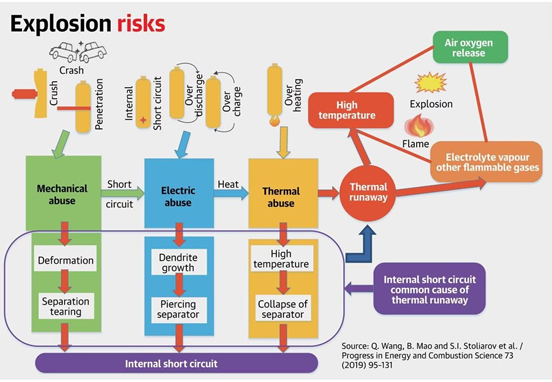
The sources of fire are varied. While most of the fires originate from the battery (thermal runaway), some of the other causes have also been found such as short circuits and glitches in regenerative braking. There are multiple cells in a battery pack, each loading and ageing slightly differently, which may cause what are called ‘hot-spots’ at specific locations in the pack. The charging-discharging cycles can result in abnormally high accumulation of heat at these hot-spots, leading to rising temperatures. However, a battery engineer of a leading e-2W, says that despite the reality of climate change and that summers are getting hotter, an EV battery made up of lithium-ion (Li-ion) cells requires a temperature rise of more than a100 °C before getting into thermal runaway and leading to fires.

While hot weather conditions and inadequate thermal management systems of the battery can negatively impact performance and shorten life, they do not necessarily cause fires. Manufacturers of most modern Li-ion batteries ensure that they automatically switch off battery operations around 45-55 °C of battery temperature. Even if these safety features aren’t built-in, it’s impossible for the ambient heat and the heat generated by batteries together to result in a spike of over a100 °C.

Preventing fire events with good battery design and protection system

Automotive Industry Standard (AIS) drafted by ARAI address the testing and certification of vehicles and engines used for both automotive and applications. They play an important role in ensuring safer, less polluting, more efficient, and more reliable vehicles.

The standard AIS048 deals with mandatory for battery compliance testing. This was originally used for lead-acid batteries but has been upgraded since for Lithium Ion batteries as well.

There is also a need to have a good battery design to prevent such fire incidents. Cylindrical Lithium-Ion (Li-Ion) cells are a good choice for EVs, which has two internal protective devices: the Positive Temperature Coefficient (PTC) and the Current Interrupt Device (CID) . The PTC protects the cells under external short conditions and the CID protects the cells under overcharge conditions. The casing of the battery should be heat conductive, robust in structure, and have electromagnetic interference (EMI) shielding. The need for effective EMI shielding is especially prevalent in electric vehicles to minimize the associated risks like damage of electrical and electronic components from corrosion, heat, and other challenging conditions.

In the case of an external short circuit, several layers of protection are required such as Battery Management System(BMS) preventive & diagnostic functions, pack fuse, and CID. Batteries also have some sensitive components like MOSFETs, and current resistors that need to be protected. Also, temperature sensors are required to monitor the battery temperatures and alert the user about possible fire risk. Therefore, industry and manufacturers need to spend sufficient time integrating safety features, testing and verifying their products to avoid such accidents in the future.

Regulatory requirements

The Global Technical Regulations are developed under the International Agreement on Vehicle Construction, to which the EU is a Contracting Party. This Agreement currently has 38 Contracting Parties (including the EU, Japan, Russia, Korea, China, India, and the United States of America). The Regulations cover the approval of vehicles’ safety and environmental aspects and are managed by the World Forum for Harmonization of Vehicle Regulations, a permanent working party of the United Nations Economic Commission for Europe (UNECE). In India, The Automotive Industry Standard has over 40 standards published that cover safety from the level of individual components. That testing is concerned with electric vehicle battery safety and lays out requirements of how those batteries must be able to tolerate a wide spectrum of abuse.

Currently, there are AIS156 in-line regulations with AIS136 for the design of electric vehicles and global technical regulations for automobiles and buses. The EVSGTR20 is designed for Phase I of this regulation, which has already been published, and Phase II focuses on electric two-wheelers. Regulations on passenger cars and buses AIS038 (Revision 2) are aligned to EVSGTR20. Regulations have been updated in all other countries in accordance with GTR20.

AIS Standards for Electric Vehicles and Chargers

StandardsDescription
AIS-038 – Electric Power Train Vehicles-Construction and Functional Safety RequirementsIt includes requirements of a vehicle with regards to specific requirements for the electric power train and requirements of a vehicle Rechargeable Electrical Energy Storage System concerning its safety.
AIS-039 – Electric Power Train Vehicles–Measurement of Electrical Energy ConsumptionIt helps in measuring the consumption of electric energy by electric vehicles
AIS-040 – Electric Power Train Vehicles – Method of Measuring the Range.It is a range test for the electric vehicles
AIS-041 – Electric Power Train Vehicles – Measurement of Net Power and The Maximum 30 Minute Power.It helps in the measurement of the net power of the electric vehicle and explains the working and benefits of the maximum 30-minute power.
AIS-049 – Electric Power Train Vehicles – CMVR Type Approval for Electric Power Train Vehicles.It is a test of grade-ability for electric vehicles.

As per Deputy Director, ARAI, fire incident is a quality issue against the default because after all, you don’t see every EV battery catching fire, but only a few of them. Therefore, instead of calling on the government to regulate, OEMs need to self-regulate.

India is participating in Phase II of the GTR20, which focuses on heat transfer, water immersion, safety requirements, and more for two-wheeler batteries. For the two-wheeler, the AIS156 was intended for mechanical abuse, thermal abuse, and electrical abuse. Apart from certification and testing, manufacturers need to perform proper design, internal testing, verification beyond certification testing, manufacturing processes, and even pattern recognition charging and discharging.

Ways to extinguish Fire

When the battery is fired, it reaches a temperature of 70°- 90°C. This is shown in various test results. There are many ways to extinguish a fire. There are three ways to put out the fire.

  • Lower the temperature
  • Separate oxygen from fire
  • Remove flammable material

Water cooling is the best method due to its large specific heat capacity (i.e., 4.2kJ/kg°C), it can absorb a significant amount of heat and reduce its temperature. Water also covers the surface of flammable substances, so it can also separate oxygen from the fire.

What can customers do?

  • Avoid charging the battery immediately after stopping the EV from running. The lithium-ion cell contained in the battery remains hot for some time. Allow the battery to cool before charging.
  • Use only vehicle-specific batteries and charging cables. Using cheaper local batteries can damage your mobility device.
  • If the battery is removable, do not place it in direct sunlight or in a hot vehicle. Also, protects the vehicle and battery from extreme temperatures. Batteries and chargers should be stored in a clean, dry, and well-ventilated place. Do not drain or fully charge the battery. Essentially, they should be between 20 – 80%
  • Regularly check the battery for damage before use, discontinue use and report to the manufacturer if any are defective. Do not use if the battery is extremely hot or damaged

Moving from Electrical Contractor to ‘Specialised O&M Managed Services Partner’ for Power Distribution Franchisees

Utilities are heavily driven by outsourcing of products and services, but most times, their integration is limited by lack of strong Service Level Agreements (SLAs) and vendor management practices. The new private operators usually start dealing with several products and contractors, and already scarce Management bandwidth gets occupied in monitoring and renegotiating contracts and performance. The key question here is – can organized vendors be developed with more end-to-end managed services for these new PPPs?

Recently, pManifold team spoke with Mr. Gagan Aggarwal, MD, Creative Entrepreneurs (CE). The company has 30+ years of experience in providing Turnkey EPC and O&M services for Power and Water utilities. The interview focuses upon ‘What new business models need to emerge for such managed services that have performance-linked contracts?’ The below shared are the author’s personal views and not to be associated with any of his company’s and other associations.

Q1) What differences you have experienced while supporting Power DFs and Discoms with normal scope of contracted work?

  • In case of Govt. Discoms, the structuring of contracts is more stereotyped. Moreover with union issues, there is also a limitation in terms of certain activities which stand reserved for the staff on rolls of the Discoms. Whereas in case of DFs, there is no such baggage and they are able to formulate contracts much more freely. Also, there is a concerted thrust by these newly formed DFs to enforce strict statutory compliances by their vendors.
  • The conventional contracts given by Govt. Discoms have predefined and fixed boundaries in terms of role, responsibility & scope, while in case of Power DFs, things are much more flexible. It happens such that we initiate the contract for one specific given activity, but as the scenario keeps changing rapidly, there is an opportunity of augmentation in other types of activities. Based on the circumstances, there are new situations to dealt and attend it, without any loss of time, to make an overall effective contribution.
  • There has been a very dynamic way of working, while supporting & dealing with Private Power DFs, compared to the conventional contracts offered by the Govt. Discoms.

Q2) How have you tailored and expanded your service offerings and delivery to fit Franchisee model better? What more your current tacit knowledge allows you to do better than others, something like Transformer Mgmt., Meter theft mgmt. etc.?

  • As we are gaining more experience and that too across various diverse areas, we are able to offer increasingly effective solutions in sync with the requirements of the Franchisees.
  • In another instance while working in a particular city, it was observed that power theft turned out to be a much bigger daemon & much more difficult to tackle than had been anticipated earlier. Special measures had to be immediately taken up to handle the developing situation so that the project could proceed as scheduled.
  • Though most activities that we carry have elements of Distribution Network, new subsets keep emerging all the time, mainly due to public reaction and observed deviations from the anticipated results. Like for one of the DFs, we started with the activity of laying their 33KV cables to augment the power availability from the SEB, soon the priority changed to converting the LT Overhead network to Underground to reduce theft and even this job was very dynamic based on the feedback and calculations of energy saving for given Distribution Transformer. Thereafter, only those DTs were taken up which would provide maximum benefit for the cost incurred. So all in all because of the constant challenges faced by the DFs the approach had to commensurate with the situation.

Q3) What changes you went through from moving from normal ‘Contractor’ to specialised ‘O&M Managed services provider’?

  • Many times the overall cost has been drastically reduced by the implementation of Trenchless Technology in lieu of Trenching methods thereby avoiding the exorbitant restoration charge by the municipal authorities. With the adaptation of appropriate technique suiting the specific site conditions in the urban areas and the quantity based pricing model provides a win-win situation for both the DFs and the service provider. This gives the DF an opportunity to deal with less vendors and for the vendor it becomes a case of economy of scale. It’s given infrastructure in a particular city being able to generate more business.
  • While normal contract working is more mechanical in its approach, a specialized O&M Managed service provider has to be much more proactive and of a system-study-&-implement kind of outfit. One has to understand the issues, rather than the ‘apparent’ requirements; to do a fair assessment and analysis; to suggest and discuss with the DFs, followed by implementation of the solution, as deemed relevant.

Q4) What loss reduction opportunities you see on both Technical and Commercial loss reduction with integrated O&M services contract?

  • Lot of integration is possible, if the service contracts are formulated for a phased manner implementation, for instance we do the network study and analysis to suggest the loss reduction schemes in phase I, thereafter we implement the approved schemes by carrying out field execution, then comes the maintenance of the Network.
  • On the power theft issue, there has to be a strong & clear political will. States where the government & administration has actively supported the efforts to curb the menace of power theft have done subsequently well. Losses have come down, the speed & extent of modernization has gone up, overall power reliability & availability has improved. On the other hand states where authorities have shied away from their role & responsibility in dealing in a stern manner on the power theft issue are languishing at the bottom of achievement charts.
  • On the technical front, we have to keep exploring and invest in the latest technologies to accurately identify components / areas, which are a source of high percentage losses. which needs immediate attention, so as to provide us with a working life line.
  • I am of the firm view that, with most cities the power distribution situation is unsustainable, unless we are able to bring down both the technical & commercial losses to an absolute minimum. Energy saved this way is twice as good as energy produced, as the energy produced would again be subjected to such high AT&C losses.

Q5) There is always ongoing tussle for quality and pricing between contractors and Utility Operators. What best practices you have seen in contract design and Monitoring? What new performance linked contracts will you be open to work?

  • The concept of performance linked contracts is a novel one, but is marred with lot of uncertainties. We are open to such contracts with a rather long term commitment, as only then can there be viability in such contracts.
  • So having prescribed the minimum must have quality parameters based on the aforesaid attributes, cost should be worked out. And then there is cost associated with a quality work
  • Yes, this is a classic dilemma, not just in our Industry, but I think its universal. Although such a tussle is an essential ingredient in any system, I would say, we have to go with a balanced approach. We have to go a step further & assign different attributes to quality in terms of minimum quality parameters for safety; minimum quality parameters for statutory compliances; minimum quality norms for long life of the Distribution Network Components etc.

Q6) Managing Labor work force has always been challenging, and so different models of outsourcing and pay roll management emerging with mixed results. How are you tackling this and keeping your grounds team motivated?

  • Needless to say that an efficient & effective workforce is more than half the battle won, it is very important to have them motivated by incentivizing their working. The incentives have to be assessed based on a very precise monitoring & recognition system. The genuine effort has to be recognized and appreciated. Create similar independent groups capable of carrying a given set of activities, assign similar works to these different groups, induce a healthy competition, the group working more or faster earning better incentives. And provide everyone with the right resources and working environment are some of the practices regularly used at CE.
  • We have been in this sector for the last 3 decades & have seen a huge change in the availability of labor force. With so many opportunities for them, thanks to the ongoing developmental phase in the country & due to government schemes like NREGA, this resource has become scarce and as a result very precious.

Q7) With your experiences with multiple DFs, how confident you feel that DF could emerge as successful model?

  • Well very frankly the confidence right now is not very high. The DF models are still evolving, fine tuning the various terms, experimenting with different methodologies. The overall financial scene also makes the current situation give a bleak outlook.
  • But having said so, I am absolutely clear that there is no option but to sort these issues out. To have any sort of sustenance in the Distribution System across the entire country, the inefficiencies have to be reduced. It may take a few iterations for the best & most effective models/mechanisms to evolve, but they have to eventually evolve.
  • Since Power features in the basic infrastructure elements of any country, no one can afford to neglect it even in the slightest way. It is so very essential for the nation building that all the stakeholders will have to come together & join hands to take things to the next level.

Summit knowledge partner at 2nd Annual Electric Vehicle India Summit 2019

pManifold was the knowledge partner at 2nd Annual Electric Vehicle India Summit 2019 which was held from 25th – 27th February in Delhi organised by Explore Exhibition

The Summit was held for 3 days. 1-day Workshop followed by 2 days Conference where various EV Thought Leaders imparted knowledge & shared their insights with the audience.

Day 2 Rahul Bagdia, Director and Co-Founder, pManifold Business Solutions Pvt. Ltd. Moderated Panel Discussion:

What Indian EV industry needs in terms of policy changes in order to create the thrust.

  • EV Policies & Regulations – Current EV policies and regulations and their implications. How the federal, state, and local regulations interact with one another
  • Moving forward: What to expect from the new policies & their regulatory standpoint. Best practices & FAQs in regulatory frameworks to facilitate market-friendly uptake programs
  • Electric Vehicles moving forward? – The current state of Electric Vehicles, manufacturer’s perspective

Presentation coverage by Rahul Bagdia:

Day 3 Rahul Bagdia was a speaker and spoke on An in-depth survey into the possibilities for e-2 wheelers and e-4 wheelers fraternity.

Presentation : EV Charging Economics for 2W, 3W, 4W and Bus, and associated Private Investments & Financing

  • EV Adoption & Maturity across Vehicle Segments
  • Mix of EV Charging Options and Infra at City Level
  • Economics for EV & Charging
  • Business Models, Investments & Financing

pManifold launched “India EV Outlook Survey 2019Q1” during EV India Summit 2019 to consolidate industry views around some of the most important questions around EVs and India forward standing. Speakers & Participants actively participated in LIVE POLL and received an opportunity to see LIVE results.

We have launched it on one of our venture company pManifold Infolabs developed LIVE polling app “Consult Engine“. You can install it using Google play store on your Android, or take it on web app at https://app.consultengine.com/