

Cheat sheet for Distribution Franchisee

This is a consolidation of our previous blogs, focussed more to help the current bidders for Madhya Pradesh DF bids.
 Bidders Perspective

Utility and Regulators perspective

Customer perspective

Distribution Model perspective

        Also pManifold organised a workshop Utility Monitoring and Power Distribution Franchisee: Enhancing SEB’s Performance 

Also we have detailed local intelligence reports on customer opinion, preferences and satisfaction for distribution utilities for the 3 towns of Gwalior, Ujjain and Sagar. The results are presented using intuitive GIS maps at town level to give localization of 28+ power and service quality attributes. This will allow bidders to get increased ROI from their on-site technical due-diligence by pointing location specific key areas of concerns for power delivery services and also better estimate/validate the required capex and opex. Each site comprehensive report is priced at Rs. 25K only. A consolidated 3 towns top level comparison report is also available at the same price. (See report sample)

Post by: Rahul Bagdia @ pManifold
DF Attractiveness Matrix: Revised 4 RFPs for Bihar Distribution Franchisees

Recently, BSEB has released revised RFPs for Power Distribution Franchisee for 4 districts in Bihar – PESU, Muzaffarpur, Gaya and Bhagalpur.

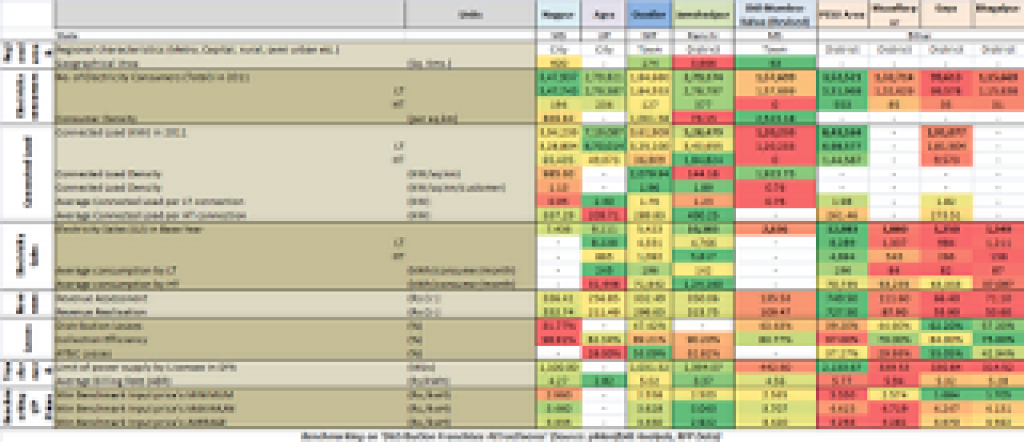
pManifold’s DF Attractiveness Matrix, provides a quick comparative study on key decision parameters for Bihar 4 DFs with reference to other states DFs like for Nagpur, Agra, Gwalior and Jamshedpur. (click on the image to see enlarged view)

 Some of the key excerpts are highlighted below:

    • The current DF scope is at District Level for all the areas. Adjoining areas (approx within 15-20 km) are also in scope of DF.
    • Geographical Area (Sq.Km.) is not mentioned in the RFP. However, a rough map (not to scale) is provided in RFP for indicative purpose.
    • Patna city and its adjoining areas comes under PESU, which has the highest consumer base compared to other areas/regions. Others are in the range of consumer base of 1.15 lakhs.
    • Connected Load (in KWs) is highest in PESU area, followed by Agra, Jamshedpur and Nagpur in that order. Connected Load for Muzaffarpur and Bhagalpur is provided only at urban (i.e. town) level and not at district level.
    • Electricity Sales (LUs) is highest in PESU area, followed by Jamshedpur and Agra in that order
    • Collection Efficiency is second highest for PESU area, after Nagpur, while it is comparatively low for other towns (i.e Gaya, Muzaffarpur and Bhagalpur in that order) creating good opportunity there for improving commercial losses from effective DF operations.
    • Distribution losses is highest for Gaya, followed by Bhagalpur, Gwalior in that order. PESU area has least Distribution losses in Bihar regions.
    • AT&C losses is highest for Gaya, followed by Gwalior. In Bihar, AT&C losses from high to low rank from Gaya, Bhagalpur, PESU and Muzaffarpur.
    • Average Billing Rate (ABR) is among the highest for all the areas in Bihar (Avg. Rs. 5.58/kWh), which is highest when compared to others like Gwalior, Nagpur, etc. (This raises some concerns on the reliability of the shared ABR rates)
    • BSEB has specified minimum Benchmark Input Price’s for bidders. The minimum benchmark price is for Gaya, followed by Bhagalpur, and highest for PESU area.

Clearly, across all regions, PESU area will likely attract more bidders because of its volume. The other 3 regions will attract small and new players to develop their base in fast emerging DF landscape in India. The baseline shared in RFP is still not very strong, and will attract many questions during the pre-bid meeting, that is planned for 16th Nov, 2012. Emerging Bihar calls again and this time for success of its first DF model, which will hopefully see increased participation.

Reference: BSEB RFP http://tenders.bih.nic.in/tenderdocs/TD-01-21-10-2012.pdf

Financial Institutions with outstanding debt to Discoms should take Equity position under planned restructuring to bring effective Performance Management’ says Amulya Charan

Mr. Amulya Charan, Chief Mentor, Power Trading and Advocacy at Tata Power has 22+ years of experience in the Indian Power Sector, spanning Generation, Transmission, Distribution and Trading. With senior Mgmt. roles at NTPC, Power Grid, Tata Power Ltd., he was ex- MD at Tata Power Trading Company Ltd for four years. Mr. Charan shared following views in recent meet with pManifold..

Q1) What are the Key Issues with our Discoms?

  • SEB Financial Health – another sub-prime crisis in the making
    • The cash losses of SEBs have increased 40x FY05-09 to a colossal Rs 284 bn and AT&C losses continue to scare at 28% (All India)
    • These losses along with theft of electricity and insufficient increase in tariffs have been the reason for staggering financial losses and curtailing their ability to service their customers
    • The investment by discoms in upgrading the distribution infra is much lower than required due to unavailability or limited availability of cash
  • High Debt exposure of lenders to the Power Sector
    • Outstanding debt of state power utilities have grown to a staggering Rs 6 lakh crore or 6% of the GDP. Roughly a third of these are loans taken to fund past losses which cannot be serviced through tariff hikes and, hence, are being considered for a benign restructuring by the Centre. Unless big reforms are undertaken to stem losses and spur revenue streams, these liabilities would grow further to Rs 7.3 lakh crore by March 2013. This looks like a reasonable estimate, given that annual losses (after receipt of subsidy) of discoms in the country were Rs 42,415 crore in 2009-10, up 18% over the previous year.
  • Weak Power Tariff Structure and Revision
    • Around 14 states raised tariffs for FY13 ranging from 2% to 37% and are already very high for certain categories such as industrial and commercial users.
    • In India, the industrial and commercial consumers pay a relatively higher tariff and cross-subsidise the lower end of domestic consumers and agricultural consumers who pay a much lower tariff and also account for mitigating the high AT&C losses partially.
    • In countries like US, France, New Zealand, Germany etc, the industrial tariffs are lower than domestic tariffs.
    • Indian Industries have been put at a competitive disadvantage due to the high cost of power and the need for redundant investment in backup generation infrastructure to mitigate the impact of frequent load shedding.
    • Subsidy from state governments was estimated at 18.94 per cent (Rs 29,665 crore) of the total revenue of state utilities in 2008-09. Although subsidies booked have grown at 30 per cent a year, cash received stood at only 14 per cent. Government Subsidies are often not paid in a timely manner.
  • Unacceptably high AT&C Losses
    • The difficulty in tapping  latent demand from households in rural/semi-urban regions across India are poor distribution infra and high AT&C losses in that region. Hence, 8% growth in demand for power over FY13-17 is an optimistic scenario considering the practical impediments of poor distribution infra and the reduction in AT&C losses and improvement in financials of discom will be gradual.
    • The T&D losses in India are substantially greater than in other emerging market countries, highlighting the drag exerted by the power sector on India’s economic prospects. Compared to a number of emerging markets, India’s power sector is substantially more inefficient. For example, the proportion of power output that is lost in India is five times greater than in China. Globally, the losses are between 6-12% whereas in India they range between 30-40% demonstrating an opportunity for drastically improvement.

Q2) What inefficiencies in current Load Shedding mechanisms and how more accountability can be brought?

  • At present distribution companies adopt to indiscriminate short term load shedding citing power shortage as the reason, when plenty of power is available to be dispatched. There have been instances in last year where more than 15 GW of power generation was available in the market to be dispatched at a price lower than INR 3/KWH and still several discoms resorted to load shedding. Industries try to tide over this shortage by investing into captive diesel power generation, which costs to the industries over INR 12/KWH, thus putting Indian Industries at a competitive disadvantage globally, and at the same time increases diesel subsidy burden on the government.
  • Ideally SERC should enforce load shedding protocol putting a limit to the extent of load shedding by the discoms. Also scheduled load shedding and unscheduled load shedding should be monitored and treated differently, where there should be penalties on unscheduled load shedding.
  • There is a crying need for peaking power to tackle the issue of load shedding during the peak hours. A regulation to encourage peaking power generation in India is already drafted by CERC, and it should be pushed for immediate implementation.

Q3) How do you see the impact of Open Access to Power Distribution landscape in India?

  • If the DISCOMs are unable to supply quality power to consumers then there should be a mechanism by which consumers may have access to alternative sources of reliable power.
  • The same can be achieved by separation of physical infrastructure and services – i.e. separation of the wires & supply businesses. This would enable competition between service providers for both wholesale and retail customers thus increasing efficiency and quality of service. Distribution is in the realm of 29 state governments. Thus, moves related to open access, free power to farmers, privatization of distribution networks, tariff increases et al fall in the area of state-level politics and are, thus, less likely to move either speedily or in an orchestrated manner. Presently, Open access is a step in this direction but it faces a few major issues.
  • Issues being faced in Open Access:
    • Apprehension in the minds of Distribution Utilities about losing high revenue cross subsidizing consumers.
    • States invoking emergency provisions under the Electricity Act, 2003 to prohibit such transactions, quoting acute power deficiency
    • DISCOMs are unwilling to provide backup power to consumers opting for open access
    • CIL refusing to sign FSAs with generator which do not sign long term PPAs with DISCOMs
  • Following steps may be taken to remove impediments in Open Access:
    • Establishment of Merchant Power Generation capacity should be encouraged
    • Regulatory and technical barriers for open access need to be reduced for greater assurance to customers
    • Augmentation of Transmission Network
    • Reduction in cross subsidy charges
    • Retail tariff of DISCOMs should reflect the cost of supply by regular tariff revision.

Q4) Shortage of Fuel is one sighted reason for peaking Electricity demand gap. How do you see it?

  • The demand for coal is expected rise to 980.50 million tonnes by 2017. The domestic availability of coal has been pegged at 795 million tonnes. This demand-supply gap of around 200 million tonnes is expected to be made up substantially by imports by 2016-17.
  • A significant amount of capacity is stranded owing to the non-availability of gas. Rising demand and falling domestic production has pushed the share of imported gas to 40 per cent of the current consumption in India.
  • On the logistics front, serious issues remain on the efficiency and capacity of railways and ports to handle 200 metric tonnes of imported coal. Liquefied natural gas, or LNG, terminals to receive imported gas require augmentation as well as pipelines across the country.

Q5) How do you see the role of our Regulators? What needs to be changed?

  • The role of the regulator in India is envisioned as a distinct role with minimal political influence. However, in practice it is seen that there is a significant lag between cost of fuel and tariff realizations due to political pressure to keep tariffs low. The SERCs need to be given further autonomy by the states including separation of finances and availability of funds.
  • State Electricity Regulatory Commissions (SERCs) must ensure appropriate frequency of revision of customer tariffs (proposed quarterly such that there is no significant lag between cost of fuel and tariff realizations)
  • SERCs need to provide a roadmap for removing cross-subsidies as part of ongoing tariff rationalization

Q6): How you propose to bring correction to our Power Distribution utilities performance in India?

  • Bailout/restructuring of the Discoms that is being discussed, it is suggested that Government of India should ensures that the financial institutions which have outstanding debt to the Discoms should be allowed to become equity holders as part of the restructuring plan. This would then ensure an independent check on the future performance of these discoms.
  • SERCs must ensure submission of Multi-Year Tariff petition and a comprehensive power procurement plan by discoms based on their demand assessments (suitably verified by external agencies)
  • Cross subsidy should be eliminated and the consumer segments needing subsidization be given subsidy by way of direct cash transfer by the Government
  • AT&C losses should be brought down by the use of technology and investment is adequate distribution infrastructure and metering systems
  • A clear segregation of Aggregate Technical and Commercial losses needs to be furnished by each discom to the concerned SERC demonstrating improvement in efficiency by pursuing metering of all loads including agricultural and prevention of theft by curtailment of supply
  • SERCs must issue Load Shedding Protocol for discoms and enforce the Universal Service Obligation – discoms need to provide information on planned, actual load shedding and rationale for load shedding daily
  • State Load Dispatch Centers (SLDCs) must track and report all open access applications made, placing all applications in the public domain and update the status including the objections against any application; it must also set a deadline for approving or disapproving each application and record the same on its website – this needs to be enforced by the SERCs
  • Government must take immediate steps to introduce competition in distribution by making a supportive framework for viability of discoms, enabling lasting private sector involvement and also by promoting open access route to enable consumers select their supplier in parallel to the privatization efforts
  • State Regulators must introduce transparency in their own operations, and must continuously monitor, evaluate and publish the performance of the State discoms on both Technical and Commercial parameters including regular monitoring of Finances and Audit of Accounts
  • Regulator must strive for creating an incentive structure for performance improvements in distribution and there is a need for periodic performance evaluation and regulatory impact assessments for ERCs.

The above views are respondent’s personal views, and not to be associated with his company in any other ways.

Bihar calls again: Revised 4 Power Distribution Franchisees for Patna, Muzaffarpur, Bhahalpur and Gaya

Bihar State Electricity Board (BSEB), after a long gap of nearly 2 years has come back, issuing revised Request for Proposal (RFP) for appointment of Distribution Franchisee for following areas/regions:

  • PESU Area
  • Muzaffarpur town and adjoining areas
  • Gaya town and adjoining areas
  • Bhagalpur town and adjoining areas

At last, BSEB got a final go ahead from the High Court to re-initiate its privatization initiative for Power supply, which went into long litigation detour with earlier entrusted Essar Power group. Having not received formal acceptance from Essar to its issued LOI in-time, BSEB has cancelled the bid, and issued fresh tender on Oct 22, 2012.

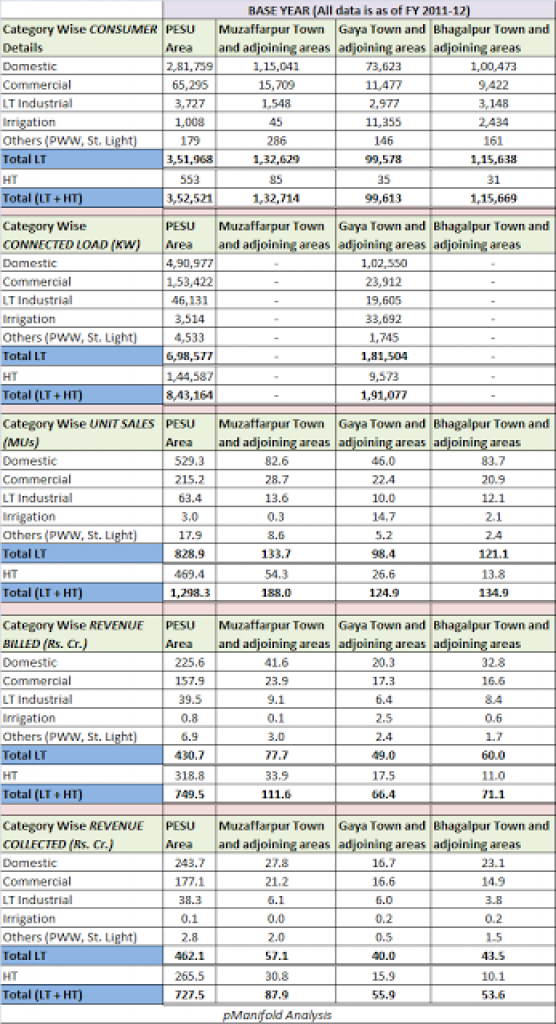
The model is 15 years Input Based DF, with below compared heterogeneity in Network, Consumers and Revenue. Key parameters like Consumer Base, Connected Load (MW), Unit Sales (MUs), Revenue Billed (Rs. Cr.) and Revenue Collected (Rs. Cr.) for all the areas/regions are compared across consumer categories (broadly Residential, Commercial, Industrial (LT & HT), Irrigation).

Other important parameters like Losses, Average Billing, Collection Efficiency are shown below. Few excerpts from the same are as follows:

    • Input Units is highest for PESU, followed by Muzaffarpur, Gaya and Bhagalpur
    • Transmission & Distribution (T&D) losses is highest for Gaya, followed by Bhagalpur, Muzaffarpur and PESU
    • Collection Efficiency is least for Bhagalpur and highest for PESU
  • Calculated AT&C losses is highest for Gaya, followed by Bhagalpur, PESU and Muzaffarpur.

Important Dates:

  • A pre-bid meeting is scheduled on 16th Nov, 2012.
  • Last date of submission of Technical bid – 17th Dec, 2012.

We wish good turnout and rationale bidding for these new coming DF opportunities. pManifold services include for DF turnkey bid advisory including Partner Identification, Technical Due-Diligence, Financial Bid Modeling and Bid Preparation. For more details, contact at rahul.bagdia@pmanifold.com or kunjan.bagdia@pmanifold.com

RFP can be downloaded from the following link: http://tenders.bih.nic.in/tenderdocs/TD-01-21-10-2012.pdf

Ease of doing Distribution Franchisee business – PESU Local Intelligence

Ease of doing Distribution Franchisee business – PESU Local Intelligence

Apart from technical & financial parameters it is important for the bidders to evaluate the local intelligence for its operation & ease of setting up a business. pManifold has developed a process to research on the local intelligence through its network & secondary research to provide bidders with glimpse of the region on Demographics – Social & Economical, Political stability & activities & enable them making right decisions. Below is the quick snapshot from the local intelligence report from pManifold on Ease of Operationalizing Distribution Franchisee.

Patna is the capital city of Bihar state. It is located on the south bank of the Ganges River. The city is approximately 35 km long and 16 km to 18 km wide. The table below shows the quick facts about the region

Patna
Municipal CorporationPatna Municipal Corporation (cc
No. of Household726,364 (Census 2001)
Male population3,051,117
Female population2,721,687
Total population5,772,804
Density(peoples/sq.km)1,803
Slum households15163
Slum population63.5% (Census 2001)
Literacy Rate72.47%
  • Growth Rate: On the basis of, assumed average annual growth, Patna has been ranked as 21st fastest growing city in the world and 5th fastest growing city in India by City Mayors Foundation. Patna registered average annual growth of 3.72%, for the period of 2006-2010. As of 2010, the per capita income of Patna was ?. 37,737.
  • On the radar of Experts:  World Bank ranked Patna in second place in India, after Delhi, in terms of the ease of starting a business.
  • Transportation: Patna is well connected to other cities via
    • Airways:  Patna has got a Lok Nayak Jayaprakash Airport or Airport Patna with connectivity to major Indian cities. The nearest International Airport is at Gaya which is 96 km from Patna. The new Airport is expected to built at Bihta.
    • Railways: Patna is located on the main line of East Central Railway hence connected with important cities of India.
    • Roadways: The city has major road highways and state highways.
    • Local Transportation: The local transportation in this area are Buses, Auto rickshaws and Local Trains. The Planning Commission of India has given nod to Patna Metro recently. Ground survey for Metro has been started.
  • Industrial Area: Patna has Industrial Area Development Authority with an objective to promote and develop. State government is mulling an IT hub at Bihta. For this the Tata Consultancy Services (TCS) has already been assigned with the responsibility of developing a main data centre which will provide IT link to all government departments.
  • Government Offices:  Patna has got many Government offices like High court, Secretariat, District Rural Development Agency (DRDA) Administration, Bihar Vidhan Bhawan etc.
  • Talent profile: Apart from various schools & colleges Patna has some of the well known institutions like IIT, NIT, BIT & AIIMS.
  • Crime Rate: According to sources, the state capital seems to lead in crime in Bihar, despite the 12 per cent fall in crime figures claimed by DGP.
  • Cost of Living:  3 BHK flat can be purchased at the rate of Rs. 25+ Lakhs, rented at 10K+ per month & a shop can be rented starting from 8K depending on size & locality
  • Entertainment: Patna has got many malls and multiplexes, restaurants, parks & also playgrounds including International Stadiums.
  • State Governing Party: The current government is governed by NDA comprising of JDU & BJP in the leadership of Chief Minister Nitish Kumar.
  • Local Municipal: The Patna Municipal Corporation is governed under the leadership of Municipal Commissioner  Pankaj Kumar Pal & city Mayor Afzal Imam.
  • Political Activities: ‘Mehangi Bijli Virodhi Sangharsh Manch’ has planned a statewide protest on November 19 2012 against the hike in electricity tariff in Bihar.
  •  Power Distribution:  The PESU region of Bihar for the power distribution is divided into two
    •  PESU East area has five subdivisions which are Rajendra Nagar, Bakipur, Kankarbagh, Gulzarbagh and Patna city.
    • PESU West area also has five subdivisions which are Patliputra, New Capital, Dakbunglow, Danapur and Gardani Bagh.

A complete report on Local Intelligence on PESU region is available. To get this report contact rahul.bagdia@pManifold.com

Ease of doing Distribution Franchisee business – Gaya Local Intelligence

Gaya is located at 24.78°N 85.0°E. Gaya is the second largest city of Bihar. Gaya is 100 kilometers south of Patna, the capital city of Bihar. Situated on the banks of Phalgu. It is surrounded by small rocky hills by three sides and the river flowing on the fourth (eastern) side.

RegionGaya
Municipal CorporationGaya Municipal Corporation
No. of Household510,968(2001)
Male population2,266,865
Female population2,112,518
Total population4,379,383
Density(peoples/sq.km)880
Slum population26620(2011)
  • Literacy Rate: Average literacy rate of Gaya in 2011 were 66.35. Gaya District has 2,399,682 literates, of which male and female were 1,427,447 and 972,235 respectively.
  • Transportation: Gaya is well connected with other cities in India via
    • Airways: Gaya Airport is the only international airport in Bihar and Jharkhand.
    • Railways:Gaya Junction is the second most important railway station in Bihar. Grand Chord rail-line that connects Howrah and New Delhi passes through Gaya junction.
    • Roadways: The National Highway 2 Grand Trunk Road from Kolkata to Delhi passes about 30 km from Gaya. Plans have been made to construct a four lane road from Gaya to Patna.
    • Local Transportation: City bus, taxis, tongas, auto rickshaw, cycle rickshaws ply across the city and for Bodhgaya.
  • On the radar of Experts: The Ministry of Panchayati Raj named Gaya one of the country’s 250 most backward districts (out of a total of 640). It is one of the 36 districts in Bihar currently receiving funds from the Backward Regions Grant Fund Program (BRGF).
  • Talent Profile: Gaya has many schools and colleges. Magadh (Gaya) University has 460 Acres of campus area is among the largest Universities of Bihar. It has 44 constituent and 105 affiliated colleges.
  • Cost Of Living: A house with 3 bedrooms can be purchased at the rate of 20 Lakhs.
  • Entertainment: Gaya has many historical places like Bodhgaya, Ghats and temples, it is a place sanctified by the Hindu, the Buddhist and the Jain religions. It also has many multiplexes and Malls like APR Mall, Prathima Multiplex, Gautam Buddha Cinema, Kiran cinema etc. for entertainment.
  • Local Governance: Gaya Municipal Corporation known as Gaya Nagar Nigam under the leadership of Mayor Vibha Devi who belongs to state Youth Congress.
  • Power Distribution: There are total three Division/Sub-Division present across Gaya town and its Adjoining areas
    • Division Gaya (Urban).
    • Sub-Division Bodhgaya.
    • Sub-Division Manpur.

A complete report on Local Intelligence on Gaya region is available. To get this report contact rahul.bagdia@pManifold.com

Ease of doing Distribution Franchisee business – Muzaffarpur Local Intelligence

Muzaffarpur located at  26°07?N 85°24?E. The district occupies an area of 3173 km. Muzaffarpur lies between the Burhi Gandak River and Furdoo nallah. Muzaffarpur is one of the many gateways to Nepal.

RegionMuzaffarpur
Municipal CorporationMuzaffarpur Municipal Corporation
No. of Household650,882(2001)
Male population2,517,500
Female population2,261,110
Total population4,778,610
Density(peoples/sq.km)1,506
Slum population77456 (2011)
  • Literacy Rate: Average literacy rate of Muzaffarpur in 2011 were 65.68. Total literate in Muzaffarpur District are 2,601,665 of which male and female were 1,539,154 and 1,062,511 respectively.
  • Talent Profile: Muzaffarpur is the 2nd leading center of education in Bihar after Patna. It has a medical and an engineering college, and is seat of one of the oldest universities of Bihar. It has many Schools and Colleges as well.
  • Transportation:
    • Airways: The airport, Patahi Aerodrome, had regular flights to some cities but does not operate any commercial flights now.
    • Railways: Muzaffarpur Railway Station is a main railway junction, with two suburban stations, Ram Dayalu Nagar and Narayanpur.
    • Roadways: The National Highways which passes through Muzaffarpur are NH 57, NH 57A, NH 102. Local and inter-state buses start from Bairiya and Imli Chatti Bus Station.
  • Local Transportation: City bus, taxis, auto rickshaw and cycle rickshaws are available for local transportation across the city.
  • Utility
    • Power: Muzaffarpur has Thermal Power Generation plant of N.T.P.C which is run by the central government has the capacity of 110 Megawatts.
    • Water: The water supply of the town is based on ground water since the water quality of the River Burhi Gandak and Furdoo Nallah are not potable.
  • Industries: Bela Industrial Estate has many industries which is present in Muzaffarpur region. Muzaffarpur is the main Industrial hub of the Mithila region. It has many industries ranging from small to big.
  • Local Municipal: Muzaffarpur has Municipal Corporation which is known as Nagar Nigam operates under the leadership of Mayor Varsha Singh.
  • Residential Area: In Muzaffarpur Abdul Razzaque colony, Lakshmi Narayan Nagar, Brahmapura, Mehdi Hassan Chowk, Moti Jheel, Chaata chowk, Lenin chowk are key residential area.
  • Cost Of Living: A house with 2/3 bedrooms can be purchased at the rate starting from INR 10 Lakhs. A house can be rented starting from INR 5000. A shop can also be rented starting from INR 5000.
  • Entertainment: Muzaffarpur has many malls and multiplexes like Dwarika City Center, Amrapali mall, Amar cinema, Jyoti Talkies, Sanjay Talkies, Jawahar Cinemas, Krishna Talkies, etc for entertainment.
  • Agriculture: The litchi crop, is mainly cultivated in the districts of Muzaffarpur and surrounding districts, in an area of about 25,800 hectare producing about 3 Lakh tonnes every year.
  • Power Distribution: There are total four Division/Sub-Division across Muzaffarpur town and adjoining areas.
    • Division Muzaffarpur(Urban)
    • Sub-Division Muzaffarpur(East)
    • Sub-Division S.K.M.C.H
    • Sub-Division Muzaffarpur(West)

A complete report on Local Intelligence on Muzaffarpur region is available. To get this report contact rahul.bagdia@pManifold.com

Strategy Map and Balanced Scorecards for Environment Management Company

About the Client

CEO of an Environment management company with 10 business verticals

Client Problem

CEO wanted to execute a structured exercise for the company’s long term strategic planning involving 10 business unit heads to align individual business unit goals with organizational goals, structure and policies.

The Solution

  • Understand the CEOs priorities and perform SWOT on individual business unit areas through executive interviews.
  • Shadow quarterly review session and conduct team workshop on portfolio analysis and drive a consensus building exercise to narrow down on the strategic plan with policies and priorities.

pManifold Proposition

  • SWOT
  • Portfolio Analysis
  • Strategic Planning
  • Leadership Workshops

Results / Benefit to Client

Individual strategy roadmaps and scorecards for each business unit aligned with company goals was developed with consensus of the entire team on the strategic plan.

Before you start consumer indexing…

There has been a huge hue and cry about the unavailability of consumer data with the Indian utilities. However, the question that needs to be asked is that whether we have really made an effort to collect the right data set? And if we have, do we have the processes to continuously update the database and maintain it?In this post, I’ve tried to list down baby-steps that would go a long way in creating a reliable and comprehensive customer database through the Consumer Indexing (CI) process.

# 1 Create consensus on how the data is required across the teams within utility 

A lot needs to be done to really come to a common consensus across the utility stakeholders about how the utility plans to use the consumer data, not just to create a database because it’s a mandate in the contract. This would also require the utility to project and decide how the data will be maintained finally when the utility operations smoothen up in due course.

Further, one also needs to take a call on what data is the priority and when and how it will be collected

# 2 Create a methodology to collect the data

Now, most widely used methodology currently adopted is the consumer surveys or consumer indexing, as many call it. However, the whole process is extremely tedious and static. One needs to think destructively to really create a methodology which will be, not just fast, but also reliable enough to feed data continuously to the other internal teams.

This could encompass use of social media to really entice and engage the customers to voluntarily post their data and update their data.

What precaution needs to be taken is to adopt a infrastructure to really accept data from multiple sources and consolidate the same into one piece of data.

# 3 Support systems needs to be designed and put in place to receive and organize the customer data

As the process of consumer data upgradation picks up pace, the utility should really be ready to receive huge chunks of data from various sources – viz. legacy systems, new connections, on-field checks, consumer indexing process, social media, etc.

I believe that MS Excel is fairly strong a tool to manage such data, provided the data structure is correctly created. At the same time, appropriate end-to-end integration needs to be done for the data collection methodology.

# 4 Selecting the right tool for the right data

GIS systems, though being one of the latest of technologies adopted by the utilities, has a major drawback. The data once imported into a GIS system is static. A GIS system will always take only that data as input that you’ll feed to the system without doing any sanity check.

Now this creates a major loop hole in the system that can only be fixed by selecting a robust tool for data collection. This tool should also take into account that at times, the data might need to be collected from the field. Our experience in the field of customer data collection has proved that even a simple smart phone integrated with web-based forms is good enough. However, a well-designed consumer survey form is the easiest of all techniques used to initially populate the customer database.

Once the base-data is ready, the Billing Centers and Customer Care Centers should be developed to act as the nodal touch-points to gather the customer data on a more regular process.

# 5 Create the right training and monitoring modules

Even with the best of the methods and tools, without a systematic training and monitoring methodology, a good consumer indexing process could go for a toss. Right tools for training, and data audits are indispensable parts of the CI process

One of the speakers at the recently concluded India Utility Knowledge and Networking Conference (12-Feb-2013, New Delhi) pointed out that the utilities will go slow when it comes to adoption of technology and partner with smaller, local players to help them roll out the operations. We believe that there is a whole lot of internal thinking that needs to go in to really ensure that the utilities hit the ground running. Lack of clarity from the utility, coupled with the inefficiencies of the local players could kill the effort spent in the consumer indexing process.

Further readings: Putting your best foot forward – Best Practices in Consumer Indexing

Putting your best foot forward – Best Practices in Consumer Indexing

As the operator tries rolling out the services, the foremost task at-hand is creating the base-line for the utility. This, typically, is collated using a consumer survey called consumer indexing (CI). The operator main aim is to collect the information required for consumer demography and demand estimation.

The figure below shows the variety of data the consumer indexing, if designed properly, can yield:

Here’s the catch though.

Since the consumer indexing process is an extensive full-city activity, our observation has been that it becomes extremely important for the operator to monitor the survey process continuously and ensure data accuracy.

Some of the Critical Factors for Success (CFS) for successful consumer indexing survey are listed below:

  1. Design and Deployment of Project Management Techniques: The CI activity usually spans a substantial period of time. This necessiates deployment of a Project Management team which is well versed with the DRD and Data Collection methodology. A well formed PM team with participation across stakeholder teams forms one of the important CFS for CI Process. The KRAs of the PM team should include Unitization of Work, Timeline planning, Progress monitoring, etc.
  2. Vendor Selection and Engagement: Identifying a vendor capable of delivering the DRD as per the pre-set data standards becomes the core of the CI project execution. As much important it is to identify the correct vendor, it is also the operator’s responsibility to engage the vendor in a manner where the CI process can be handled in a smooth and timely manner.
  3. Appropriate Data Validation Rules (DVR): Once the DRD and Technical spcs are frozen, the operator should identify for itself the validation rules he needs to apply to check the data being collected by the CI vendor. Inappropriate or too rigid validation rules lead either to mass rejection or too poor quality of data being collected.
  4. Well Defined Technical Specifications: The geo-spatial information being collected in the consumer indexing requires high end technical inputs to be ready for the survey before the start of the survey. These specifications include the likes of a high resolution satellite image of the area under survey, clear definitions of boundaries of zones and sub-zones (if any), etc.
  5. Data collection methodology and medium: The operator should identify all the options available to select the best suited methodology to collect the data identified in the goals of the CI process. In the same step, the operator should also develop and design the medium, usually a survey form, for the CI process. The “wow” effect of the survey form design changes and improved efficiency of the consumer interview was observed when we re-designed the survey form from a functional flow question to a consumer interaction flow.
  6. S.M.A.R.T. Goals: It is very important for the operator to upfront decide the data he wants to collect as a part of the consumer indexing process. The goals need to be identified across the teams which are going to be the users of the data collected. At the same time, the goals need to be clearly defined to the survey vendor so as to apprise him of the data usage. During our engagement with our clients, we have noticed that not much is done in documenting all the teams’ requirements right in the beginning. We strongly recommend writing up a  well defined Data Requirement Document (DRD). It not only becomes one of the most important pillars of the CI Process but also avoids endless discussions between teams on what is required, by whom and by when.
  7. Business Process Management: The operator should be engaging in monitoring of not just the data being collected, but also the vendor processes. This, in the long term, helps the operator to achieve more accurate and timely data. Independent audits of internal as well as vendor processes always helps.

The data collected through CI process forms the base-line for the operator to put its plans (CapEx, OpEx, Revenue Planning) in place. Therefore, we believe, the onus of successful execution of the CI process is as much on the operator as it is for the survey vendor.