Most ship/boat fleets today emit high toxic gases and particulates equivalent to multi-million cars. Due to the need to reduce local pollution of NOx, SOx and particulate matter, many vessel operators have mainly turned to low-sulphur fuels such as methanol and LNG, as well as invested in scrubbers to clean tail-pipe gases before they are released, some have already invested in hybrid and electric power trains. Since the late 2000’, sales of pure electric and hybrid vessels have picked up.
Electric boats will be more important in the near future. Electric boats are not only environmentally friendly also getting more and more economical with various benefits – less requirement for maintenance, reduced fuel cost, reduced motor weight compared to ICE with less vibrations and others.
Although a transition is underway, ultimately there will be a co-existence with today’s propulsion technologies because of high upfront cost, high energy and distance requirements for vessels, lack of charging infrastructure and the slowness of change in the marine industry.
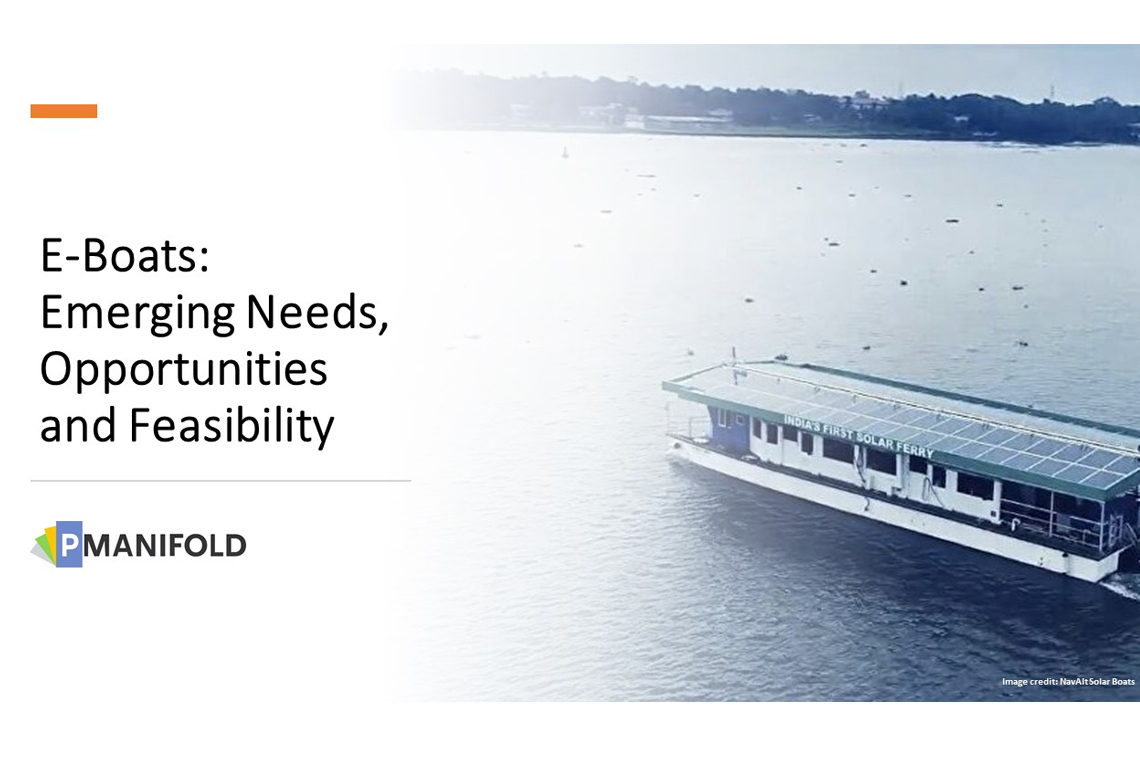
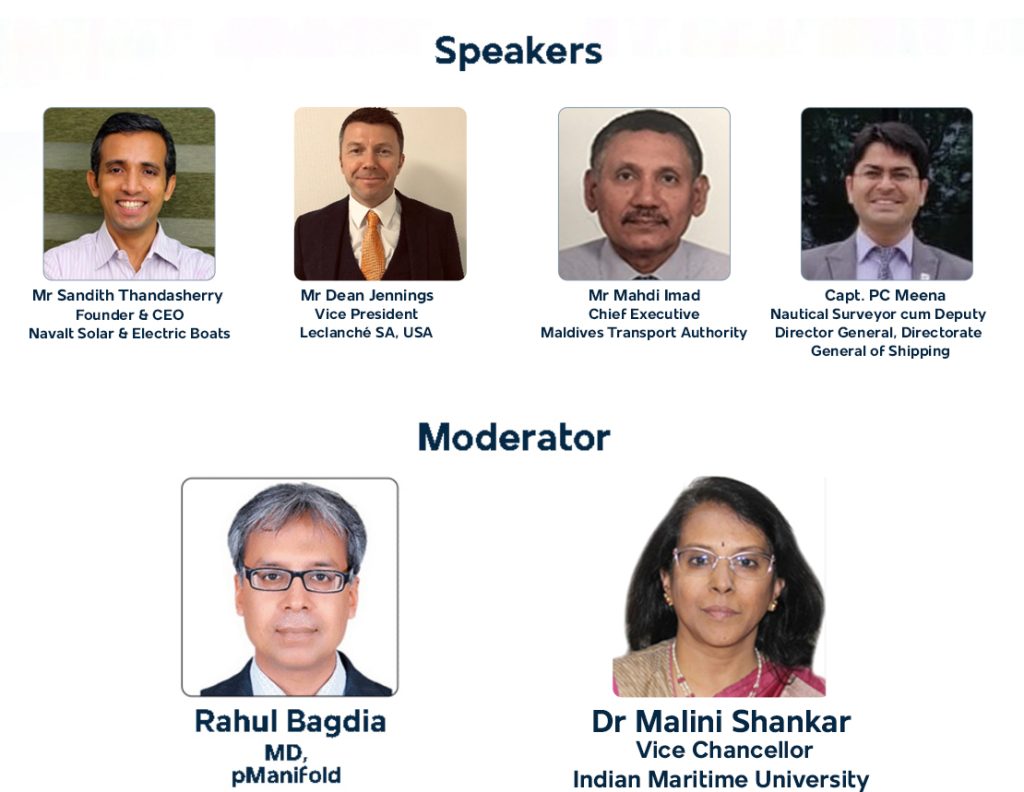
This Webinar will bring experts from multiple domains – Electric Boats OEM, Government stakeholders, Vessel Industry Association to discuss following questions:
What cost economics and challenges with conventional vessel fleet and sub-segments?
What sub-segments has highest potential for electric power train conversion? How e-Boats performing in these sub-segments?
What opportunity areas and new innovations in e-Boats happening globally (including solar powered boats, energy storage etc.)?
What success stories in e-Boats and what learning for further design and cost improvements and wider adoption?
What key ecosystem challenges, including policies remain to be solved to drive higher adoption of e-boats?
What drivers for Country and State Governments to act to support e-Boat pilots and setting time targets for conversion/replacement to electric? What if any means for demand aggregation in this space?
Electric Vehicles (EVs), the future of mobility, is generally considered only an urban phenomenon. A number of factors have led to this interpretation like higher upfront costs of EVs, lower financing credibility of the rural region, lack of required strong grid infrastructure, insignificant emission density of the rural regions thus lacking motivation for EV uptake push among others. Assuming, higher cost a rural user has to pay for transportation for different inefficiencies, and high opportunity cost, it is expected that TCO for EVs in rural would come favorable than current cost structure. It is believed that e-Mobility brings efficiency to transportation (EVs 6X efficient from tank-to-wheel energy conversion) and with its required charging electricity quantum has potential to improve energy supply economics in rural for improved energy access. This improved energy access and higher affordable transportation has potential to drive next wave of rural economic growth.
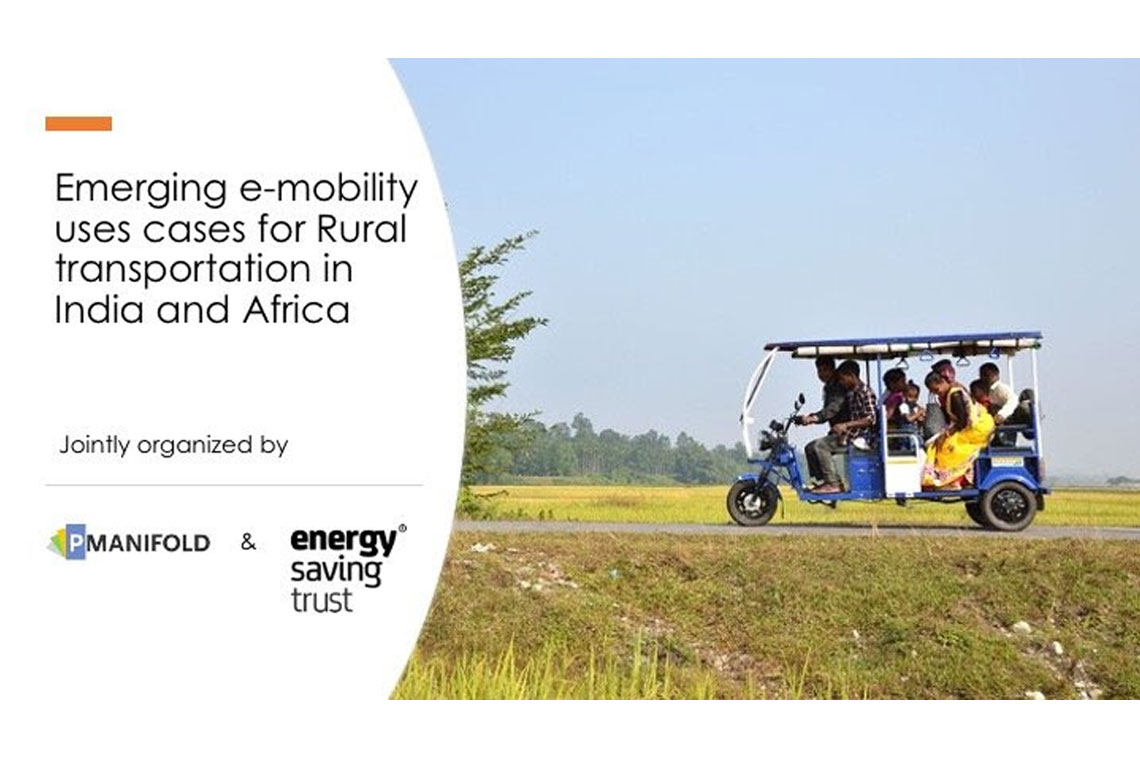
Thus, this webinar jointly organized by pManifold and EST will focus on:
Existing transportation landscape in rural regions, driving factors and economics
Need and suitability (use cases) of EV For Rural Applications
Opportunities, success stories and barriers to develop integrated e-mobility ecosystem for rural regions
Potential business models
Developing ecosystem of e-mobility around battery/ renewable energy to empower rural economy and energy access
Global vehicle sales projections – going from the most pessimistic to most optimistic estimates – indicate between 50 to 150 million EVs will be sold by 2030. Within next 10 years, EVs expected to outsell gasoline vehicles in most markets. Even in India, EV sales for 2 and 4 wheelers grew by 20 per cent in 2019-20. McKinsey, however, has put India under 1 out of 5 score on its Global Electric Vehicle Index’s both dimensions – Market adoption and Industry leadership. Out its 15 countries indexing, India ranks lowest on market adoption score, and 7 th in EV Industry leadership. For being the 4 th largest automotive market globally, it is important for Indian automakers to gear up for indigenous EV development and upskill its legacy teams.
Engineering a system as complex as an EV to meet the requirements of emerging market like India, which is hyper-sensitive in terms of price as well as performance, can be quite a challenge. Other complexities it poses is its very unique traffic conditions and driving styles. India has witnessed many global bestsellers failing in its market due to lack of a consumer-centric approach towards its buyers.
As consumers in developing economy no longer look for confirmation from developed countries for their needs, a bottom-up approach of engineering starting with understanding the customer usage typical to the region of sales is fast becoming a success formula. The vital component of this approach is the virtual model-based development, which can simulate any customer behavior in any region and provide vital inputs to forming vehicle technical specifications. These can further be cascaded to sub-system specifications and component design targets. Virtual model-based development also helps apply the customer usage effects as load cases in design activities, which helps optimize the design for a cost-effective and robust product which everyone likes to use.
This Webinar will bring experts from multiple domains – Pure EV OEM, Mix ICE and EV OEM, Automobile/ EV Industry Association to discuss following questions:
What typical product development cycle followed by automobile manufacturer, and role and impact of modeling and simulations?
What going forward trends in digitalization of product design and development, including testing and calibration by the OEMs?
What skill requirements in product design, prototyping, development, testing, calibration teams to speed up and improve overall reliability and performance of EVs?
Any particular skill gaps in EV teams when compared to mature ICE industry? What trainings would be beneficial?
How to develop right teaching and learning ecosystem on-site at OEMs, and also Engineering education system to advance EV knowledge and hands-on skills?
India’s national EV policy FAME II scheme was launched in Apr 2019 with a target to support over 1.5 million EVs through a financial incentive package of INR 10,000 Crores. Till Feb 2020, the scheme supported 14,160 EVs with incentive disbursement of ~INR 50 Crores. DHI has also approved 2,636 charging stations in 62 cities with a support of INR 500 Crores. Over last three years, several players have come up with alternative charging infrastructure technologies/business models such as battery swapping which could potentially accelerate mass adoption of EVs. Battery Swapping approach to charging infrastructure for electric mobility involves usage of small swappable battery(ies) which may or may not be sold along with the electric vehicle (EV). An Energy Operator (EO) sets up mechanism (bulk or distributed) enabling the drained batteries to be charged and swapped (or interchanged) for the EV user.
This approach allows use of a smaller battery in the vehicle enabling it to achieve the desired range by doing multiple quick swaps in a day, thus reducing the overall battery requirement for the fleet. As the raw material for battery pack (Lithium cell or Lithium ore) is 100% imported today, these alternate approaches can significantly reduce the battery import bill and make the system more efficient.
India EV growth will be unique with 80% of its transport mode dominated by 2-Wheelers, 3% by 3-Wheelers and 12-15% by car segments. The 2-Wheeler and 3-Wheeler segments will use smaller battery packs and most attractive for battery swapping. Several players have invested in building technology and business models using this approach, including SUN Mobility, Esmito, Lithion Power, Piaggio, Kinetic, Ola Electric, Bounce, Exicom, Amara Raja Batteries, GrinnTech, NTPC, PGCIL and others. But there is still lack of clarity of regulatory framework and policy support for this technology.
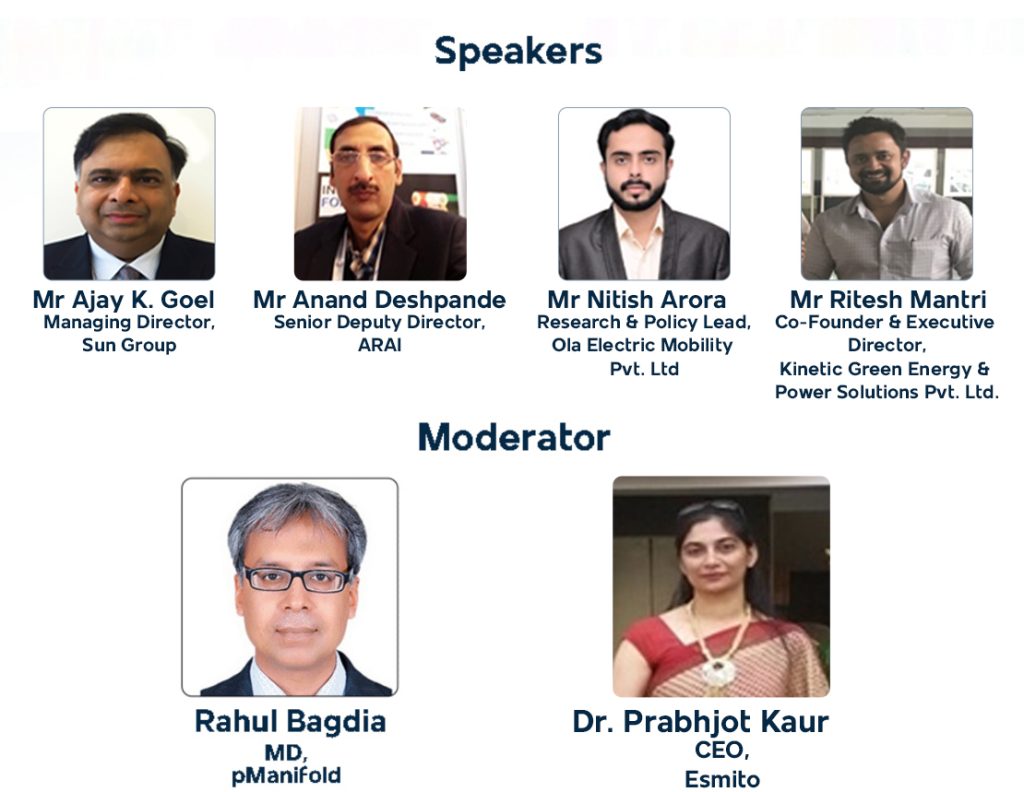
This Webinar will bring experts from multiple domains – Battery Swap Technology Provider, EV OEM, Fleet Operator and EV Testing Agency to discuss following questions:
1. Has battery swapping technology enough proved its techno- commercial feasibility and reliability? 2. If and what standardization is required to build right consensus in OEMs and battery swapping infra providers for hassle free end-use by individuals and fleet operators and scaled up adoption? And at what levels standardization should happen – OEM level, Operator level, National Level? 3. With new amendment by Ministry of Power (dated 8th June, 2020) which has now recognised battery swapping technology, what further next steps and suggestions for its inclusion in various EV policies?
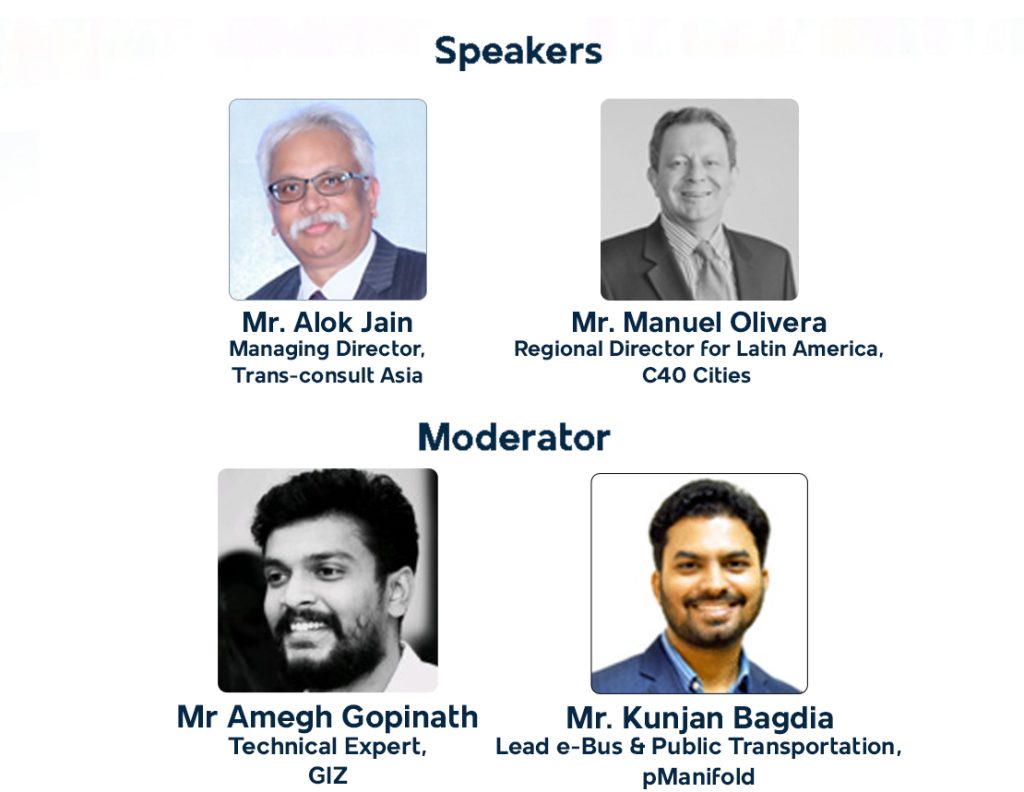
e-Bus Adoption and Integration: Lessons from South Asia and Latin America
Two forces are acting globally to increase e-Buses penetration for environmental and economic benefits they offer 1) New cities making efforts to drive first pilot deployments and 2) Cities with existing e-Buses are working to improve integration and operational efficiency and increasing e-Bus fleet size. Indian State Transport Utilities (STUs) falls in both buckets, and similar is the scene globally. There are different business models including capex purchase, opex purchase, leasing and other variants that are being piloted to improve adoption of higher upfront cost e-Buses and balancing risk-return share between different players. There are different approaches of in-sourcing and out-sourcing manpower to transition to cleaner public transportation and improve overall integration with legacy system and processes.
Growing cities around the world are setting good examples on well adoption and integration of electric bus fleet. Shenzhen in China is one such city which has successfully transitioned to 100% electric bus fleet with total fleet size of some 16,359 buses between three operators, and different business model variants.Hongkong has adopted superconductor electric buses. Santiago, de Chile is home to the world’s largest pure electric bus fleet of some 700 outside of China, with strong private sector participation. Bogota is another good case study for high 2,000 e-Buses procurement.
This e-Mobilogues’ Webinar,will bring global experts sharing their experiences and case studies from South Asia and Latin America with discussion on improving overall adoption and integration of e-Buses. The discussion will cover following,
What supportive policies can enable smooth transition into electric bus fleet in public transportation?
What business models and structuring to better enforce co-operation and productivity between STU (or Transport Authority), OEM, Private Operator, and Batteries and Charging Infra Provider?
How to better engage private sector participation in capex heavy e-Bus eco system?
What learnings drawn from current procurement and deployments to go for bigger next planning and procurement of e-Buses?
How best to drive integration of e-Buses in mixed fleet legacy systems?
How planned Training and Capacity building can improve e-Bus utilization and overall ROI?
e-Buses Operations and Monitoring: Smart Planning, Scheduling and Charging
India has seen some 600+ e-Buses pilot deployment in last 2 years with another 5,000+ expected in next 2-3 years. These first deployments in many of the STUs are helping establish some performance benchmarks to evaluate e-Buses further scale-up. The fuel cost opex reduction from e-Buses by approx. 70% is getting appreciated, but still there remains many other hurdles to overcome to fully establish lower TCO advantage of e-Buses and hassle-free operations. One strong most area of improvement is Operations and Monitoring of e-Buses, which is daily lifeline for maintaining healthy and viable fleet, post the procurement and Charging infrastructure setup is completed.
Most Depots having e-Bus fleet today are also having much bigger ICE bus fleet with established legacy systems and processes.e-Buses systematic planning, daily scheduling and charging operations are not well coordinated for efficient operations. The selected routes for e-Buses are not checked for energy kWh consumption in different hours of the day under different city loading conditions and showing huge variations. The schedules are not prepared keeping in mind these SOC/range variations in one full-charge and need for intermittent charging time (with given chargers’ locations and availability). This is resulting into high number of stand-by e-Buses at Depot to service schedules while returning e-Buses are put on-charge, leading to lower kms/day utilization of e-Buses relative to ICEs.
Most monitoring is done through manual logs and there is not strong data analytics and control to improve overall performance, utilization and costs. The multi-charger operations throughout the day are not auto monitored and controlled for optimal peak power management and overall cost of electricity.
There is strong need for Operators and STUs to improve Monitoring and Controls of e-Bus daily Operations for deriving best performance possible with already procured costly assets, and fully realise e-Bus advantages.
The 3rd Webinar under the e-Mobilogues series brings global practitioners, who will share their experiences and best practices around improving e-Bus Operations and Monitoring, with special focus on Planning, Scheduling and Charging. This Webinar will help understand and answer following top questions:
What key differences in Planning and Scheduling of e-Buses compared to conventionalICE buses, and how best to undertake it?
Once e-Buses procurement and charging infrastructure setup completed, what set of analysis and inputs to be used for routes selection and developing daily schedules for achieving higher kms per day e-Bus utilization?
What smart monitoring and charging elements can bring useful control for overall healthy and optimal e-Bus, batteries and charging performance?
What learnings to draw from current pilot deployments to 1) improve current e-Bus operations and ROI and 2) improved next planning and procurement of e-Buses?
e-Bus Adoption and Integration: Lessons from Europe and the Middle East
Worldwide, public transport systems run predominantly on fossil fuels, leading to increased carbon emissions, growing concerns over urban air quality and contributing to growing high fuel imports. The clean public transportation, especially transition to the electric bus (or e-Bus), is expected to not only help reduce carbon emission/footprint but also save fuel. It also addresses the issue of congestion on roads by promoting shared mobility. One of the studies estimates the electric bus market to increase from 137 thousand units in 2019 to 935 thousand units by 2027.
India is reported to have 350+ e-Buses plying on roads as of 2019, contributing ~0.2% to the State Transport Undertakings (STUs) fleet of ~1,36,000 buses. These early deployments are supported through the combination of subsidies from the Centre (FAME-I) and State. The Government has sanctioned 5000+ e-Buses in 64 cities for intracity and intercity operations over the next 3 years. However, there are still several barriers that are holding back STUs in India for more aggressive adoption, including – high upfront cost; technology apprehension; limited end of life performance data available; lack of debt financing; limited experience of OEMs suppliers in India; limited Operators (outside e-Bus OEMs) to run and manage e-Buses for STUs; evolving e-Bus contracting models; limited exposure to e-buses planning, procurement, operations & maintenance, charging infra setup and operations, integration with legacy fleet; and others.
This webinar, 2nd in the e-Mobilogues series, will bring global experts sharing their experiences from Europe and the Middle East and answer the following questions:
How has been their experience in e-Bus deployments/ early assessments and with what benefits?
What global best practices can be adopted by Indian STUs/ Transport Authorities for e-buses induction and integration?
What planning/ decision matrix support is being provided to Transport Officials/ Government in overall e-Bus Strategy?
What considerations for Cities/ STUs to procure and integrate e-buses appropriately?
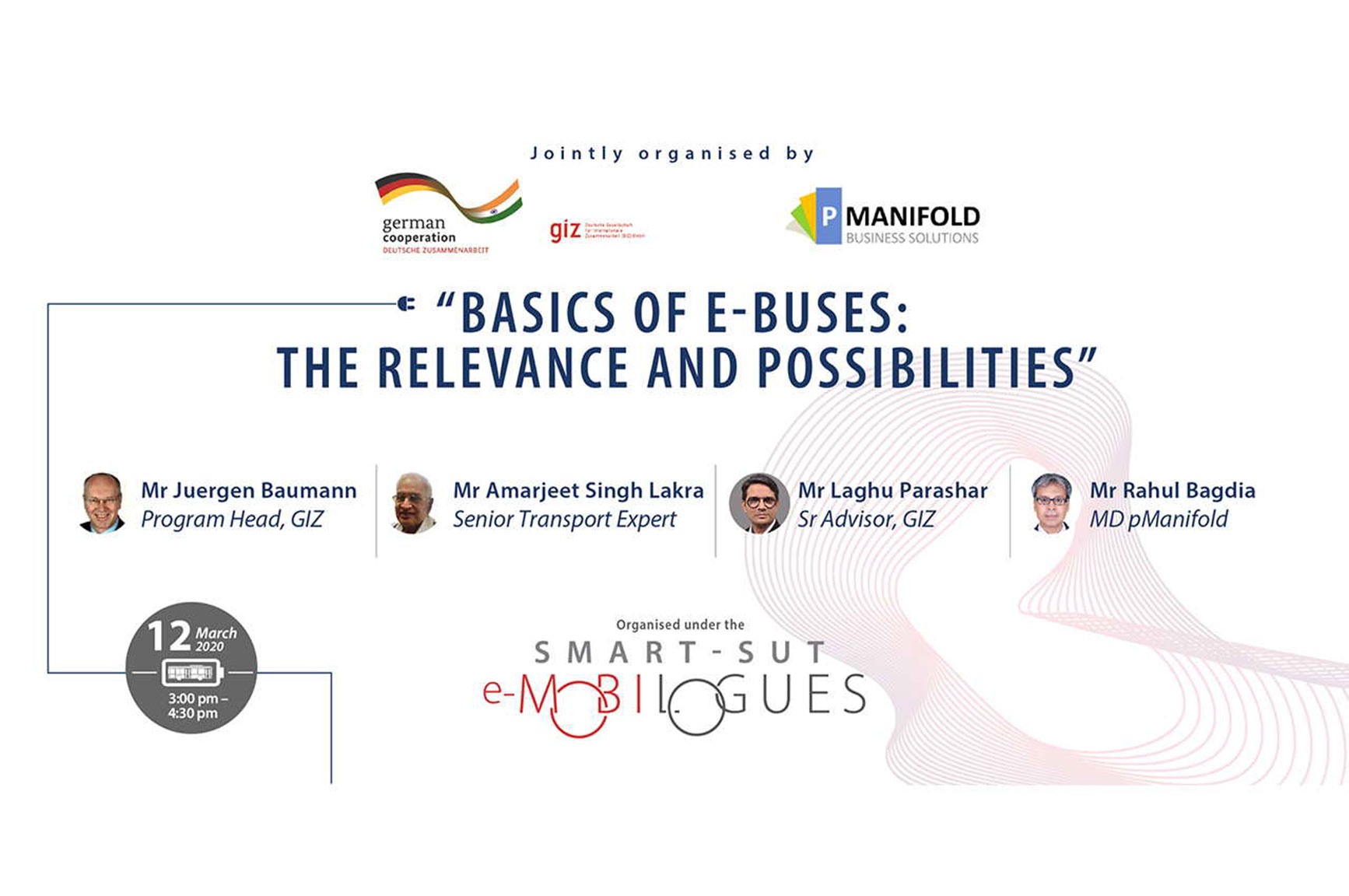
India is witnessing rapid urbanization which has led to a tremendous increase in demand for transport and other basic services. By 2025, 46% of Indians will live in cities with more than 1 million people, and by 2030, the number of cities with populations of more than 1 million will grow from 42 to 68. With the rising urban population, cities are preparing themselves to respond to the emerging demand for transportation and are learning to make it more robust and resilient. City buses are the backbone of public transport, and its electrification can help cities to make it more sustainable and greener. The e-Buses can help cities to address the issues of city-level pollution, GHG emission, and improving the Air Quality Index (AQI). To give a further push to clean mobility in public transportation, the Department of Heavy Industry has approved the sanction of 5595 electric buses to 64 Cities / State Govt. Entities /STUs for intra-city and intercity operation under FAME India scheme phase II. The e-Buses are emerging as a strong option for green, and sustainable mobility and cities are proactive to switch towards it. The resilient transition of ICE buses to e-Buses required knowledge and awareness at all level of stakeholders to create a positive and supportive ecosystem. This was the first webinar of the series ‘e-mobilogues- Shifting the Gears: Towards Electric Buses’. It is a joint initiative of GIZ under the SMART-SUT project along with pManifold Business Solutions. The webinar series will have industry experts sharing their experiences and insights on national and state-level EV policies, current practices, national and international case studies, and lessons learned during E-bus adoption.
This first webinar answers the following questions:
a) Why there is need of e-Buses in India and its overall benefits (environmental, social, economic)?
b) What are the different components of e-Buses?
c) What are the different battery models and charging options for e-Buses?
d) What are the different operation models for e-Buses and leading technology providers?
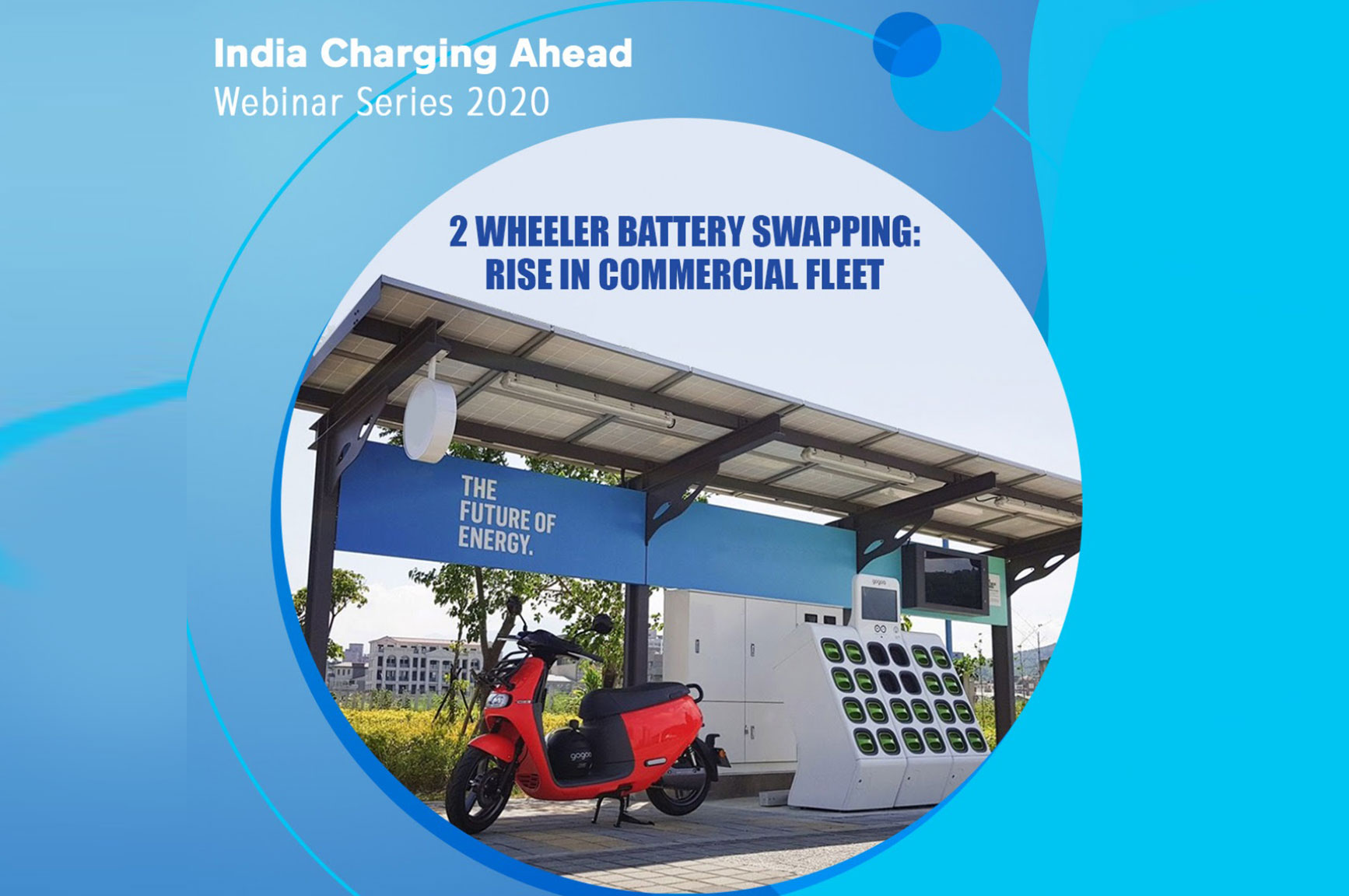
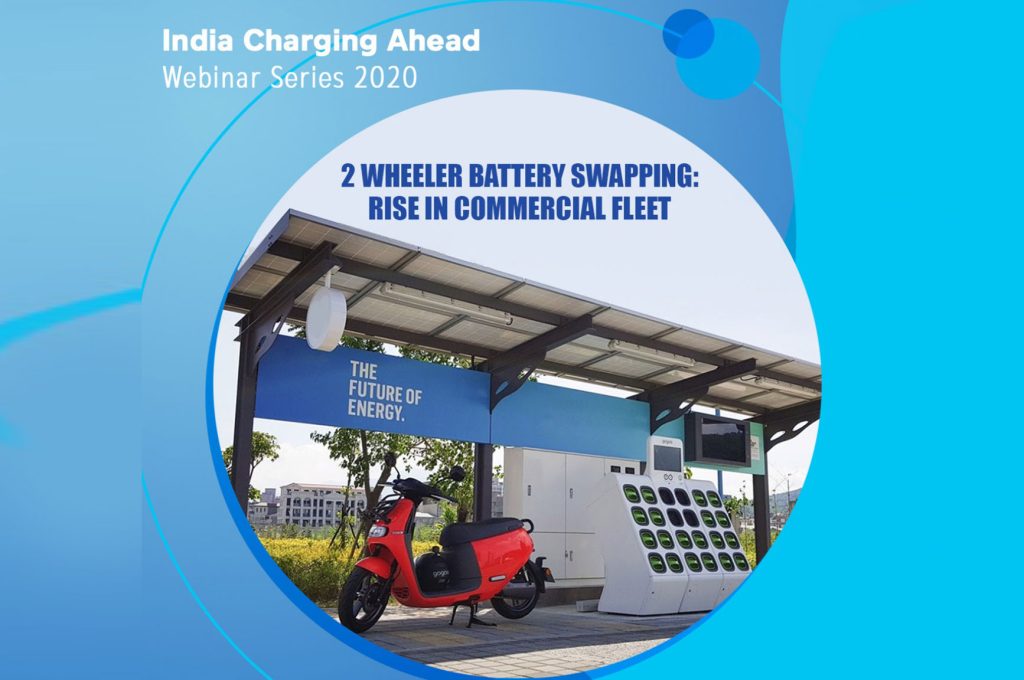
Electric 2 Wheeler Battery Swapping Rise in Commercial Fleet
India is the biggest 2W market in the world (FY 2018-19 =highest 2W sale of 21MM units). This boom is supported by an increase in purchase capacity, changed perception around mobility, a rising number of female riders & increased demand from the semi-urban area. E-commerce delivery using 2Ws has grown notably with players like Zomato, Swiggy and others. 2W rental/taxi services is another fast-rising segment with players like Ola Bike, Uber Moto, Bounce, Vogo, Yulu.
High electrification of mobility will further open the mass individual electric 2W segment in India. Strong economics of e-2W will be single most basis for the commercial fleet operator for the transition. The standalone fixed battery system in e-2Ws offer lower TCO compared to ICEs, but existing limited financing options make high initial cost barrier. Waiting time for charging and struggle for parking spaces are other challenges in adoption.
Battery swap model has seen success in the e-3W fleet application in India and the same can be extended to the e-2W commercial fleet. It offers the benefit of
Lower upfront capex cost without battery
No wait time for charging as charged batteries can be easily swapped at swapping station
Better organization of lower cost and systematic charging at back-end bulk charging stations for best battery health
Lower TCO than a fixed battery system
The OEMs will remarkably benefit from this fleet adoption as they can offer similar products like detachable battery system, separate battery financing etc. for high uptake in the individual segment.
The webinar has answered below questions:
What is the economics of e-2W battery swap system Vs fixed battery system?
What operational & business models for e-2W battery swap system in commercial fleet, & their pros-cons?
How OEMs are gearing up to support fast-rising e-2W commercial fleet segment?
How to pursue battery standardization & build right consensus in industry/policymakers?
What innovations on battery swapping, analytics & commercial fleet management for high traceability & ROI?
ICA Webinar Series 2020 | e Bus Planning and Overall System Optimization: India Landscape
India has a target of some 5,500+ e-Buses procured under GOI FAME-II initiative, with a max public fleet size of 300 nos. of e-Buses with a single STU. This will form some 3% mix of overall STU ICE fleet nos. today. With this deployment under FAME-II, India will become the second largest country with such a big e-Bus fleet. With this successful adoption and integration, India will be targeting a 100% e-bus mix in new procurement before 2030.
Most of the procurement and deployment today is planned for overnight Depot charging requiring large battery sizes to support ~200 km/day trip length (though there are known used cases where intermittent charging is carried at Depot only). FAME-II supported e-Buses tenders are Gross Cost Contract (GCC) based and Operator attract penalties for missing operational SLAs. Most Operators are learning in a hard way by paying penalties various e-Bus related performance issues, which they didn’t plan for real STU driving conditions including
Real AC loads due to door open/close and different weather conditions
Road traffic and congestion’s, resulting into surprise range reduction (not much regenerative braking contribution)
Significant range deviations from different drivers
Battery degradation and aging
Charging time deviations over specs, etc.
These issues will grow further with an increasing % mix of e-Buses in the fleet. Each route performance can be different, and hence broad generalization with simple estimations can lead to erroneous planning and bad taste.
It is important that Indian OEMs, Operators and STUs take up systematic planning much before procurement and learn to collaborate well with each other for best results.
With this view, this Webinar attempted to find answers to below top questions:
How e-Bus performance can vary on different routes, and why route-specific modeling and planning is important?
What important e-Bus, battery and charger characteristics, coupled with STU route timetables and sensitivities are important to estimate close to real e-Bus performance?
How to find the best configurations of e-Bus and charger sizes and numbers and optimize Capex, Opex, and ROI and meet performance SLAs?
How to account for battery performance and sensitivities to the overall estimation of TCO economics for bidding?
What pros and cons of different charging methods and potential investment optimization opportunities?
What reserve e-bus capacity will be required to handle SLAs management?
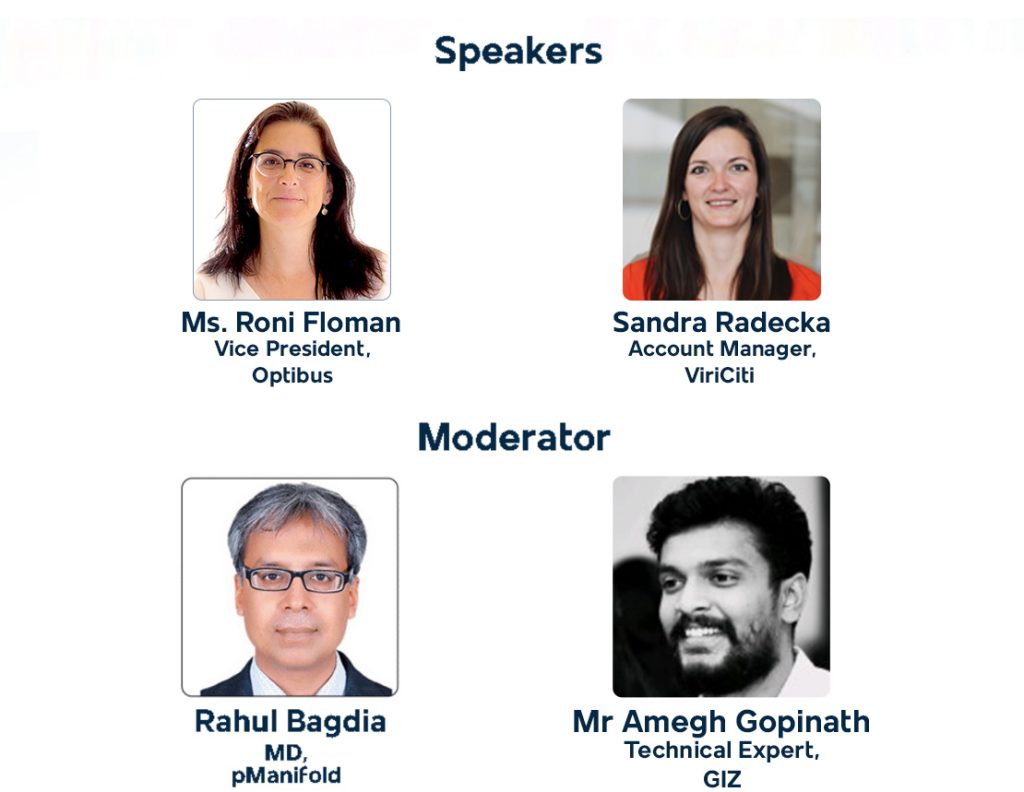
Panelists: M Narayanan Sankar, Co-founder, and Director, Microgrid Labs (MGL); Mr Amegh Gopinath, Technical Expert, SMAR- SUT Project, GIZ and Mr Rahul Bagdia, MD, pManifold business Solutions