


Corporate climate action has undergone a fundamental transformation over the last decade. What began as a race to announce ambitious net-zero commitments has become a test of whether those commitments can be translated into credible, measurable, and financially viable pathways. Investors, regulators, lenders and corporate boards are no longer asking whether organizations have climate targets, but whether those targets are supported by robust governance, implementation strategies, capital allocation, and clear mechanisms for accountability.
This shift reflects mounting concern over greenwashing, implementation gaps, and the financial risks of an uneven transition. Stakeholders no longer take a company’s climate goals at face value, but they want to know how those goals will be governed, funded and delivered.
The changing landscape was visibly reinforced in June 2026, when the Science Based Targets initiative (SBTi) released the Corporate Net-Zero Standard V2.0. It was the first time the standard required large companies to publish a board-approved Climate Transition Plan as a core component of credible net-zero action, rather than an optional supplement to target-setting (Science Based Targets initiative, June, 2026). The revision came against the backdrop of mounting evidence that corporate ambition was not being matched by implementation. CDP’s assessment of more than 18,600 disclosing companies found that only 81 organizations just 0.4% (CDP, Feb 16th 2023), had developed a transition plan that met its credibility benchmark.
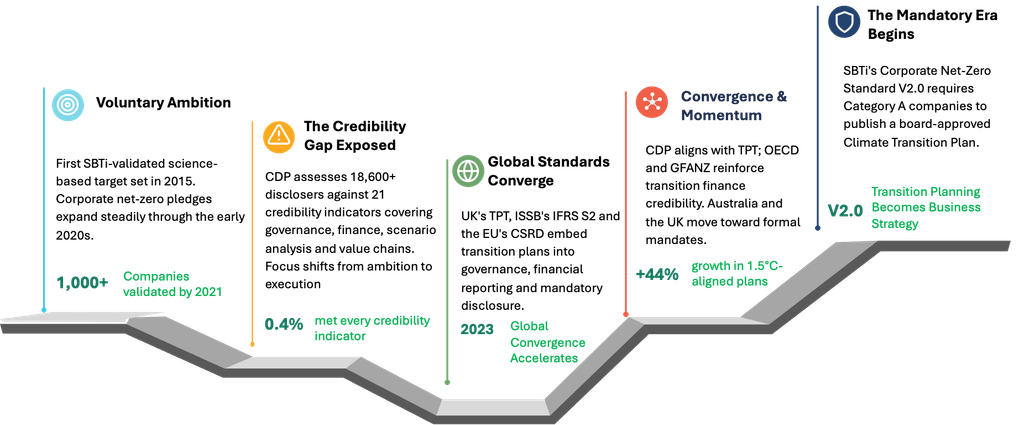
The significance of this development extends far beyond a single framework. These expectations are being reinforced across a growing set of frameworks like the OECD’s guidance on transition finance, the UK’s Transition Plan Taskforce (TPT), IFRS S2 and the EU’s Corporate Sustainability Reporting Directive (CSRD). The question moved for companies from target setting to how those targets will be achieved, governed, financed and demonstrated.
When Climate Ambition Was No Longer Enough
Corporate commitment to climate action has expanded rapidly over the past decade, reflecting growing recognition of climate-related risks and the increasing alignment of businesses with global net-zero ambitions. By January 2026, eleven years after the SBTi validated its first science-based target more than 10,000 companies had done the same. This momentum continued through 2025, with validated targets rising 40% and net-zero commitments 61%. Asia accounted for more than half of this growth (53% of validated targets), led by China, Japan and India (Science Based Targets initiative, April 9th 2026). These trends indicate that science-based target setting has become an integral component of corporate climate strategy rather than a niche sustainability exercise.
However, the rapid growth of targets has also exposed a more fundamental challenge. While organizations have become increasingly successful in setting ambitious targets, very few have demonstrated how those targets will be achieved. CDP’s 2022 assessment found that fewer than 1% of disclosures met all 21 credibility indicators for a Climate Transition Plan spanning governance, financial planning, scenario analysis and value chain engagement. Although roughly 2,300 companies disclosed against most of these indicators, significant gaps remained (CDP, Feb 16th 2023). Independent academic analysis in 2023 reached a similar conclusion, reporting that fewer than 0.6% of more than 23,200 disclosing companies had developed credible transition plans, while over 80% had yet to establish science-based targets (Nicolajsen et al., 2025). The implications of this credibility gap extend well beyond corporate reporting. As businesses continued to strengthen climate commitments, investors, lenders, regulators and standard-setting bodies simultaneously developed disclosure frameworks, transition finance taxonomies, benchmarking initiatives and regulatory requirements to distinguish credible implementation from aspirational commitments. Consequently, the focus of corporate climate action has shifted from announcing long-term targets to demonstrating credible, financeable and accountable pathways for achieving them. It is this shift from ambition to implementation that has placed Climate Transition Plans at the center of emerging climate governance.
The Global Convergence Around Climate Transition Planning
The increasing prominence of Climate Transition Plans reflects a broader convergence across regulators, standard setters, investors, and financial institutions on how climate commitments must be supported by credible governance, implementation pathways, financial planning, and measurable accountability.
This convergence became evident in 2023. The UK’s Transition Plan Taskforce (TPT) established a structured disclosure framework centered on ambition, action, and accountability. The ISSB’s IFRS S2 embedded transition plans within global sustainability reporting, linking them to governance, financial reporting, and scenario analysis, while the EU’s Corporate Sustainability Reporting Directive (CSRD) integrated transition planning into mandatory corporate sustainability disclosures. Beyond regulation, CDP aligned its disclosure framework with TPT and recorded a 44% increase in companies disclosing 1.5°C-aligned transition plans by mid-2024, reaching 5,906 organizations (CDP, Jun 19th 2024). Similarly, the Organization for Economic Co-operation and Development (OECD) and Glasgow Financial Alliance for Net Zero (GFANZ) developed complementary guidance to strengthen the credibility of transition finance and align corporate and financial sector transition planning.
Australia launched consultations on transition planning under its Sustainable Finance Roadmap in 2025 (Australian Government Treasury, 2024), while the UK moved towards formalizing the previously voluntary TPT framework (Department for Energy Security and Net Zero [DESNZ], 2025). Although regulatory approaches differ, the direction of travel is increasingly consistent.
At the same time, convergence should not be mistaken for uniformity. The European Union’s 2025 Omnibus I package softened CSRD’s transition plan requirement, highlighting the political limits of prescriptive sustainability regulation. Regional differences also persist, with CDP reporting that 49% of global disclosing companies had transition plans in 2025, compared with only 27% of US companies (CDP, May 22nd 2026).
For businesses, the implication is straightforward. While regulatory requirements may continue to evolve, the underlying expectations of credible Climate Transition Plans aligned with emerging global practices is likely to strengthen regulatory preparedness, investor confidence, and long-term business resilience.
What Makes a Credible Transition Plan?
Leading frameworks including TPT, ISSB, CSRD, CDP, OECD, GFANZ and SBTi have converged around a common definition of what constitutes a credible Climate Transition Plan. First, effective governance has become a foundational requirement. A transition plan is no longer treated as a sustainability-team exercise; leading frameworks now expect board-level oversight with clearly assigned executive accountability. Climate action, in other words, has become a matter of corporate governance rather than corporate reporting.
Second, this expectation extends into financial decision-making. Frameworks such as IFRS S2, TPT and CDP require organizations to demonstrate how climate commitments influence capital allocation, financial planning and investment decisions, shifting transition planning from sustainability reporting to core business strategy.
Third, credible plans must be underpinned by robust climate scenario analysis and measurable implementation pathways. The growing use of NGFS scenarios by financial regulators reinforces the expectation that transition plans stay aligned with evolving scientific evidence and external benchmarks, rather than internal assumptions alone.
Fourth, expectations now extend deeper into the value chain. SBTi’s Corporate Net‑Zero Standard V2.0 expands Scope 3 target options to include category and activity‑specific targets alongside overarching Scope 3 reduction or supplier/customer alignment targets, encouraging companies to work directly with suppliers and customers to cut emissions across the most material parts of the value chain (Science Based Targets initiative, june 2026). Lastly, credibility increasingly depends on independent verification and transparent use of carbon removals. SBTi V2.0 introduces mandatory third-party assurance for large companies (Category A) while positioning carbon removals as a complement but not a substitute for direct emissions reductions through its Ongoing Emissions Responsibility (OER) recognition program (Science Based Targets initiative, June 2026).
Collectively, a credible Climate Transition Plan integrates governance, finance, risk management, supply chain engagement, and independent assurance into a single strategic framework, making it a core business document rather than a standalone sustainability disclosure.
Why Climate Transition Plans Have Become a Strategic Imperative
The growing importance of Climate Transition Plans is reflected not only in evolving regulations but also in changing market behavior. Investors, lenders, and companies increasingly view transition plans as strategic financial instruments rather than sustainability disclosures, making their credibility central to investment decisions and corporate governance.
Unilever’s 2024 Climate Transition Action Plan illustrates this shift. The company submitted its plan to a binding shareholder advisory vote, securing over 97% support (Unilever, 16th May 2024), signaling that transition planning is now subject to the same level of investor scrutiny as executive remuneration or major capital allocation decisions. Similarly, Climate Action 100+ evaluates companies not only on emissions targets but also on whether corporate lobbying, governance, and business decisions are aligned with their published transition plans, reinforcing that implementation consistency has become a key measure of credibility.
The financial markets are sending the same signal. CDP estimates that the global cost of climate inaction could reach US$38 trillion by 2050, while investments in climate adaptation and resilience can yield up to US$21 for every US$1 invested. Companies also disclosed US$4.4 trillion in environment-related business opportunities in 2024 (CDP, August 6th 2025). These figures help explain why the OECD’s Guidance on Transition Finance treats strong transition plans as essential to the credibility of transition-labelled financial instruments and as a safeguard against greenwashing.
The situation is more challenging for the financial institutions. Unlike corporates plans, which primarily addresses operational and value chain emissions, the banks and investors must manage emissions embedded across their lending and investment portfolio. This gave rise to the development of dedicated guidance by GFANZ, now adopted by more than 675 financial institutions across 50 jurisdictions (United Nations Framework Convention on Climate Change (UNFCCC), Oct 7th 2024). As GFANZ shifts its focus towards mobilizing private capitals and scaling transition finance, the more emphasis is on moving from transitions plans to assessing whether they are sufficiently credible to support financial decisions.
Ultimately, it’s the execution which determines whether a transition plan is adding any strategic value or not. Ørsted’s 98% reduction in the emission intensity, achieved before the 2025 target (Ørsted), shows that ambitious plans can be delivered. Maersk’s redesign of its shipping network points to a similar capacity for structural change in sectors that are hard to abate. Shell’s experience cuts the other way, having targeted a 15–20% reduction by 2025, the company achieved only 9% (Kizhakedath, March 24th 2026), which shows that credibility now on measurable progress rather than the scale of the original ambition. For management, the question moved from whether a transition plan exists to whether that plan is credible enough to attract investment and financing, inform strategic choices and generate measurable outcomes.
The Future of Credible Transition Planning
The upcoming phase of transition planning is shifting from the disclosure to practical challenges of implementation, assurance and adaptation as organization begin translating published plans into long-term business decisions.
First, independent assurance is likely to become a defining feature of credibility. SBTi’s Corporate Net-Zero Standard V2.0 already introduces mandatory third-party assurance for large companies, although globally accepted methodologies for verifying forward-looking transition plans remain at an early stage. Closing this gap is likely to become a priority for auditors, consultancies and standard setters as they work towards more consistent approaches to assessing implementation and progress.
Second, regional adaptation will become increasingly important as transition planning expands into emerging markets. Most existing guidance has been shaped by the regulatory systems and corporate structures of Europe and other developed economies, yet Asia, especially India, is now the fastest-growing region for science-based target adoption. Applying established approaches across different governance models, financing conditions and regulatory environments will require greater localization, creating demand for guidance that reflects the realities of emerging economies rather than simply replicating developed-market practice.
Finally, transition planning is beginning to extend beyond carbon. GFANZ has signaled a stronger focus on nature-related risks, including biodiversity, land use and water, and the Taskforce on Nature-related Financial Disclosures (TNFD) integrates directly into this agenda. TNFD’s disclosure recommendations surpassed 733 organizations and USD 22 trillion in AUM by late 2025 ( TNFD, 7th Nov, 2025). The NGFS, is expected to release updated climate scenarios by the end of 2026. As scientific understanding and policy expectations continue to evolve, organizations will need to revisit their transition pathways more regularly rather than treating them as static, long-term commitments.
Taken altogether, the development suggests that the transition plan is entering in the more mature phase where the challenge is no longer to produce a plan but to keep it credible, adaptable and capable of guiding strategic decision in an increasingly complex environment.
From Commitment to Credibility
A well-designed transition plan now influences strategic decisions on investment, risk management, operations, and corporate governance, making it an increasingly important indicator of long-term business resilience. As expectations continue to evolve, organizations will be judged less by the ambition of their commitments than by their ability to execute them consistently and transparently.
The transition to a low- carbon economy is already underway. The organization that will lead it will not necessarily be the one that announces the most ambitious goals, but the one that can demonstrate a credible, adaptable and investment pathway for achieving them.