

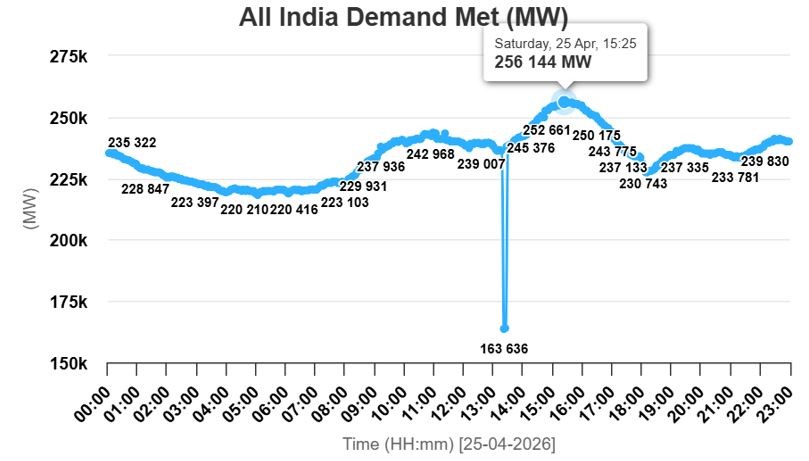
India’s power system crossed a historic milestone on 25 April 2026, when national peak electricity demand touched 256,144 MW (256.14 GW) at 3:25 PM, (Source: Image – National Power Portal) the highest ever recorded in the country. The number itself is significant, but the real story lies deeper in what this peak reveals about the future of India’s electricity system.
For years, India’s power sector discussions were centered around one question: Can we generate enough electricity? Today, that question is changing.
The real question is now: Can India deliver electricity at the exact hour when everyone wants it?
This is the transition from an energy deficit problem to a peak deficit problem.
India may have enough installed capacity on paper, but the real stress emerges during a few critical hours, especially during extreme summer afternoons and increasingly sharp evening ramps, when cooling demand, residential consumption, EV charging and industrial load all collide. The 256 GW peak is not just a summer statistic. It is a signal that India’s load curve is being fundamentally reshaped by climate change, urbanisation, and electrification.
Why the Peak Happened Earlier than Expected: Traditionally, India’s highest electricity demand came in May or June, when summer temperatures reached their harshest levels. This year, the record came in April itself. Across North, West and Central India, temperatures crossed 42–45°C or even more, far earlier than usual. Heatwave alerts were issued across multiple states and cities in Rajasthan, Gujarat, Maharashtra, Delhi and Madhya Pradesh experienced unusually intense heat conditions.
The peak demand was recorded at 3:25 PM, which is equally important. This confirms that India’s power system is now being driven primarily by cooling demand. Afternoon peaks indicate that air-conditioning load, not just lighting or evening residential demand, which is becoming the dominant driver of electricity consumption.
If the peak had occurred at 8 PM, it would reflect lighting and household consumption. Whereas, 3 PM peak tells us something much bigger, may be India’s grid is becoming temperature-driven. Cooling is no longer a luxury. It is becoming an economic necessity
Air-Conditioning Load Explosion, one of the most important signals hidden inside the power demand data is the rise in night-time load. It is to note that 2 AM demand is one of the best proxies for incremental air-conditioning load, since industrial activity is relatively stable and cooling load becomes more visible. In early April 2026, India’s 2 AM demand stood around 190 GW. By 26 April, it had reached nearly 225 GW, an increase of nearly 35 GW in just a few weeks.
And yet, India’s household AC penetration is still only around 9–10%. According to NITI Aayog projections, this could rise to 65% by 2047 and nearly 80% by 2070. That means the current peak is only an early warning and this is not a temporary summer spike, but it is a structural demand transformation. As incomes rise, urbanisation accelerates and climate stress intensifies, cooling demand could become the single largest driver of India’s future electricity system.
Solar is Not the Problem, It Is Preventing a Much Bigger Crisis: There is often criticism around solar power because of the so-called “duck curve” and afternoon grid balancing challenges. But the 25 April peak tells the opposite story. Without utility-scale solar and rooftop solar generation, India would have required nearly 60 GW of additional coal capacity, over and above the existing 227 GW coal capacity, just to meet the afternoon peak. Coal generation would have needed to be 15–20% higher on a daily basis, placing enormous pressure on coal supply chains.
India’s challenge is not whether solar should expand. It is how the system manages the transition between solar-rich hours and non-solar hours.
Why BESS Matters? : Battery Energy Storage Systems (BESS) are now moving from pilot stage to mainstream. with the recent tenders for:
- Standalone BESS
- Solar + BESS
- Firm and Dispatchable Renewable Energy (FDRE)
- Pumped hydro storage
- Hybrid renewable projects
show that India is finally beginning to procure flexibility, not just megawatts. But BESS alone will not solve the problem. There is a growing assumption that solar + storage can fully substitute thermal generation.
If thermal generation remains around 180 GW for 12 non-solar hours, replacing that entirely would require extremely large storage capacity. Even with 4-hour storage assumptions, the scale required becomes enormous and economically impractical in the near term.
CEA’s long-term planning models largely assume 4–6 hour storage durations. But real summer heatwave conditions, especially from mid-March to mid-May, may require much deeper analysis of longer-duration reliability.
The future grid cannot be built on the assumption that short-duration storage alone will solve summer peaks. Thus, storage is essential, but realistic planning matters.
Time-of-Use Tariffs: The Missing Reform: Perhaps the biggest policy gap today is not technology, it is pricing. Electricity is often priced almost the same at 2 PM and 9 PM, even though the system cost is dramatically different. Households continue to concentrate consumption during expensive peak hours because the tariff does not reflect the real cost of supplying that electricity.
India now urgently needs Time-of-Use (ToU) tariffs, especially for:
- Urban residential consumers
- EV charging
- High-load commercial users
- Distributed cooling demand
Residential charging an EV at midnight or shifting appliances to solar hours should see a lower bill. A DISCOM investing in BESS should also have price signals that reduce the peak it is trying to serve.
What India Must Do Next: India’s future power challenge can be addressed through a two-part strategy:
1. Build Flexibility at Scale: The goal is not just more capacity, but better response capability
- Large-scale BESS deployment
- Pumped storage expansion
- Flexible thermal operations
- Hybrid renewable procurement
- Distributed solar + storage
- Stronger transmission and substation upgrades
2. Build Smarter Demand: Peak demand must be managed, not merely supplied
- Time-of-Use tariffs
- Demand response for industries and buildings
- Cooling efficiency programs
- Super-efficient AC adoption
- Urban heat reduction strategies
- Decentralized energy systems and microgrids
Because every avoided peak megawatt is cheaper than building new peak generation.
Thus, India’s 256 GW peak is not just a new record, but it signals a shift from energy deficit to peak deficit. India now needs storage, flexible grids, Time-of-Use tariffs, efficient cooling and smarter demand management. The future of the power sector will depend less on how much electricity we produce and more on how intelligently we manage when it is consumed.