


Before most residents wake, urban freight is already keeping the city moving. Trucks deliver vegetables to wholesale markets, light commercial vehicles (LCVs) replenish retail stores, three-wheelers (3Ws) supply neighbourhood businesses, and two-wheelers (2Ws) carry food, medicines and parcels to customers. Throughout the day, construction materials, industrial products, waste, groceries and e-commerce packages continue to move between warehouses, markets, businesses and homes.
This largely invisible network keeps cities functional. It also consumes fuel, occupies road space, creates noise and releases pollutants close to where people live and work. As cities grow and consumers demand faster deliveries, freight operators will place more vehicles on roads that are already congested.
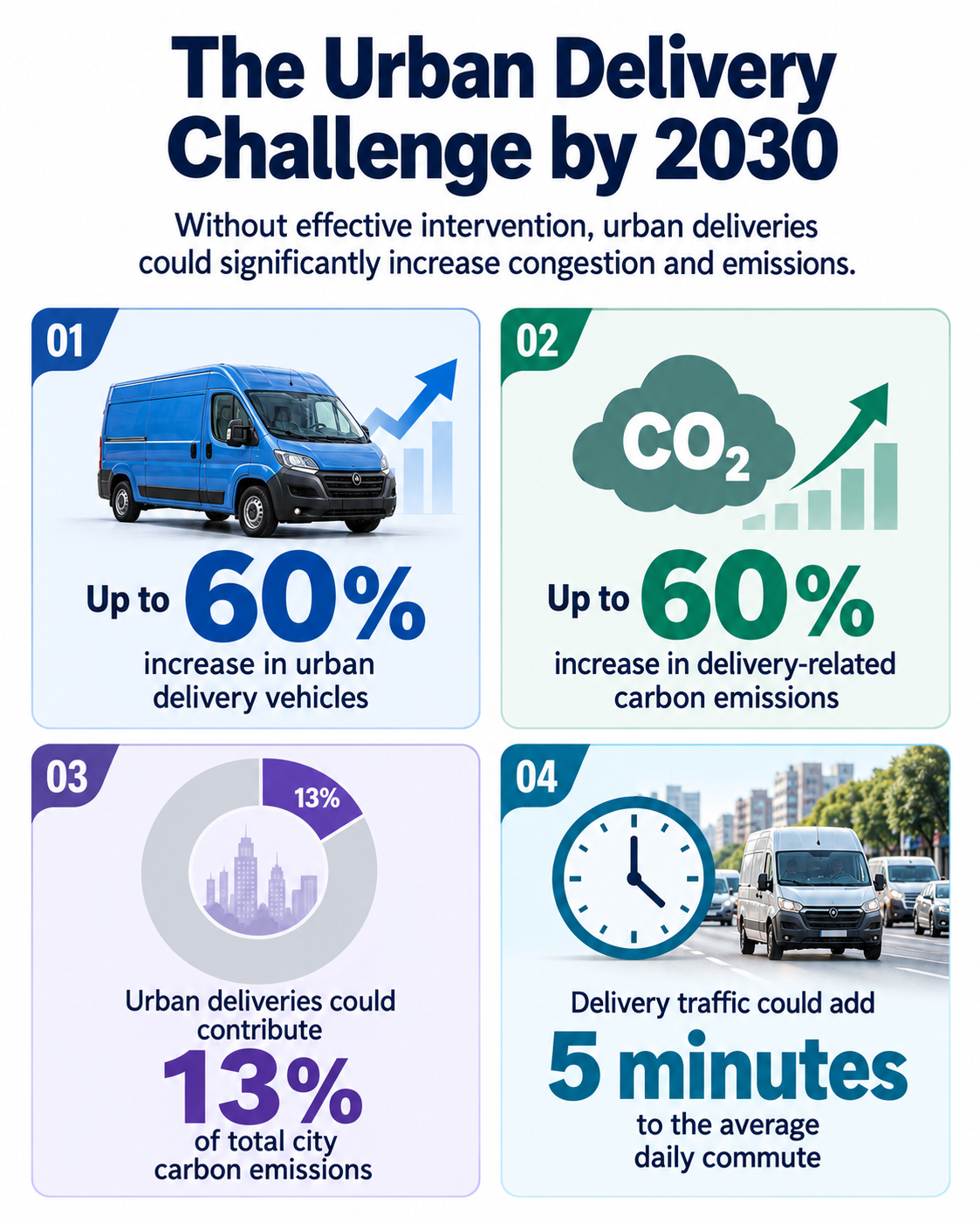
The World Economic Forum estimates that, without effective intervention, urban delivery vehicles and their carbon emissions could each rise by as much as 60% by 2030. Urban deliveries could then account for around 13% of a typical city’s carbon emissions, while additional delivery traffic could add about five minutes to the average daily commute.[1]
Cities therefore face a clear choice: (i) allow freight demand to lock in more fossil-fuel vehicles, or (ii) use electrification to build a cleaner, quieter and more efficient goods-movement system.
[1] World Economic Forum, Transforming Urban Logistics: Sustainable and Efficient Last-Mile Delivery in Cities, 2024, https://reports.weforum.org/docs/WEF_Transforming_Urban_Logistics_2024.pdf
Electric urban freight markets are scaling at different speeds
The global EV transition has moved beyond passenger cars. Fleet operators now deploy electric 2W (e-2W), e-3Ws, e-LCVs and e-trucks across urban deliveries, logistics operations, industrial routes and commercial services. Yet each segment has reached a different stage of market maturity. China leads e-truck and e-2W deployment, Europe drives e-LCV growth, and India anchors the global e-3W market[1].
[1] IEA (2026), Global EV Outlook 2026, IEA, Paris, https://www.iea.org/reports/global-ev-outlook-2026
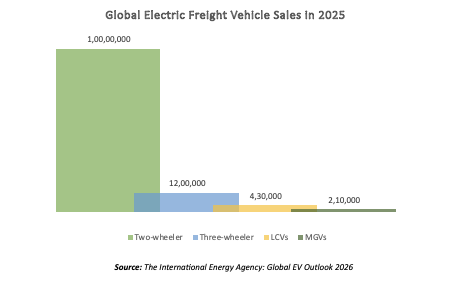
Note: The IEA totals for e-2Ws and e-3Ws include passenger and personal-use vehicles as well as commercial application. LCVs and MGVs figures refer to commercial freight-vehicle categories
e-2Ws and e-3Ws have reached scale
e-2Ws and e-3Ws remained the most electrified road-transport categories in 2025. Together, they recorded approximately 11 million sales, nearly 15% more than in 2024 and represented around 15% of total global 2W and 3W sales. Electric models also accounted for roughly 10% of the global 2W and 3W fleet.
e-2W sales increased by 15% to almost 10 million vehicles, giving electric models around 14% of the global market. China sold more than 7 million units, India sold slightly fewer than 1.3 million and Vietnam more than doubled sales to about 735,000. African sales also expanded from fewer than 1,000 vehicles in 2020 to around 70,000 in 2025, supported by ride-hailing, delivery services, battery swapping and flexible repayment models.
e-3W achieved deeper market penetration. Global sales exceeded 1.2 million vehicles even as the overall 3W market contracted, lifting the electric share above 25%. India led with almost 800,000 sales and an electric share close to 70%, while China, India and Türkiye together accounted for more than 95% of global electric three-wheeler sales.[1]
[1] The IEA’s two- and three-wheeler totals include passenger and personal-use vehicles as well as commercial fleets. They should not be read as freight-only sales. However, this scale of adoption expands vehicle supply, financing options, service networks and charging or swapping ecosystems that cities can adapt for last-mile freight
Electric LCVs and MGVs are entering the next growth phase
LCVs already serve parcel delivery, retail distribution, municipal services and small-business logistics. Global e-LCV sales exceeded 430,000 vehicles in 2025, increasing by about 45%. Europe became the largest market with nearly 200,000 sales and doubled its electric share to 10%, while China sold about 140,000 units and reached a 14% share. India’s market grew by more than 50% to over 9,000 vehicles, but electric models still represented only around 1% of LCV sales.
MGVs offer the next major opportunity for larger urban distribution operations. The IEA recorded approximately 210,000 e-MGVs sales in 2025 which is 65% more than in 2024, raising their global sales share from around 6% to 9%.
China accounted for more than 90% of global e-truck sales and concentrated deployment in ports, mines, industrial hubs and utility operations where predictable routes and centralized charging support high utilization. Europe and North America recorded smaller markets, but MGVs drove much of their growth because depot access, shorter duty cycles and manageable charging requirements make them a practical entry point for fleet electrification.
Across the freight chain, the market signal is consistent, electrification scales fastest where suitable vehicles, predictable routes, high utilization, reliable charging, supportive regulation and viable finance converge. e-2Ws and e-3Ws have already demonstrated scale, e-LCVs and e-MGVs now extend the opportunity into warehouse replenishment, retail distribution and movement between urban logistics hubs.
Why urban operations create a strong case for electrification
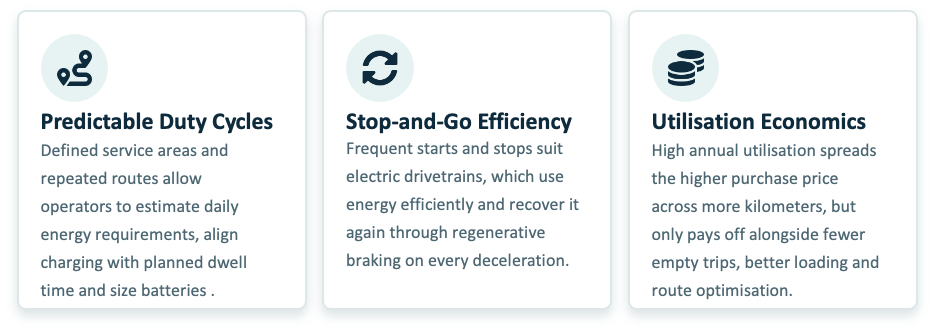
Urban freight operations offer a strong case for electrification because freight vehicles follow predictable routes, operate in stop-and-go conditions and accumulate high annual mileage. These characteristics support efficient battery sizing, regenerative braking and greater lifetime cost savings. However, cities must combine vehicle electrification with better loading, route optimisation, shipment consolidation and right-sized vehicles to reduce both emissions and unnecessary freight movement.
From market opportunity to implementation
The global market has already demonstrated that EVs can serve a growing range of urban freight operations. e-2Ws and e-3Ws have achieved scale, while LCVs and MGVs increasingly support larger distribution tasks. The next challenge lies in building the transport, charging, energy, financing and policy ecosystem required to convert this momentum into a city-wide transition.
pManifold’s work in urban freight electrification responds directly to this need. Through city-level freight assessments, vehicle and charging analysis, financial modelling and implementation planning, pManifold supports governments and industry stakeholders in identifying where electrification can work first and how it can scale commercially.